
System Integration Market Witnesses Strong Growth Through AI Adoption
How AI integration, cloud adoption, and enterprise digitalization are accelerating demand for advanced system integration services across industries worldwide.

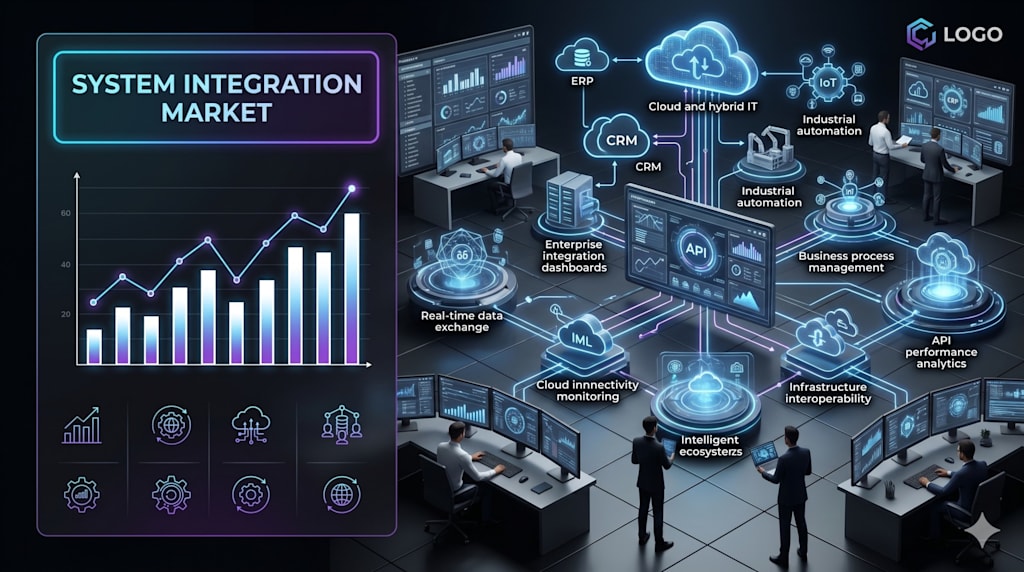
According to IMARC Group's latest research publication, the global system integration market size is currently valued at USD 482.7 Billion. Looking forward, IMARC Group expects the market to reach USD 853.6 Billion, reflecting a strong and sustained growth trajectory driven by accelerating digital transformation, widespread hybrid cloud adoption, and the rising complexity of enterprise IT ecosystems worldwide.
How AI is Reshaping the Future of System Integration Market
- Intelligent Workflow Orchestration and Self-Optimizing Systems: AI-powered integration platforms are moving enterprises beyond rigid, rule-based workflows toward dynamic systems that adapt automatically to changing data environments. These platforms use predictive analytics and automated anomaly detection to flag system conflicts before they disrupt operations, shrinking deployment timelines and reducing manual configuration effort.
- Generative AI for API and Connector Development: Generative AI tools are accelerating the creation of API connectors and data transformation layers, allowing integration teams to build and test interfaces in a fraction of the time previously required. This shift is particularly visible in financial services and telecommunications, where rapid system interoperability is a competitive necessity.
- AI-Driven Anomaly Detection and Cybersecurity Embedding: Machine learning models embedded within integration frameworks continuously scan for unusual data flows, unauthorized access attempts, and configuration drift across multi-cloud environments. This proactive monitoring helps organizations close security gaps that often emerge when legacy systems are connected to modern cloud-native applications.
- Natural Language Interfaces for Enterprise Orchestration: Integration platforms are increasingly incorporating natural language processing, allowing non-technical staff to query, configure, and monitor complex integration pipelines using conversational commands. This democratization of integration management is reducing dependency on specialized technical teams for routine adjustments.
- Predictive Maintenance for IT Infrastructure: AI-powered integration tools analyze historical performance data from servers, networks, and storage systems to predict hardware failures and capacity constraints before they occur. This capability is especially valuable for organizations managing distributed IoT deployments across manufacturing, utilities, and smart city initiatives, where downtime carries significant operational costs.
System Integration Industry Overview
The system integration industry has become a foundational pillar of enterprise technology strategy, as organizations across nearly every sector work to unify legacy infrastructure, cloud platforms, and emerging digital tools into cohesive operational frameworks. Asia Pacific currently holds the largest share of the global market, supported by extensive government-backed digital transformation programs across China, Japan, India, and South Korea, alongside rapid adoption of smart manufacturing and Industry 4.0 technologies. The United States continues to play a central role in shaping global demand, with enterprises across healthcare, defense, financial services, and telecommunications investing heavily in projects that harmonize legacy platforms with modern cloud environments and AI-powered tools. Europe maintains a mature and steadily expanding market, anchored by Germany's manufacturing leadership and the European Union's push toward digital interoperability standards, while Latin America and the Middle East and Africa are emerging as dynamic growth corridors supported by expanding fintech ecosystems and large-scale government digitization initiatives.
System Integration Market Trends and Drivers
The accelerating shift toward hybrid and multi-cloud architectures stands as one of the most powerful forces shaping the system integration landscape. Enterprises are migrating workloads at scale to enhance operational flexibility and cost efficiency, generating substantial demand for integration services that bridge on-premises infrastructure with modern cloud platforms. This transition requires system integrators to deploy sophisticated API management frameworks, middleware solutions, and automation tools capable of ensuring consistent data flow and secure access management across distributed environments. The proliferation of cloud-native applications and microservices architectures continues to add new layers of complexity, pushing demand for specialized integration expertise even higher.
The rapid expansion of the Internet of Things across manufacturing, healthcare, utilities, and smart city initiatives is generating sustained demand for integration frameworks capable of supporting real-time connectivity and large-scale data exchange. Government-driven programs such as China's industrial modernization push, India's digital governance initiatives, and Japan's Society 5.0 framework are catalyzing widespread adoption of integrated IT systems across both public and private sectors. The proliferation of smart factory deployments enabled by Industry 4.0 technologies requires seamless integration of operational technology with IT systems, and according to the International Federation of Robotics, China alone accounted for more than half of global industrial robotics installations, underscoring the scale of integration activity tied to automation rollouts.
The banking, financial services, and insurance sector remains among the most intensive adopters of system integration services, driven by the urgent need to harmonize legacy core banking systems with modern digital channels, real-time payment networks, and stringent regulatory compliance frameworks. The rise of fintech partnerships, open banking mandates, and Banking-as-a-Service models has sharply increased the volume and complexity of integration requirements within the sector. India's Unified Payments Interface processed tens of billions of transactions with sharp year-over-year growth, illustrating the scale of integration infrastructure required to support modern digital payment ecosystems. Meanwhile, organizations across every industry continue to consolidate enterprise applications to reduce operational silos, strengthen data governance, and accelerate decision-making across increasingly interconnected technology environments.
Leading Companies Operating in the Global System Integration Industry
- Accenture Plc.
- BAE Systems Plc.
- Capgemini SA.
- Cisco Systems Inc.
- Dell Inc.
- Fujitsu Limited (Furukawa Group)
- HCL Technologies Limited
- Hewlett Packard Enterprise Company
- IBM Corporation
- Infosys Limited
- Oracle Corporation
- Tata Consultancy Service Limited
- Wipro Limited
System Integration Market Report Segmentation
By Service:
- Infrastructure Integration
- Application Integration
- Consulting
Infrastructure integration holds the largest share of the market, as enterprises increasingly rely on it to support scalable, resilient, and secure digital operations spanning networking equipment, server hardware, storage systems, and hybrid cloud environments.
By End Use Industry:
- BFSI
- Government
- Manufacturing
- Telecommunications
- Retail
- Oil and Gas
- Healthcare
- Others
BFSI leads the end-use segment, driven by the sector's critical need to unify legacy core banking platforms with digital channels, payment gateways, and fraud detection systems while meeting strict regulatory compliance requirements.
Regional Insights:
- North America (United States, Canada)
- Asia Pacific (China, Japan, India, South Korea, Australia, Indonesia, Others)
- Europe (Germany, France, United Kingdom, Italy, Spain, Russia, Others)
- Latin America (Brazil, Mexico, Others)
- Middle East and Africa
Asia Pacific holds the dominant regional position, underpinned by robust digital transformation investments, large-scale industrial automation programs, and extensive smart manufacturing deployments across the region's leading economies.
Recent News and Developments in System Integration Market
- August 2024: HCL Technologies launched its new Digital Integration Platform, Integrate360, designed to streamline enterprise application integration and API management while enhancing real-time data interoperability for businesses pursuing digital transformation.
- November 2024: IBM and Microsoft formed a strategic partnership to expand cloud offerings and strengthen system integration capabilities, focusing on combining advanced AI tools with workflow automation platforms to help businesses leverage analytics at scale.
- February 2025: Infosys acquired Wipro's consulting business for approximately USD 700 million, a move that strengthened its position in enterprise consulting and system integration services across global markets.
- July 2025: Accenture acquired Systema in Germany to strengthen its semiconductor and high-tech manufacturing integration capabilities, with Systema's specialists joining Accenture's Industry X practice.
- October 2025: Tata Consultancy Services expanded its partnership with Google Cloud to integrate Gemini Enterprise, enabling agentic AI orchestration and multi-agent workflow automation across enterprise environments for global clients.
Note: If you require specific details, data, or insights that are not currently included in the scope of this report, we are happy to accommodate your request. As part of our customization service, we will gather and provide the additional information you need, tailored to your specific requirements. Please let us know your exact needs, and we will ensure the report is updated accordingly to meet your expectations.
About the Creator
Abhay Rajput
I am working in market research company that provides market and business research intelligence across the globe.
Enjoyed the story? Support the Creator.
Subscribe for free to receive all their stories in your feed.
Comments
There are no comments for this story
Be the first to respond and start the conversation.