
Synthetic Paper Market Thrives Amid Rising Investments in Sustainable Materials
How smart manufacturing, consumer demand, and sustainable material adoption are driving profitability and growth in the synthetic paper market

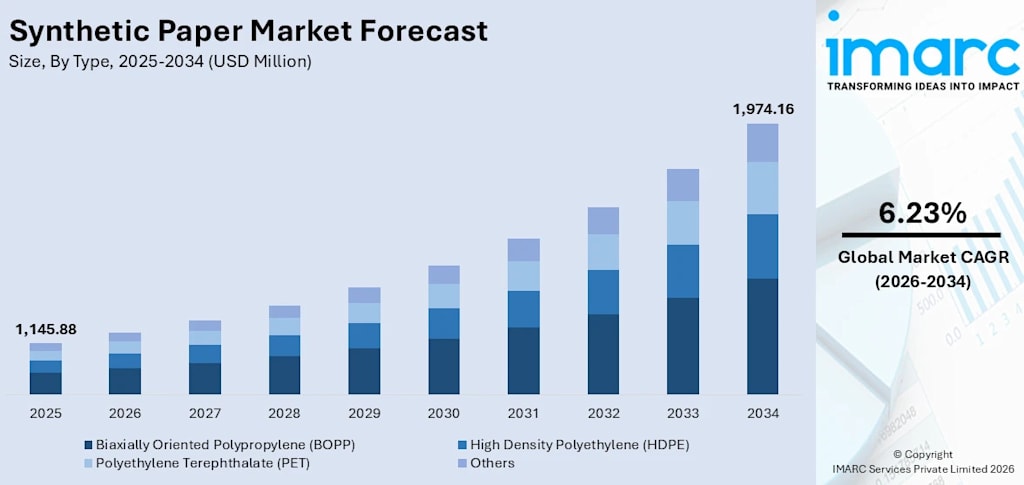
Rising industrial modernization, robust e-commerce growth, and the escalating demand for highly durable, moisture-proof packaging substrates are fueling synthetic paper expansion, supported by advancements in material science, versatile printing technology compatibility, and increasing investments in film extrusion. According to IMARC Group’s latest data, The global synthetic paper market size was valued at USD 1,145.88 Million in 2025. Looking forward, IMARC Group estimates the market to reach USD 1,974.16 Million by 2034, exhibiting a CAGR of 6.23% from 2026-2034.
Synthetic paper now represents a multi-billion-dollar global market showing steady year-on-year expansion. Demand is driven by the urgent corporate need for robust, tear-resistant media capable of surviving extreme weather, moisture, and chemical exposure across harsh manufacturing environments. High-performance retail logistics, specialized industrial tags, and medical labeling solutions are further accelerating adoption as corporate entities phase out weaker standard wood-pulp papers.
Synthetic Paper Market Growth Drivers:
- Escalating Need for High-Durability Industrial Labeling Substrates
Heavy manufacturing, logistics, and chemical processing sectors require tracking systems that withstand brutal operating environments without degrading. Standard wood-pulp tags tear and blur when exposed to oil, friction, or extreme climates, destroying vital safety data. Synthetic substrates solve this vulnerability by offering exceptional tensile strength and complete water resistance, ensuring barcoded shipping tags and chemical drum warnings remain legible throughout global distribution loops. Industrial operations account for a massive 44% of global demand due to these structural safety benefits, motivating factory managers to adopt resilient polymer materials to prevent supply chain disruptions and maintain safety compliance.
- Explosive Retail and E-Commerce Supply Chain Expansion
The global e-commerce boom has dramatically intensified pressure on shipping logistics, requiring packaging materials that endure intensive automated handling and varying weather during transport. Packages travel across multiple transit points, facing humidity, rain, and friction on conveyor belts, which easily ruins traditional paper labels. Logistics companies increasingly rely on polymer-based synthetic papers to keep tracking codes perfectly scannable from warehouses to residential doorsteps. This logistical shift is especially prominent in highly developed retail markets like the United States, where robust fulfillment networks use waterproof labels to maintain high accuracy and minimize lost shipments due to torn barcodes.
Get a Preview of the Latest "Synthetic Paper Market" Research Report Now!
- Broadened Technical Printing Compatibility and Processing Investments
Modern production breakthroughs have solved historical limitations regarding ink adhesion, allowing synthetic sheets to run seamlessly on standard commercial presses. Advanced formulations are fully compatible with diverse commercial systems, including flexographic, digital, ultraviolet (UV) inkjet, and traditional offset printing, eliminating the need for expensive specialized equipment modifications. Concurrently, major producing nations are heavily investing in state-of-the-art film extrusion technologies to streamline operations. These manufacturing improvements maximize processing efficiency, lower raw sheet production costs, and yield highly uniform surfaces, allowing commercial print shops to easily transition client catalogs, outdoor banners, and restaurant menus to premium synthetic options.
Synthetic Paper Market Trends:
- Rising Corporate Integration of Fully Recyclable Polymer Base Materials
Global consumer goods and industrial brands are aggressively auditing supply chains to replace mixed-material laminates with mono-material solutions that simplify regional waste management. Traditional paper coated with plastic film creates a combined structure that is notoriously difficult to process in standard recycling facilities. In contrast, pure polyolefin and high-density polyethylene sheets can be directly shredded and reprocessed into industrial raw materials after use. Brands use these chemical profiles to meet strict national circular economy targets while retaining heavy-duty structural integrity. This environmental shift allows businesses to eliminate hard-to-recycle vinyl coatings across mass-market retail signage, corporate loyalty cards, and heavy field manuals.
- Dominance of High-Performance Labels in Clinical and Medical Settings
The pharmaceutical and healthcare sectors have established rigorous guidelines for medical container labeling, requiring sterilization resilience that traditional materials cannot provide. Medication vials, blood bags, and chemical samples face sub-zero cryogenic storage, moisture condensation, and repeated rubbing alcohol exposure during daily sanitization routines. Polypropylene-based synthetic stocks remain structurally sound under these extreme clinical pressures, preventing critical patient records or dosage tracking barcodes from peeling off or blurring. Hospitals and laboratory networks utilize these stable substrates to secure data integrity across hazardous diagnostics, matching strict health regulations while ensuring flawless scan rates on automated medical lines.
- Widespread Adoption of Specialized Heavy-Duty Non-Label Applications
Beyond traditional adhesive tags, global enterprises are rapidly expanding synthetic paper use into heavy-wear, un-laminated printed products that endure continuous human contact. Outdoor maps, heavy-duty construction blueprint sheets, field-ready tactical manuals, and restaurant menus rely on polymer structures to completely repel water, sweat, and grease. Traditional paper menus stain and fray rapidly, requiring frequent, costly print replacements. By utilizing moisture-proof synthetic sheets, commercial venues can frequently wash and sanitize printed surfaces without causing wrinkling or edge separation. This structural longevity significantly lowers long-term operational replacement costs for field organizations, educational institutions, and hospitality brands.
Recent News and Developments in Synthetic Paper Market
- September 2025: Yupo Corporation unveiled a new generation of ultra-thin, highly opaque synthetic paper containing high percentages of post-consumer recycled content, allowing food and beverage enterprises to achieve strict environmental goals without dropping labeling line speeds.
- November 2025: Cosmo First Limited launched an advanced range of non-tearable, top-coated synthetic papers optimized specifically for high-speed digital and UV inkjet presses, drastically improving ink drying times and reducing overall production energy usage for commercial printing providers.
- February 2026: Arjobex SAS finalized a strategic distribution partnership with a major European packaging firm to accelerate the deployment of high-density polyethylene tags across the agricultural and horticultural sectors, ensuring outdoor plant labels endure severe UV exposure and moisture.
Note: If you require specific details, data, or insights that are not currently included in the scope of this report, we are happy to accommodate your request. As part of our customization service, we will gather and provide the additional information you need, tailored to your specific requirements. Please let us know your exact needs, and we will ensure the report is updated accordingly to meet your expectations.
About the Creator
Andrew Sullivan
Hello, I’m Andrew Sullivan. I have over 9+ years of experience as a market research specialist.
Enjoyed the story? Support the Creator.
Subscribe for free to receive all their stories in your feed.
Comments
There are no comments for this story
Be the first to respond and start the conversation.