
Synthetic Diamond Market: Aerospace Applications, Durability Enhancements & Industry Forecast
How aerospace engineering requirements, high-durability materials, and advanced machining technologies are fueling expansion in the synthetic diamond market

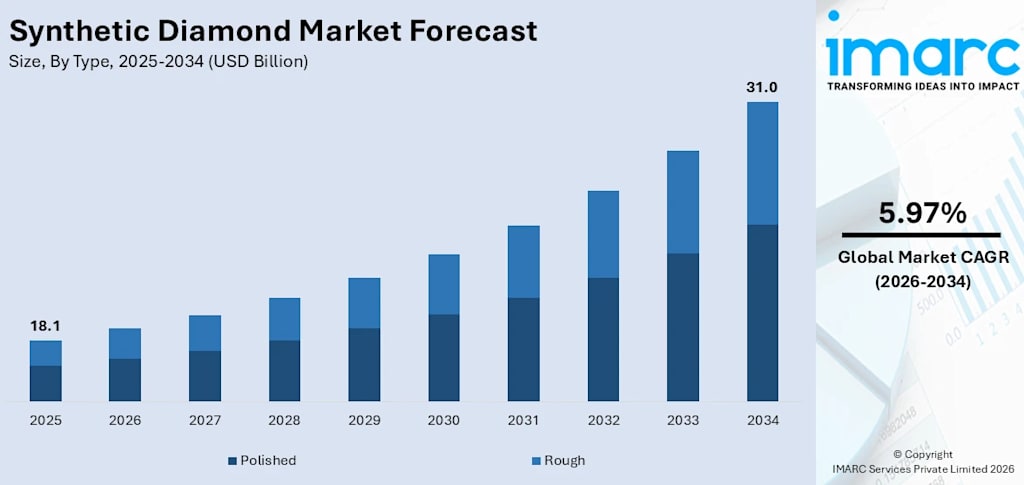
Let me search specifically for the IMARC Group Synthetic Diamond Market report details to ensure I use the exact numbers and text style they expect.The global synthetic diamond market is seeing robust growth driven by escalating demand in high-power electronics, heavy manufacturing, and the ethical retail jewelry landscape. According to IMARC Group’s latest data, the global synthetic diamond market size was valued at USD 18.1 Billion in 2025. Looking forward, IMARC Group estimates the market to reach USD 31.0 Billion by 2034, exhibiting a CAGR of 5.97% from 2026-2034.
Synthetic diamonds now represent a highly dynamic and expanding global industry, capturing a substantial share of both industrial and commercial applications. The market is fueled by the exceptional physical properties of lab-grown diamonds, notably their extreme hardness, unmatched thermal conductivity, and structural uniformity. In heavy industry, they are widely adopted for advanced machining, cutting, and drilling tools, while the semiconductor sector relies heavily on them as heat sinks for next-generation electronics.
Synthetic Diamond Market Growth Drivers:
- Escalating Thermal Management Demands in High-End Electronics
Modern semiconductor design focuses heavily on miniaturization and processing speed, creating intense thermal challenges. Because synthetic diamonds possess a thermal conductivity that is five times higher than copper, they serve as the ultimate heat sinks and substrate materials for high-power electronics. The global electronics manufacturing landscape, which reported sector revenues exceeding USD 66 billion, relies on these diamond modules to prevent overheating in high-frequency field-effect transistors and cellular communication hardware. This critical safety application ensures component longevity and maintains structural performance during continuous, high-load operations across the telecom industry.
- Heavy Industrial Adoption in Precision Machining and Cutting Tools
The global aerospace, construction, and automotive sectors demand highly durable materials for complex cutting, grinding, and drilling activities. Synthetic diamonds fulfill this need perfectly due to their intrinsic structural hardness and extreme resistance to mechanical wear. Manufacturers globally utilize diamond-infused grit, powders, and cutting stone surfaces to process tough alloys, reinforced concrete, and specialized composite parts. This reliance on high-performance abrasive tools, a sector valued at over USD 50 billion globally, significantly optimizes production speeds and reduces tool replacement expenses across heavy manufacturing workflows.
- Shift in Consumer Preferences Toward Sustainable and Ethical Jewelry
The global fine jewelry market is undergoing a major demographic transformation as younger buyers actively prioritize sustainability and origin transparency. Cultured or lab-grown diamonds offer the exact identical physical and chemical attributes of mined stones but carry a much lighter ecological footprint and a lower retail price. This economic accessibility allows commercial jewelry brands to introduce extensive, traceable bridal and fashion lines with verified blockchain authentication. By matching these specific ethical demands, consumer jewelry remains the fastest-expanding commercial segment, aligning with broader circular economy principles globally.
Synthetic Diamond Market Trends:
- Dominance of Chemical Vapor Deposition Manufacturing Methods
Production technologies are shifting rapidly toward Chemical Vapor Deposition (CVD) because it allows for precise control over diamond purity and structural configuration. This method utilizes carbon-rich gas mixtures in a vacuum to grow high-quality single-crystal diamonds at lower atmospheric pressures. Industrial manufacturers favor CVD systems because they can produce wide, uniform diamond plates perfectly suited for high-tech optical lenses and semiconductor wafers. The operational cost reductions achieved through refined gas recycling and energy management are encouraging widespread facilities investments, making CVD the largest manufacturing segment worldwide.
- Strategic Integration in Advanced Quantum Computing and Sensing Technologies
The frontier of data processing is utilizing engineered synthetic diamonds, particularly those with nitrogen-vacancy centers, to create stable quantum bits. These unique structural imperfections allow the diamond crystals to detect minute magnetic and thermal fluctuations at room temperatures. This advanced physical capability has direct, real-world applications in medical diagnostic imaging, ultra-secure defense communications, and quantum computing frameworks. As governments allocate major funding to quantum research, specialized electronics brands are forming deep research partnerships to secure a stable supply of high-purity, laboratory-grown crystal substrates.
- Asia Pacific Manufacturing Dominance and Infrastructure Investments
The global supply chain for synthetic diamond production is centered heavily in the Asia Pacific region, fueled by massive infrastructure and low production costs. Industrial facilities throughout China lead the global output of high-pressure high-temperature industrial diamond categories, while Indian manufacturers expand their high-tech polishing ecosystems. Regional governments are heavily supporting this growth; for instance, India’s Ministry of Commerce established a specialized research center for lab-grown stones backed by a multi-million-dollar grant. This institutional backing ensures the region maintains a dominant market share exceeding forty percent of global revenue.
Recent News and Developments in Synthetic Diamond Market
- June 2025: De Beers Group launched its new ORIGIN platform and specialized polished diamond collections at JCK Las Vegas, integrating advanced blockchain tracking via the Tracr platform to significantly enhance supply chain traceability and boost consumer confidence in stone sourcing.
- August 2025: A leading electronics conglomerate finalized a strategic partnership with a key synthetic diamond producer to develop specialized diamond-on-silicon wafers, aiming to resolve thermal management limitations in next-generation satellite communication chips.
- October 2025: Sarine Technologies reported a significant profit increase driven entirely by the expanded adoption of its automated lab-grown diamond scanning and grading modules, highlighting the industry's rapid shift toward automated quality control.
Note: If you require specific details, data, or insights that are not currently included in the scope of this report, we are happy to accommodate your request. As part of our customization service, we will gather and provide the additional information you need, tailored to your specific requirements. Please let us know your exact needs, and we will ensure the report is updated accordingly to meet your expectations.
About the Creator
Andrew Sullivan
Hello, I’m Andrew Sullivan. I have over 9+ years of experience as a market research specialist.
Enjoyed the story? Support the Creator.
Subscribe for free to receive all their stories in your feed.
Comments
There are no comments for this story
Be the first to respond and start the conversation.