
Sustainable Biofuels Market: Powering the Transition to a Lower-Carbon Future
How innovation, policy, and shifting energy priorities are reshaping the global fuel landscape.

The global energy transition is no longer a distant ambition—it is unfolding in real time. Governments, businesses, and consumers are searching for practical ways to reduce carbon emissions without disrupting economic activity. Among the many solutions being explored, sustainable biofuels have emerged as one of the most promising pathways toward cleaner energy systems.
Unlike traditional fossil fuels, these alternatives are derived from biological materials and are designed to meet strict sustainability standards. Their appeal lies not only in their ability to lower lifecycle emissions but also in their compatibility with existing transportation and energy infrastructure. From aviation and shipping to power generation and industrial operations, sustainable biofuels are increasingly becoming part of the conversation about how the world can meet growing energy demands while addressing climate concerns.
As policies tighten and corporate climate commitments accelerate, the market is entering a period of significant expansion. Understanding the forces driving this growth provides insight into how tomorrow's energy economy may take shape.
Market Highlights
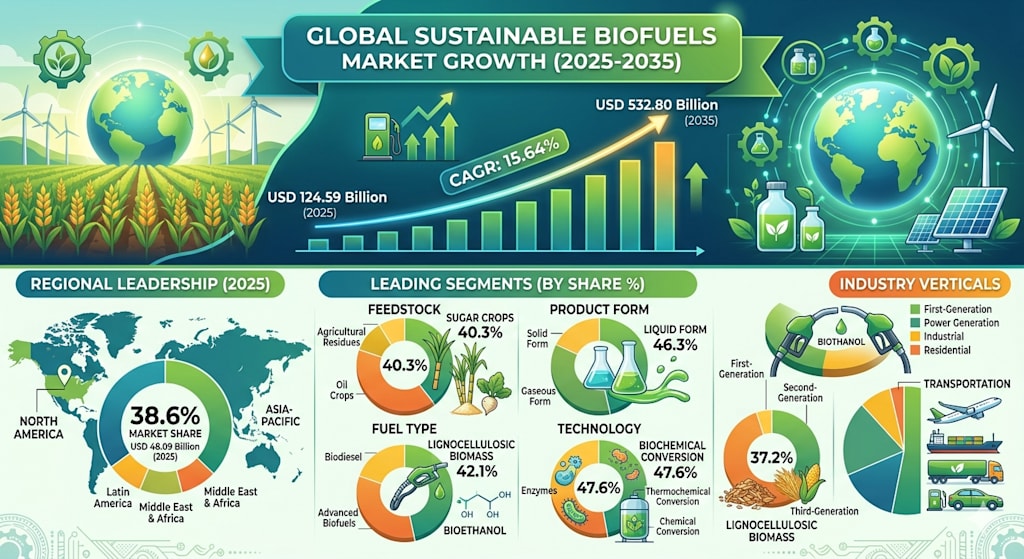
- North America leads all regions with a 38.6% market share, valued at USD 48.09 Billion in 2025.
- Sugar Crops dominate the feedstock segment with a 40.3% share.
- Liquid form leads product form at 46.3%.
- Bioethanol leads fuel type at 42.1%.
- Biochemical Conversion leads technology at 47.6%.
- Lignocellulosic Biomass leads material type at 37.2%.
- Transportation leads industry verticals at 53.7%.
A Market on the Rise
The sustainable biofuels market is experiencing remarkable momentum. Forecasts indicate that the market could expand from approximately USD 124.59 billion in 2025 to more than USD 532 billion by 2035, reflecting strong long-term confidence in the sector.
Several factors are contributing to this growth. Governments across major economies have introduced mandatory blending requirements that compel fuel suppliers to incorporate renewable alternatives into their products. At the same time, companies seeking to meet net-zero commitments are increasingly turning to certified fuels as part of their emissions reduction strategies.
Unlike voluntary sustainability initiatives of the past, many of today's regulations carry legal obligations. This shift transforms demand from optional to essential, creating a more predictable environment for producers capable of meeting certification requirements.
The transportation sector remains the largest consumer segment. Airlines, shipping operators, logistics companies, and commercial fleets are under increasing pressure to reduce emissions while maintaining operational efficiency. Sustainable biofuels offer an immediate solution because they can often be integrated into existing systems without major modifications.
Why Certification Matters
Not all biofuels are created equal.
One of the defining characteristics of sustainable alternatives is their emphasis on verified environmental performance. Producers must demonstrate that their fuels achieve measurable reductions in greenhouse gas emissions throughout the entire lifecycle—from feedstock cultivation and processing to final combustion.
This verification process has become a critical differentiator.
Buyers operating in regulated industries require documented proof that their fuel purchases comply with evolving standards. As a result, companies with transparent sourcing practices and robust compliance systems gain a competitive advantage.
Certification also helps address concerns that have historically surrounded biofuels, particularly questions related to deforestation, land use, and food security. By raising accountability standards, the industry is moving toward greater credibility and consumer confidence.
For producers, however, achieving compliance demands investment. Smaller players may struggle with the administrative and financial burden associated with traceability systems, while larger firms are often better positioned to absorb these costs.
The Feedstocks Driving Production
The materials used to produce biofuels play a major role in determining cost, scalability, and environmental impact.
Sugar crops such as sugarcane and sugar beet currently hold a leading position due to their proven efficiency in ethanol production. Existing fermentation infrastructure in several regions allows producers to convert these crops into fuel relatively quickly and economically.
Starch crops, including corn and wheat, also remain important contributors, particularly in North America. Their role has been reinforced by established renewable fuel programs that guarantee baseline demand.
Meanwhile, interest is growing in alternative feedstocks that avoid direct competition with food supplies.
Agricultural residues, forestry waste, and other lignocellulosic materials are increasingly viewed as attractive options. These resources offer environmental benefits because they utilize non-food biomass that might otherwise go unused. Waste oils and used cooking oils have similarly gained popularity, although limited availability presents challenges as demand intensifies.
Algae represents another intriguing possibility. It can be cultivated on non-arable land and has the potential for exceptionally high yields. While commercial viability remains a work in progress, continued research and technological improvements could unlock new opportunities in the years ahead.
Technology and Innovation Reshaping the Industry
Advances in production technologies are helping the industry evolve beyond its early stages.
Biochemical conversion methods remain widely used due to their long operating history and relative reliability. Processes involving fermentation and enzymatic treatments benefit from decades of refinement, making them attractive choices for commercial-scale production.
At the same time, thermochemical approaches are gaining attention.
Techniques such as gasification and pyrolysis can process a broader range of feedstocks, including municipal waste and lignocellulosic biomass. Although these facilities often require larger upfront investments, their flexibility may become increasingly valuable as competition for conventional feedstocks intensifies.
Another notable trend involves integrating renewable fuel production within existing petroleum refining infrastructure. Rather than constructing entirely new facilities, some producers are adapting current assets to process biological inputs alongside conventional materials.
This strategy reduces capital requirements and accelerates deployment timelines, enabling faster responses to growing market demand.
Digital innovation is also beginning to influence operations. Improved data analysis, predictive modeling, and optimization tools help producers manage feedstock sourcing more efficiently while minimizing waste throughout the supply chain.
Policy, Regulation, and Global Momentum
Government action continues to shape the pace and direction of industry development.
In Europe, aviation-specific regulations are creating mandatory markets for renewable alternatives. Fuel suppliers are required to provide increasing volumes of sustainable aviation fuels over time, encouraging investment in production capacity and supply chain development.
North America maintains its leadership position through longstanding renewable fuel standards and established ethanol infrastructure. Regulatory frameworks provide producers with greater revenue certainty and encourage continued expansion.
Across Asia-Pacific, ambitious blending targets and energy security objectives are fueling rapid growth. Countries throughout the region are pursuing domestic production capabilities to reduce dependence on imported fossil fuels while supporting economic development.
These policy frameworks do more than stimulate demand.
They also send clear signals to investors. Long-term targets help justify substantial capital commitments, particularly for projects that require years of planning and construction before reaching commercial operation.
As more countries adopt similar approaches, global momentum behind renewable fuels is expected to strengthen further.
Challenges That Cannot Be Ignored
Despite encouraging prospects, the path forward is not without obstacles.
Feedstock availability remains one of the sector's most pressing concerns. Competition with food production and other industries can drive up input costs, squeezing profit margins and limiting scalability.
Infrastructure expansion presents another hurdle.
Building advanced production facilities often involves significant financial commitments and lengthy development periods. Investors must make decisions based on expectations about future policies and market conditions, introducing an element of uncertainty.
There is also the challenge of maintaining public trust. As demand increases, stakeholders will expect rigorous oversight to ensure that sustainability claims translate into genuine environmental benefits.
Successfully addressing these issues will require collaboration among governments, producers, researchers, and end users.
Looking Ahead
Sustainable biofuels occupy a unique position within the global energy transition. They offer a practical bridge between today's infrastructure and tomorrow's climate ambitions, enabling meaningful emissions reductions without requiring immediate system-wide transformation.
Their future success will depend on balancing growth with responsibility. Continued innovation, supportive policies, and transparent sustainability practices will determine whether the industry can meet rising expectations while overcoming supply and cost constraints.
What is increasingly clear is that renewable fuels are no longer a niche concept. They are becoming an integral part of how industries, governments, and consumers envision a lower-carbon future. As the world searches for realistic pathways toward decarbonization, sustainable biofuels are poised to play an increasingly important role in powering the journey ahead.
About the Creator
Yash Mule
SEO Specialist with 10+ years of experience at Evolvance Market Research. Expert in technical SEO, content strategy, and data-driven optimization, with a proven track record of significantly increasing organic traffic and search rankings.
Enjoyed the story? Support the Creator.
Subscribe for free to receive all their stories in your feed.
Comments
There are no comments for this story
Be the first to respond and start the conversation.