
Sustainable Aviation Fuel Is Transforming Air Travel’s Future
Global airlines and energy companies are racing to scale cleaner jet fuel as aviation faces mounting pressure to cut emissions.

Introduction
Air travel has long been one of the toughest industries to decarbonize. While electric vehicles are becoming common on roads, commercial aircraft still depend heavily on liquid fuel to travel long distances efficiently. That challenge has placed Sustainable Aviation Fuel, commonly known as SAF, at the center of the aviation industry’s climate strategy.
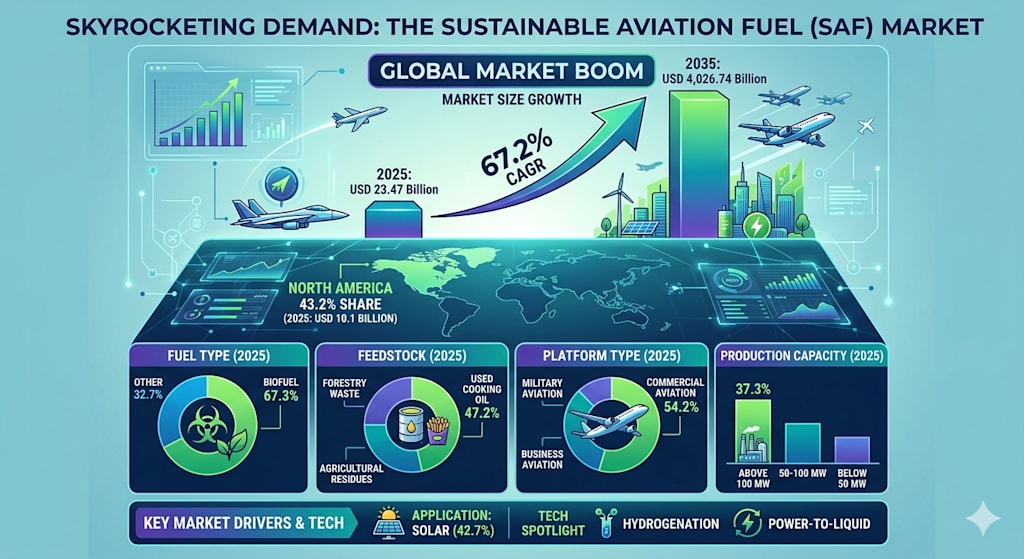
Momentum is building rapidly. The Sustainable Aviation Fuel (SAF) Market is projected to expand from USD 23.47 billion in 2025 to nearly USD 4,026.74 billion by 2035, growing at an extraordinary CAGR of 67.2%. Governments are introducing mandatory blending requirements, airlines are signing long-term fuel agreements, and investors are pouring capital into cleaner fuel technologies.
What was once viewed as a niche environmental initiative is now becoming a critical part of global aviation policy and business planning. The transition is still in its early stages, but the direction is unmistakable: cleaner aviation fuel is moving from experimentation to industrial-scale deployment.
Market Highlights
- North America leads the market with a 43.2% share, valued at USD 10.1 Billion in 2025.
- By Fuel Type, Biofuel dominates with a 67.3% share.
- By Platform Type, Commercial Aviation leads with 54.2%.
- By Capacity, the Above 100 MW segment holds 37.3%.
- By Feedstock, Used Cooking Oil leads at 47.2%.
- By Application, Solar leads at 42.7%.
Why SAF Has Become Essential for Aviation
The aviation sector contributes a significant share of global greenhouse gas emissions, and unlike road transport, it has limited alternatives to liquid fuels. Aircraft require energy-dense fuel capable of powering long-haul flights safely and reliably. Sustainable aviation fuel offers a practical solution because it can be used in existing aircraft engines without major modifications.
SAF is produced from renewable or waste-based materials such as used cooking oil, agricultural waste, municipal waste, and synthetic feedstocks. Depending on the production pathway, it can reduce lifecycle carbon emissions dramatically compared to conventional jet fuel.
This environmental benefit is becoming increasingly important for airlines facing pressure from regulators, investors, and travelers. International aviation bodies and regional governments are implementing emissions targets that make low-carbon fuel adoption a business necessity rather than a voluntary sustainability measure.
In Europe, mandatory blending requirements have already taken effect, while similar initiatives are emerging in North America and Asia-Pacific. These policies are creating a guaranteed market for producers and accelerating investment across the supply chain.
Airlines Shift from Trials to Long-Term Fuel Strategies
One of the clearest signs of market maturity is the way airlines are purchasing fuel. In the past, many carriers bought small SAF volumes primarily for demonstration projects or public sustainability campaigns. That approach is changing quickly.
Today, airlines are signing multi-year offtake agreements to secure future supply. These long-term contracts provide fuel producers with predictable revenue while helping airlines reduce exposure to future regulatory risks and fuel shortages.
Large international carriers are already integrating SAF into regular operations. Some airlines have increased usage several times over within just a few years, reflecting how quickly adoption is accelerating. Cargo operators and corporate aviation clients are also joining the movement, especially companies looking to meet environmental, social, and governance (ESG) targets.
Another factor driving demand is public perception. Travelers are becoming more aware of aviation’s environmental impact, and airlines increasingly view cleaner fuel adoption as part of their brand identity and competitive positioning.
Still, cost remains a major challenge. SAF can cost several times more than conventional jet fuel, forcing airlines to balance sustainability commitments with financial realities. Many carriers currently rely on government incentives and blending mandates to justify the additional expense.
Technology and Feedstocks Shape Market Growth
The rapid expansion of the industry is being driven by advances in production technology and feedstock development. Different production pathways offer varying levels of efficiency, emissions reduction, and scalability.
Hydroprocessed Esters and Fatty Acids (HEFA) currently dominate the market because they use widely available waste oils and fats. This method is commercially proven and compatible with existing refinery infrastructure, making it the fastest route to large-scale production.
Perhaps the most closely watched innovation is Power-to-Liquid fuel, often called eSAF. This process combines captured carbon dioxide with green hydrogen produced from renewable electricity. While still expensive, eSAF has the potential to deliver near-zero lifecycle emissions and could become a major long-term solution for the aviation industry.
Infrastructure and Supply Constraints Remain Major Obstacles
Despite strong demand growth, supply-side challenges continue to slow market expansion. One of the biggest concerns is the gap between announced projects and actual operational capacity.
Many planned production facilities face delays due to financing issues, permitting challenges, technology risks, or feedstock supply uncertainty. As a result, only a fraction of announced global capacity has been completed so far.
Airport infrastructure is another hurdle. SAF requires dedicated logistics systems, blending facilities, and fuel distribution networks. Some major airports have begun integrating SAF directly into their fueling systems, making it easier for airlines to access cleaner fuel without separate supply arrangements.
This infrastructure development is important because it simplifies adoption across multiple carriers simultaneously. Once an airport supports SAF blending, airlines operating there can use the fuel more efficiently and at greater scale.
The market also faces regional imbalances. North America currently leads due to strong financial incentives and production investment, while Europe remains the most policy-driven market. Asia-Pacific is emerging rapidly but still requires significant infrastructure expansion to catch up with demand growth.
Investment and Innovation Are Accelerating Worldwide
The level of investment entering the sector has increased sharply over the past few years. Energy companies, airlines, technology startups, and governments are all competing to secure positions in the future aviation fuel economy.
Large energy firms are retrofitting existing refineries to produce renewable jet fuel, reducing capital costs and speeding up deployment timelines. Meanwhile, startups are focusing on breakthrough technologies that promise lower emissions and improved efficiency.
Corporate partnerships are becoming increasingly common. Airlines are teaming up with fuel producers, airports, and logistics providers to create integrated supply ecosystems capable of supporting large-scale operations.
Innovation is also improving economics. Advances in renewable electricity, green hydrogen production, and carbon capture are gradually lowering production costs for synthetic fuels. As these technologies mature, analysts expect SAF pricing to become more competitive over time.
The Future of Aviation Depends on Cleaner Fuel
The next decade will likely determine how successfully aviation can transition toward lower emissions. Aircraft technology alone cannot deliver rapid decarbonization at a global scale, which makes cleaner fuel solutions essential for the industry’s future.
Governments are expected to tighten emissions regulations further, pushing airlines to increase blending ratios steadily over time. This will create sustained demand for producers capable of delivering reliable, large-scale supply.
The opportunity is enormous, but so is the challenge. Scaling production from current levels to the volumes needed by global aviation will require billions in investment, stronger supply chains, and continued technological progress.
Conclusion
Sustainable aviation fuel is no longer a niche experiment reserved for environmentally focused airlines. It is rapidly becoming a core component of global aviation strategy as governments, airlines, and energy companies work toward long-term climate goals.
The market’s projected growth reflects both urgency and opportunity. Regulatory mandates are creating guaranteed demand, while technological innovation is opening new pathways for cleaner and more efficient fuel production. Yet significant obstacles remain, particularly around cost, infrastructure, and supply scalability.
About the Creator
Yash Mule
SEO Specialist with 10+ years of experience at Evolvance Market Research. Expert in technical SEO, content strategy, and data-driven optimization, with a proven track record of significantly increasing organic traffic and search rankings.
Enjoyed the story? Support the Creator.
Subscribe for free to receive all their stories in your feed.
Comments
There are no comments for this story
Be the first to respond and start the conversation.