
Surrogacy Market Overview: Patient-Centric Care, Clinic Investments & Forecast to 2034
How telehealth consultations, improved legal frameworks, and expanding fertility clinic networks are transforming the global surrogacy market outlook.

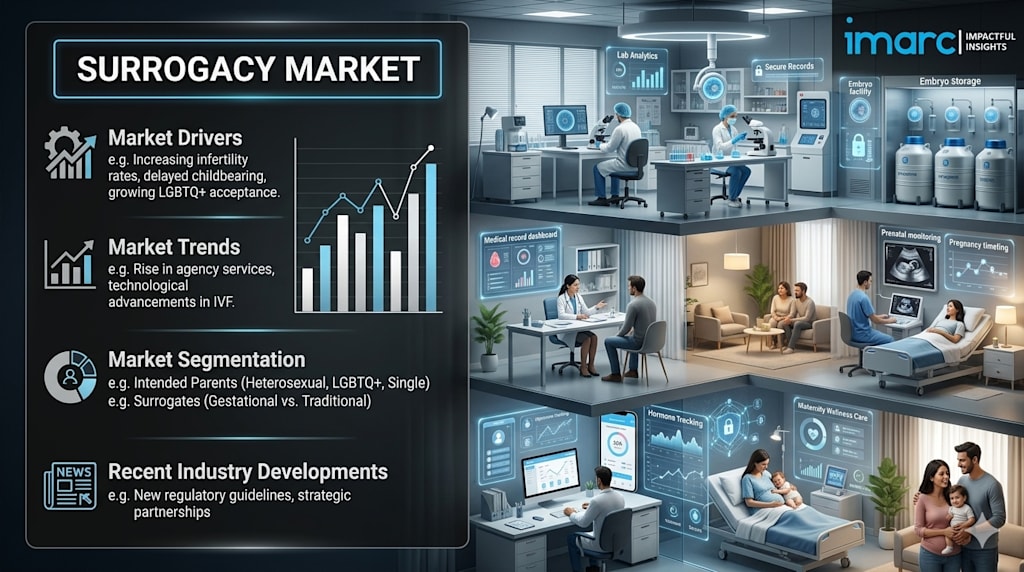
Rising infertility rates, growing recognition of LGBTQ+ family-building rights, rapid advancements in assisted reproductive technologies, increasing societal acceptance of non-traditional family structures, and expanding fertility clinic networks worldwide are driving surrogacy market demand, supported by evolving legal frameworks, improved IVF success rates, and the rapid growth of cross-border fertility tourism. According to IMARC Group's latest data, The global surrogacy market size reached USD 204.6 Million in 2025. Looking forward, IMARC Group estimates the market to reach USD 329.2 Million by 2034. North America currently dominates the market, benefiting from a well-established legal environment, advanced medical infrastructure, and high societal acceptance of surrogacy arrangements.
The Surrogacy Market represents a rapidly evolving segment within the broader assisted reproductive technology landscape. Demand is accelerating on the back of rising global infertility prevalence, shifting cultural norms around family formation, and meaningful improvements in the clinical success rates of IVF-based procedures. Gestational surrogacy, which accounts for approximately 90% of all surrogacy arrangements globally, has emerged as the dominant type due to its genetic separation between the surrogate and the child, simplifying both legal and psychological dimensions of the process. Around 60 to 80 million couples suffer from infertility annually worldwide, with approximately 15 to 20 million of those couples residing in India alone, representing roughly 25% of the total global infertility population. IVF technology commands a 63.4% share of the surrogacy market by technology segment, while fertility clinics account for the majority of service provider share at 63.3%, functioning as comprehensive hubs for medical, legal, and psychological support throughout the surrogacy journey.
Surrogacy Market Growth Drivers:
Rising Global Infertility Rates and Delayed Parenthood
Consumers and medical institutions alike are grappling with a sharp rise in infertility cases globally, driven by high-stress lifestyles, sedentary habits, environmental toxins, hormonal disruptions linked to obesity, and the widespread trend of delaying pregnancy to later years. These converging factors are expanding the pool of individuals and couples who require assisted reproductive support, making surrogacy a mainstream rather than last-resort family-building option. Approximately 2% of all babies born in the United States are now conceived through assisted reproductive technology, reflecting how deeply embedded these procedures have become in modern family-building strategies. The below-35 age group is emerging as a fast-growing segment within the surrogacy market, driven by higher IVF success rates for younger women who proactively pursue surrogacy arrangements before fertility decline accelerates. Among large employers in the United States, 35% signaled plans to expand surrogacy coverage within employee fertility benefit packages, illustrating how institutional recognition of infertility as a workplace health concern is directly broadening demand across socioeconomic groups.
Advancements in Assisted Reproductive Technologies
Continuous innovations in assisted reproductive medicine have made surrogacy safer, more reliable, and accessible to a broader range of intended parents. IVF combined with intracytoplasmic sperm injection (ICSI) addresses complex fertility challenges by injecting a single sperm directly into an egg to maximize fertilization probability, widening the scope of surrogacy to include intended parents with severe male-factor infertility. The pregnancy success rate per embryo transfer in gestational surrogacy currently ranges from 30% to 60%, rising significantly to 75% to 80% when pre-implantation genetic testing (PGT)-screened embryos are used. These high success rates directly strengthen intended parent confidence and encourage uptake of surrogacy services over repeated conventional IVF cycles. AI-guided embryo grading platforms are now being licensed across multiple clinic networks, further standardizing outcomes and reducing procedural costs. Approximately 2% of babies born in the United States are already conceived through ART, a figure that continues to grow as technology barriers diminish and clinical outcomes improve consistently year on year.
Growing LGBTQ+ Family Formation and Societal Acceptance
The expanding global recognition of LGBTQ+ parental rights is one of the most significant structural drivers reshaping the surrogacy market. For same-sex male couples, gestational surrogacy is often the only pathway to biological parenthood, making this demographic a substantial and rapidly growing consumer segment. Studies indicate that 63% of same-sex couples planning to have children intend to use assisted reproduction, including surrogacy arrangements. Beyond the LGBTQ+ community, broader societal shifts are accelerating acceptance of surrogacy across previously conservative regions and professional communities. A study conducted among professionals in Lebanon found that 54.8% of medical students and 52.9% of lawyers surveyed expressed support for surrogacy as a family-building option, signaling growing institutional acceptance. This normalization of surrogacy as a respected and legally recognized process is continuously expanding the addressable consumer base across urban, educated, and internationally mobile demographic segments.
Surrogacy Market Trends:
Gestational Surrogacy Consolidates Dominant Market Position
Gestational surrogacy has firmly established itself as the preferred surrogacy model, accounting for approximately 90% of all surrogacy arrangements globally and commanding the overwhelming majority of market share by type. Its dominance is rooted in the clear genetic separation between the surrogate and the child, which significantly reduces legal disputes over parental rights and removes the surrogate's biological connection to the infant entirely. This characteristic is particularly valued in markets where legal frameworks are still developing, as it creates a more straightforward parental establishment process for intended parents navigating complex cross-border or domestic regulatory environments. The strong synergy between gestational surrogacy and IVF technology has created a mutually reinforcing growth dynamic, where advances in IVF success rates directly translate into higher gestational surrogacy uptake. Fertility clinics are reinforcing their role as primary service providers by offering comprehensive medical, legal, and psychological support under one roof, further cementing gestational surrogacy's position as the clinically and legally preferred pathway globally.
Fertility Tourism Expands Access and Fuels Cross-Border Demand
The rapid growth of fertility tourism is reshaping the geographic boundaries of the surrogacy market, with intended parents increasingly crossing borders to access surrogacy services in jurisdictions offering favorable legal frameworks, cost advantages, and high clinical quality. Countries with well-regulated and commercially accessible surrogacy markets attract significant volumes of international intended parents, generating demand that domestic clinic networks alone cannot serve. Nova IVF's expansion to over 50 operational centers across India has significantly improved access to assisted reproductive technology in Tier 2 and Tier 3 cities, directly widening the addressable surrogacy market in one of the world's highest concentrations of infertile couples. IVIRMA Global's recent opening of a new fertility center in the UAE targets rising demand from Gulf Cooperation Council nationals seeking advanced reproductive care and surrogacy consultation closer to home. This geographic expansion strategy by leading fertility providers signals a deliberate effort to tap into previously underserved populations across the Middle East, South Asia, and Southeast Asia.
Corporate Benefit Plans and Employer Support Drive Institutional Adoption
A notable and relatively new trend within the surrogacy market is the growing integration of surrogacy coverage into corporate employee benefit programs, particularly among large employers in North America. As talent competition intensifies across sectors, companies are expanding reproductive health benefits to attract and retain employees, with surrogacy coverage increasingly viewed as a marker of progressive workplace culture. Kindbody's recent announcement of a series of corporate employer partnerships across the United States, integrating surrogacy coverage directly into employee fertility benefit packages, illustrates how the market is moving beyond individual consumer demand into institutionally supported channels. The acquisition of Alternative Reproductive Resources (ARR), a US-based gestational surrogacy agency, by Kindbody positioned the company to internalize surrogacy services within its care delivery model, reducing costs and improving continuity of care for intended parents navigating employer-sponsored fertility benefit programs. These structural shifts are embedding surrogacy demand into recurring, predictable corporate procurement cycles rather than purely discretionary individual spending.
Recent News and Developments in Surrogacy Market
November 2025: Kindbody announced a series of corporate employer partnerships across the United States, integrating surrogacy coverage into employee fertility benefit packages, reflecting growing institutional demand for inclusive reproductive health support within workplace wellness programs across major industry sectors.
June 2025: The Indian government released updated guidelines under the Surrogacy (Regulation) Act, clarifying eligibility criteria for intending couples and streamlining state surrogacy board documentation processes to reduce administrative delays and improve accessibility of regulated surrogacy arrangements nationwide.
March 2025: IVIRMA Global opened a new fertility center in the UAE, targeting rising demand from Gulf Cooperation Council nationals seeking advanced reproductive care and surrogacy consultation services, reflecting the company's strategic push into the Middle East as a high-potential growth corridor for fertility services.
August 2024: Nova IVF crossed the milestone of 50 operational centers across India, advancing toward its stated network expansion target and significantly improving access to assisted reproductive technology in Tier 2 and Tier 3 Indian cities, where fertility services were previously limited or unavailable.
June 2024: AHH's Nova IVF Fertility unveiled an expanded roadmap targeting the establishment of 100 centers within a defined growth window, underscoring the organization's commitment to scaling accessible and advanced fertility care across India's rapidly urbanizing regional markets.
Note: If you require specific details, data, or insights that are not currently included in the scope of this report, we are happy to accommodate your request. As part of our customization service, we will gather and provide the additional information you need, tailored to your specific requirements. Please let us know your exact needs, and we will ensure the report is updated accordingly to meet your expectations.
About the Creator
Suhaira Yusuf
I specialize in Consumer Insights, focusing on transforming detailed market data into strategic business solutions that accelerate growth and improve customer engagement.
Enjoyed the story? Support the Creator.
Subscribe for free to receive all their stories in your feed.
Comments
There are no comments for this story
Be the first to respond and start the conversation.