
Supply Chain Finance Market Witnesses Strong Growth Amid Global Trade
The supply chain finance market is growing due to rising demand for improved cash flow and working capital management across businesses.

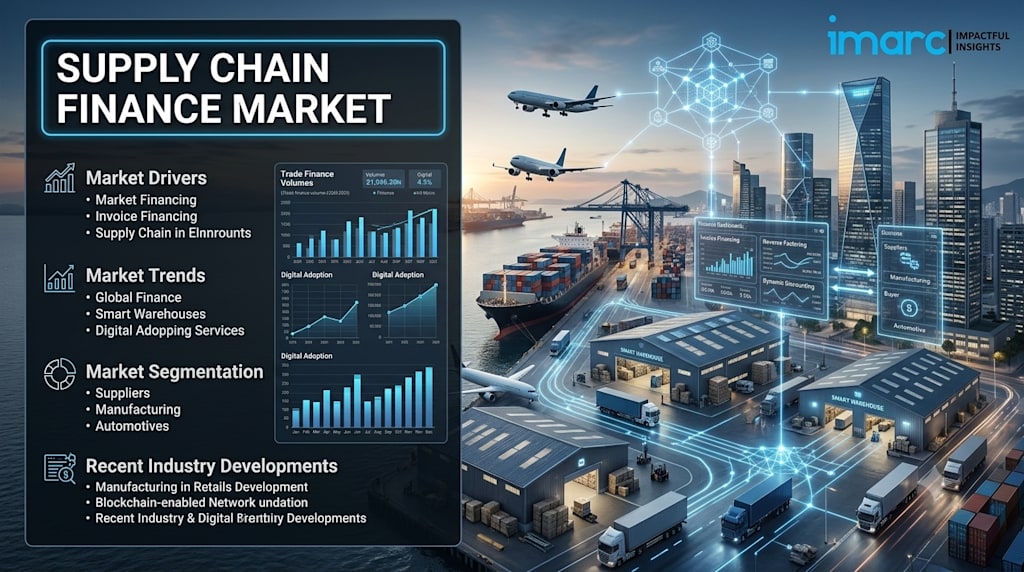
According to IMARC Group's latest research publication, global supply chain finance market size was valued at USD 8.1 Billion in 2025. Looking forward, IMARC Group estimates the market to reach USD 15.8 Billion by 2034, exhibiting a growth rate (CAGR) of 7.68% during 2026-2034.
How AI is Reshaping the Future of Supply Chain Finance Market
- AI-Powered Credit Risk Assessment and Fraud Detection: Machine learning algorithms analyze alternative data sources like transaction histories to assess supplier creditworthiness accurately, bypassing traditional credit ratings and expanding financing access for underserved SMEs globally.
- Predictive Cash Flow Forecasting and Working Capital Optimization: AI-driven predictive analytics forecast cash flow patterns and identify financial risks in real time, helping businesses optimize financing strategies, reduce working capital cycles, and maintain liquidity across complex supply chains.
- Automated Invoice Processing and Smart Contract Execution: AI automates invoice approvals, payment scheduling, and supplier onboarding tasks, dramatically cutting administrative burden while blockchain-enabled smart contracts ensure secure, transparent, and faster settlement of trade finance transactions.
Supply Chain Finance Industry Overview:
The global supply chain finance market is witnessing steady expansion, fueled by growing demand for working capital optimization across industries. With banks commanding an 88.6% provider share and large enterprises holding a 63.0% end-user share, SCF solutions are becoming mainstream. The IFC estimates a USD 5.7 Trillion SME financing gap globally, driving governments and fintechs to accelerate adoption through platforms like India's TReDS, which now channels over USD 2 billion monthly.
Access the Latest 2026 Market Data & Forecasts
Supply Chain Finance Market Trends & Drivers
Digitalization and fintech innovation are fundamentally changing how businesses access working capital. Over 65% of global companies have already integrated generative AI into at least one function, and SCF platforms are at the forefront of this shift. Blockchain-enabled smart contracts ensure immutable transaction records and reduce fraud, while AI-driven credit models help suppliers especially SMEs access financing without traditional collateral. India's TReDS platform alone now facilitates over USD 2 billion monthly in MSME financing, demonstrating how digital infrastructure can close long-standing liquidity gaps at scale.
Globalization and complex cross-border trade are pushing demand for specialized SCF solutions to new heights. The global trade-to-GDP ratio climbed from 20% in 1995 to 31% in 2022, reflecting how deeply integrated international commerce has become. Managing currency exchange, customs compliance, and multi-supplier payment settlement now demands tailored financing instruments. Export and import bills the leading product segment with a 40.6% share remain critical for enabling short-term liquidity for global traders. Supply chain finance is increasingly the preferred tool for mitigating geopolitical risks, natural disruptions, and fluctuating trade conditions across emerging and developed markets alike.
Supplier-centric financing and ESG-aligned practices are creating a fresh growth wave in the SCF market. SMEs represent 65–70% of global suppliers, yet most face significant financing bottlenecks — a gap the IFC pegs at USD 8 Trillion when informal businesses are included. Governments are responding: India's Make in India scheme and the US Small Business Administration's programs are expanding SCF access for smaller players. Sustainable SCF programs linked to ESG goals are gaining traction in Europe, while IFC and Citi's USD 500 million sustainable supply chain finance facility in Mexico part of a broader USD 2 billion initiative highlights how green financing is reshaping capital flow strategies across emerging markets.
Leading Companies Operating in the Global Supply Chain Finance Industry:
- Asian Development Bank
- Bank of America Corporation
- BNP Paribas
- DBS Bank India Limited
- HSBC
- JPMorgan Chase & Co.
- Mitsubishi UFJ Financial Group Inc.
- Orbian Corporation
- Royal Bank of Scotland plc (NatWest Group plc)
Supply Chain Finance Market Report Segmentation:
By Provider:
- Banks
- Trade Finance House
- Others
Banks represent the largest segment, commanding an 88.6% share, leveraging their vast networks and financial expertise to deliver customized working capital solutions.
By Offering:
- Letter of Credit
- Export and Import Bills
- Performance Bonds
- Shipping Guarantees
- Others
Export and Import Bills hold the largest share at 40.6%, playing a critical role in providing short-term liquidity for businesses engaged in international trade.
By Application:
- Domestic
- International
Domestic leads with 60.0% of market share, driven by rising demand for efficient invoice processing and working capital management among local businesses.
By End User:
- Large Enterprises
- Small and Medium-sized Enterprises
Large enterprises account for the largest share at 63.0%, supported by their diverse supplier networks, stronger access to capital markets, and established procurement processes.
Regional Insights:
- North America (United States, Canada)
- Asia Pacific (China, Japan, India, South Korea, Australia, Indonesia, Others)
- Europe (Germany, France, United Kingdom, Italy, Spain, Others)
- Latin America (Brazil, Mexico, Others)
- Middle East and Africa
Asia Pacific dominates the market with a 42.2% share, driven by rapid industrialization, a vast SME ecosystem, and increasing adoption of fintech-powered SCF platforms across China, India, and Japan.
Recent News and Developments in Supply Chain Finance Market
- January 2025: The Reserve Bank of India granted KredX permission to develop a Trade Receivables Discounting System (TReDS) platform, authorizing it to auction trade receivables and improve MSME liquidity access through regulated financial solutions.
- January 2025: NEC Thailand partnered with AIRA Factoring to launch a Digital Supply Chain Financing platform in Thailand, leveraging NEC's TASConnect technology to improve SME cash flow and credit disbursement, aligned with Thailand's 4.0 innovation strategy.
- November 2024: The Reserve Bank of India directed non-banking financial companies (NBFCs) to report comprehensive supply chain financing data, enhancing regulatory transparency and financial ecosystem monitoring across the sector.
Note: If you require specific details, data, or insights that are not currently included in the scope of this report, we are happy to accommodate your request. As part of our customization service, we will gather and provide the additional information you need, tailored to your specific requirements. Please let us know your exact needs, and we will ensure the report is updated accordingly to meet your expectations.
About the Creator
sujeet. imarcgroup
With 2 years of hands-on experience at IMARC Group, I have conducted in-depth market research and analysis across diverse industries including technology, healthcare, agriculture, and consumer goods.
Enjoyed the story? Support the Creator.
Subscribe for free to receive all their stories in your feed.
Comments
There are no comments for this story
Be the first to respond and start the conversation.