
Supercapacitor Market Outlook: IoT Expansion, Energy Efficiency & Growth Forecast to 2034
Integration of supercapacitors in smart electronics, IoT devices, and wearable technologies is enabling compact, efficient, and fast-charging energy solutions for modern consumer applications.

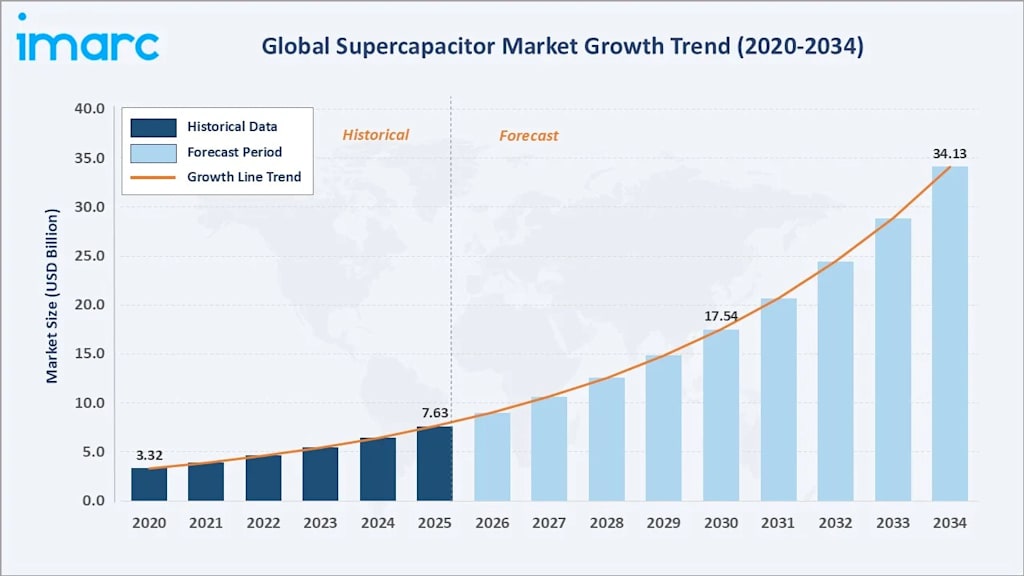
The accelerating shift toward clean energy and the rapid electrification of the global transport sector are creating a massive surge in demand for high-speed energy storage. Supercapacitors, known for their ability to deliver rapid bursts of power and endure millions of charge-discharge cycles, have become essential in bridging the gap between traditional batteries and high-frequency power needs. According to IMARC Group’s latest data, the global supercapacitor market size was valued at USD 7.63 Billion in 2025. Looking forward, IMARC Group estimates the market to reach USD 34.13 Billion by 2034, exhibiting a CAGR of 18.11% from 2026-2034.
Supercapacitors now represent a multi-billion-dollar critical infrastructure market, underpinned by their role in regenerative braking for electric vehicles and frequency regulation for renewable energy grids. Unlike standard batteries, these devices offer nearly instantaneous charging and discharging, making them indispensable for industrial automation, high-speed rail, and grid stabilization. Recent technological breakthroughs in graphene-based electrodes and hybrid lithium-ion capacitor architectures are pushing the boundaries of energy density, allowing these units to replace lead-acid batteries in various backup power and heavy-duty applications.
Download the "Supercapacitor Market" Outlook Sample for Free
Supercapacitor Market Growth Drivers:
- Rapid Expansion of Electric Vehicle (EV) Infrastructure
The automotive industry is a primary engine for growth as manufacturers integrate supercapacitors to handle peak power demands during acceleration and to capture energy through regenerative braking. By absorbing kinetic energy that would otherwise be lost, supercapacitors can improve overall vehicle efficiency by approximately 15% and extend the life of the primary lithium-ion battery. With global EV sales reaching record highs, major automakers are shifting toward hybrid energy storage systems.
- Renewable Energy Grid Stabilization and Storage
As solar and wind power become more prevalent, the inherent volatility of these energy sources requires immediate frequency response and voltage control. Supercapacitors excel in this role, responding within milliseconds to short-term power fluctuations that would typically stress traditional battery banks. Real-world applications are visible in smart grid projects across Europe and North America, where supercapacitors provide the "fast-acting" buffer needed to maintain grid stability. For instance, the U.S. Department of Energy allocated substantial funding in 2025 specifically for energy storage research, recognizing that supercapacitors are vital for a resilient, carbon-neutral electrical infrastructure capable of handling intermittent renewable loads.
- Proliferation of IoT and Industrial Automation
In the era of Industry 4.0, millions of IoT sensors and automated robotic systems require reliable, maintenance-free power sources. Supercapacitors are increasingly replacing batteries in these devices because they function reliably in extreme temperatures and offer a lifespan exceeding 10 to 15 years without replacement. This significantly reduces the total cost of ownership for industrial plants. For example, in automated warehouses, supercapacitor-powered robots can "opportunity charge" in seconds during brief stops, eliminating the hours of downtime required for battery recharging.
Supercapacitor Market Trends:
- Advancements in Graphene and Nanomaterial Electrodes
The industry is moving away from traditional activated carbon toward advanced nanomaterials like "curved graphene" to overcome the historical limitation of low energy density. Recent engineering breakthroughs have enabled graphene-based architectures to achieve volumetric energy densities of nearly 100 Wh/L, putting them on par with conventional lead-acid batteries while maintaining superior power delivery. In late 2025, commercial demonstrations showed that these materials could increase per-cell voltage from 2.7V to over 3.0V, representing a 23% jump in energy capacity.
- Integration of Hybrid Lithium-Ion Capacitors (LICs)
A major structural shift is the rise of hybrid capacitors, which combine the high energy density of lithium-ion battery electrodes with the high power density of electric double-layer capacitors (EDLCs). This "best of both worlds" approach is gaining traction in heavy-duty transport, including electric buses and light rail systems. For example, several urban transit projects in Europe are now deploying buses that charge entirely via supercapacitor banks at every stop, allowing for 24/7 operation without heavy, slow-charging battery packs.
- Sustainability and Circular Economy Practices
Environmental regulations and consumer demand for "green" electronics are forcing a shift toward sustainable sourcing and recyclable components. Unlike lithium-ion batteries, which contain cobalt and other difficult-to-recycle materials, supercapacitors are primarily composed of carbon, aluminum, and polymers. Leading manufacturers are now focusing on 100% recyclable designs and reducing the carbon footprint of the electrode manufacturing process. This aligns with the European Green Deal’s circular economy objectives, where manufacturers are increasingly held responsible for the end-of-life disposal of electronic components.
Recent News and Developments in Supercapacitor Market:
- September 2025: Skeleton Technologies launched its "GrapheneGPU" power shelf, a graphene-based supercapacitor solution tailored for data centers. This technology optimizes energy efficiency during high-magnitude power bursts required by AI computing, responding in milliseconds to prevent thermal stress on traditional UPS systems.
- September 2025: A major energy storage firm in India completed the initial phase of a dedicated supercapacitor manufacturing facility in Kerala, marking a significant step in localized production to support the nation’s growing renewable energy and electric mobility targets.
- October 2025: Researchers at Monash University demonstrated a new material architecture that allows supercapacitors to match the energy density of lead-acid batteries, effectively closing the performance gap and opening new markets in off-grid power storage and emergency backup systems.
Note: If you require specific details, data, or insights that are not currently included in the scope of this report, we are happy to accommodate your request. As part of our customization service, we will gather and provide the additional information you need, tailored to your specific requirements. Please let us know your exact needs, and we will ensure the report is updated accordingly to meet your expectations.
About the Creator
Andrew Sullivan
Hello, I’m Andrew Sullivan. I have over 9+ years of experience as a market research specialist.
Enjoyed the story? Support the Creator.
Subscribe for free to receive all their stories in your feed.
Comments
There are no comments for this story
Be the first to respond and start the conversation.