
Stone Flooring Market Witnesses Strong Growth in Premium Construction
How smart construction practices, sustainable sourcing initiatives, and innovative flooring designs are transforming the competitive landscape of the market

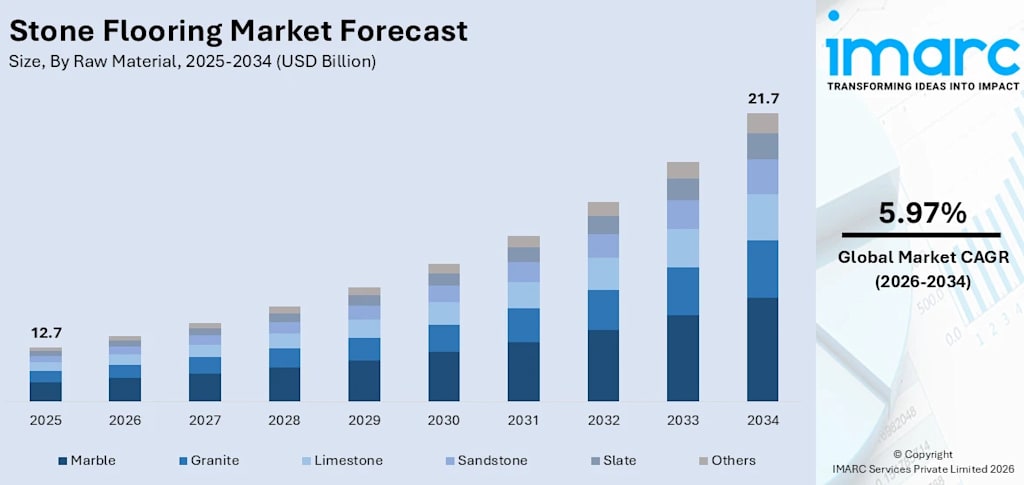
Rising investments in residential and commercial infrastructure, an increasing preference for long-lasting materials, and shifting aesthetic choices toward natural aesthetics are driving stone flooring demand. This is strongly supported by technological progress in stone fabrication, expanding real-world applications in high-end developments, and robust distribution setups across both retail and direct contractor pipelines. According to IMARC Group’s latest data, the global stone flooring market size was valued at USD 12.7 Billion in 2025. Looking forward, IMARC Group estimates the market to reach USD 21.7 Billion by 2034, exhibiting a CAGR of 5.97% from 2026-2034.
Stone flooring has evolved into a prominent multi-billion-dollar global industry, demonstrating consistent growth across diverse regional construction markets. The structural demand is primarily propelled by escalating urbanization, expanding disposable incomes that encourage luxury home renovations, and the inherent physical resilience of materials like marble, granite, slate, and limestone. Real estate developers and homeowners increasingly specify natural and composite stone options because they provide unique visual character, low maintenance requirements, and exceptional resistance to heavy foot traffic.
Start Exploring the "Stone Flooring Market" with a Analysis Sample Report
Stone Flooring Market Growth Drivers:
- Escalating Investments in Global Construction and Infrastructure
Expanding urban development drives massive project pipelines in residential, hospitality, and corporate sectors. For example, architectural specifications for modern luxury skyscrapers, shopping centers, and airport terminals heavily rely on high-durability floor materials. Data from the United States Census Bureau highlights that domestic construction spending from January to April alone reached USD 660.2 Billion, indicating a clear, capital-intensive expansion in real estate development. Developers systematically choose premium stones like granite and marble for these high-traffic public spaces to ensure long-term structural integrity and property value appreciation.
- Rising Consumer Preferences for Premium and Personalized Interiors
Growing household incomes empower property owners to invest in specialized, high-end home customization and remodeling ventures. In major metropolitan hubs, expanding personal capital directly triggers higher luxury housing expenditures. For instance, public indices indicate that disposable personal income in the United States reached USD 22,361.70 Billion, signaling substantial consumer spending capability. Homeowners increasingly shift away from synthetic coverings toward authentic natural stone because it delivers unmatched individuality, scratch resistance, and low-volatile organic compound (VOC) profiles that improve indoor air health and residential aesthetics.
- Technological Innovations in Processing, Cutting, and Installation
Advancements in factory machinery and quarry extraction techniques dramatically alter the cost efficiency and availability of stone products. The integration of advanced computer numerical control (CNC) machining and high-precision waterjet cutting technologies allows manufacturers to process massive stone blocks with minimal material waste. These production updates facilitate the output of ultra-compact slabs and calibrated thin tiles that are far easier to transport and install. As a result, premium materials become highly accessible across mid-tier residential markets, removing traditional weight barriers and expanding real-world layout opportunities.
Stone Flooring Market Trends:
- Surging Popularity of Sustainable and Low-Embodied-Carbon Materials
Architects and green building councils systematically prioritize natural stone over synthetic alternatives due to its minimal processing footprint and outstanding lifecycle longevity. Unlike vinyl or plastic composites, natural quarry stones do not rely on intensive chemical synthesis or fossil-fuel derivatives. The low lifecycle environmental impact fits perfectly into corporate green building frameworks and modern ecological regulations. Major suppliers are responding by standardizing transparent supply chain practices and investing in fully electric quarry machinery to further lower carbon outputs, matching the sustainability goals of eco-conscious global real estate developers.
- Rapid Integration of Digital Catalogs and Spatial Visualization Tools
The retail side of the business is undergoing a digital shift, with major brands launching detailed online material registries and sophisticated spatial simulators. Consumers and contract designers can now inspect subtle veining patterns and surface color variations via ultra-high-definition interactive portfolios without entering physical showrooms. Furthermore, augmented reality (AR) smartphone applications allow customers to superimpose real stone slabs directly onto their existing home floors. This visual certainty accelerates client approvals, streamlines supply chains, and reduces product return rates for large-scale corporate and residential distribution channels.
- Product Premiumization Through Unique Sourcing and Structural Slabs
Market leaders are achieving higher margins by marketing rare stone variants from historic European and Asian quarries as exclusive luxury design pieces. Brands emphasize the explicit origin stories, geological age, and specialized mineral profiles of stones like Italian Carrara marble or deep-hued exotic granites. Concurrently, the rise of sintered and ultra-compact composite stones allows builders to implement heavy-wear flooring that retains a natural look while offering superior stain resistance. This premium positioning matches high-end corporate branding, luxury hospitality lobbies, and custom residential architectural designs perfectly.
Recent News and Developments in Stone Flooring Market
- September 2025: A leading global building surfaces manufacturer announced the successful installation of a massive rooftop solar array at its primary quartz and composite stone facility, aiming to slash manufacturing carbon outputs.
- November 2025: An eco-focused architecture network recognized a prominent natural stone supplier for its innovative circular recycling program, which reclaims and transforms quarry cutting sludge into structural building aggregates.
- January 2026: A major surface design firm launched a new collection of ultra-thin, lightweight stone veneer tiles engineered specifically for complex commercial retrofits where structural floor weight limits prevent traditional stone slab placement.
Note: If you require specific details, data, or insights that are not currently included in the scope of this report, we are happy to accommodate your request. As part of our customization service, we will gather and provide the additional information you need, tailored to your specific requirements. Please let us know your exact needs, and we will ensure the report is updated accordingly to meet your expectations.
About the Creator
Andrew Sullivan
Hello, I’m Andrew Sullivan. I have over 9+ years of experience as a market research specialist.
Enjoyed the story? Support the Creator.
Subscribe for free to receive all their stories in your feed.
Comments
There are no comments for this story
Be the first to respond and start the conversation.