
Stablecoins in DeFi Explained: Beginner’s Guide to RWA-Backed Stablecoins
Understanding Stablecoins, DeFi, and RWA-Backed Innovation in Crypto
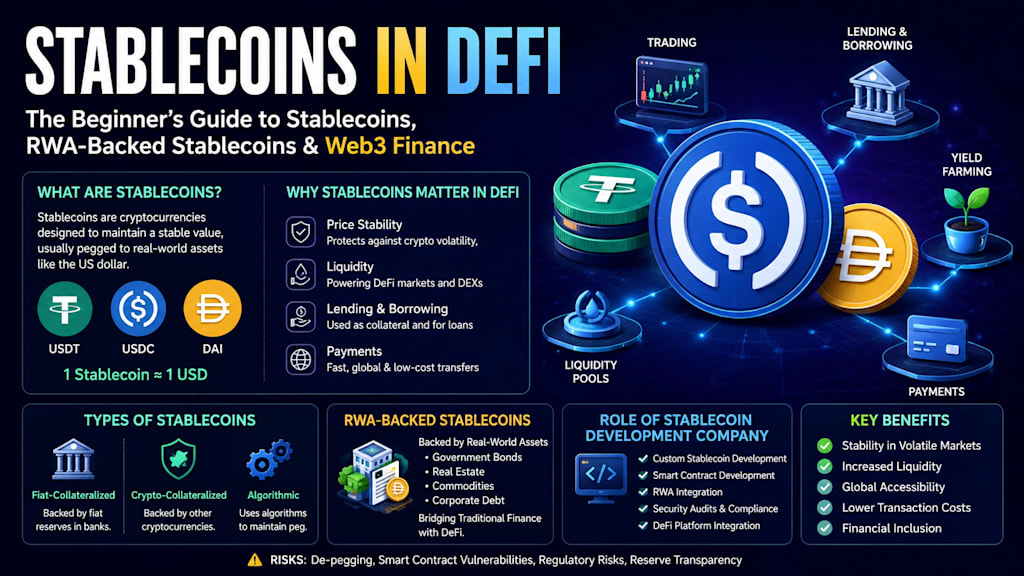
Stablecoins are one of the most important building blocks in the cryptocurrency world, especially in DeFi (Decentralized Finance). If you are new to crypto, understanding stablecoins is essential because they act as the “stable money” that powers trading, lending, and payments in blockchain ecosystems.
In this guide, we will explain what stablecoins are, how they work in DeFi, the rise of RWA-backed stablecoins, and how a stablecoin development company plays a role in building the future of Web3 finance.
What Are Stablecoins?
A stablecoin is a type of cryptocurrency designed to maintain a stable value. Unlike Bitcoin or Ethereum, which can experience major price fluctuations, stablecoins are usually pegged to real-world assets like the US dollar.
The most common peg is:
1 Stablecoin ≈ 1 USD
Popular stablecoins include:
USDT (Tether)
USDC (USD Coin)
DAI (Decentralized Stablecoin)
Because of their price stability, stablecoins are often called digital dollars in the crypto ecosystem.
Why Stablecoins Are Important in DeFi
The crypto market is highly volatile. Prices can rise or fall within minutes, making it difficult to use cryptocurrencies for everyday transactions. Stablecoins solve this issue by providing stability.
In DeFi (Decentralized Finance), stablecoins are used for:
Trading cryptocurrencies without volatility risk
Lending and borrowing assets
Earning interest through yield farming
Transferring money globally
Providing liquidity in decentralized exchanges
Without stablecoins, DeFi would not function efficiently because users would constantly face unpredictable price changes.
What Is DeFi?
DeFi (Decentralized Finance) refers to financial services built on blockchain technology without relying on banks or centralized institutions.
Instead of traditional intermediaries, DeFi uses smart contracts, which are automated programs that execute transactions securely.
In DeFi, users can:
Lend and borrow digital assets
Trade cryptocurrencies on decentralized exchanges
Earn passive income through staking
Participate in liquidity pools
Access global financial services without restrictions
Stablecoins are the most commonly used assets in these systems because they provide consistency and reduce risk.
How Stablecoins Work in DeFi
Stablecoins are deeply integrated into almost every part of the DeFi ecosystem.
1. Lending and Borrowing
Users can deposit stablecoins into lending protocols and earn interest. Others can borrow stablecoins by locking up crypto as collateral.
This system allows:
Passive income opportunities
Stable borrowing and repayment values
Reduced exposure to market volatility
2. Trading in DeFi Markets
Stablecoins are widely used in decentralized exchanges (DEXs). Traders use them as a safe exit during market volatility.
For example:
Sell ETH into USDC during a price drop
Re-enter the market when conditions improve
This helps traders protect their capital without converting to traditional currency.
3. Liquidity Pools
In liquidity pools, users provide stablecoins along with other crypto assets to enable trading.
Stablecoins help:
Reduce price fluctuations in trading pairs
Improve liquidity stability
Increase efficiency of DeFi platforms
4. Global Payments
Stablecoins allow fast and borderless payments without banks.
They are commonly used for:
Cross-border transfers
Freelance payments
Instant settlements
Transactions are completed within seconds and often with very low fees.
Types of Stablecoins in DeFi
Stablecoins come in different forms based on how they maintain their value.
1. Fiat-Collateralized Stablecoins
These stablecoins are backed by real-world currency reserves held in banks.
Examples:
USDC
USDT
Advantages:
Simple structure
High stability
Disadvantages:
Centralized control
Trust required in issuing company
2. Crypto-Collateralized Stablecoins
These are backed by other cryptocurrencies and are usually over-collateralized to handle volatility.
Example:
DAI
Advantages:
More decentralized
Transparent system
Disadvantages:
Complex mechanism
Sensitive to market crashes
3. Algorithmic Stablecoins
These stablecoins rely on algorithms and smart contracts to maintain price stability without traditional reserves.
Advantages:
Fully decentralized design
Innovative model
Disadvantages:
High risk
Some past failures in the market
RWA-Backed Stablecoins: A New Financial Evolution
A major innovation in the crypto industry is RWA-backed stablecoins (Real-World Asset-backed stablecoins).
These stablecoins are backed by real-world financial assets such as:
Government bonds
Real estate
Commodities
Corporate debt instruments
Why RWA-Backed Stablecoins Matter:
Strong real-world asset backing increases trust
Reduces volatility risk compared to crypto-backed models
Attracts institutional investors
Bridges traditional finance and blockchain ecosystems
RWA-backed stablecoins are expected to play a major role in the next phase of DeFi growth and global adoption.
Role of a Stablecoin Development Company
A stablecoin development company builds blockchain-based stablecoin systems for businesses, startups, and DeFi platforms.
These companies specialize in creating secure and scalable financial infrastructure.
Key Services:
Stablecoin creation and token development
RWA-backed stablecoin architecture
Smart contract development and auditing
Blockchain integration for DeFi platforms
Regulatory compliance and security frameworks
As demand for digital assets increases, stablecoin development companies are becoming essential in building reliable Web3 financial ecosystems.
Risks of Stablecoins in DeFi
While stablecoins are designed for stability, they still carry certain risks:
De-pegging risk: Losing 1:1 value with USD
Regulatory risk: Government restrictions or legal changes
Smart contract risk: Bugs or vulnerabilities in code
Reserve transparency risk: Unclear backing of assets
Users should always understand these risks before using stablecoins in DeFi platforms.
Future of Stablecoins in DeFi
The future of stablecoins looks strong as DeFi continues to grow globally. Innovations like RWA-backed stablecoins and advanced solutions from a stablecoin development company are making the ecosystem more secure and scalable.
In the coming years, stablecoins are expected to:
Become more widely adopted in global payments
Integrate with traditional banking systems
Support institutional investment in crypto
Power next-generation DeFi applications
Conclusion
Stablecoins are the foundation of the DeFi ecosystem. They bring stability, liquidity, and usability to an otherwise volatile crypto market. With the rise of RWA-backed stablecoins and innovations driven by a stablecoin development company, decentralized finance is evolving into a more stable and globally accessible financial system.
If you are starting your journey in crypto, understanding stablecoins in DeFi is one of the most important steps toward mastering the future of digital finance.
About the Creator
Enjoyed the story? Support the Creator.
Subscribe for free to receive all their stories in your feed.
Comments
There are no comments for this story
Be the first to respond and start the conversation.