
Stablecoin Payments: The Future of Global Remittance
Discover how stablecoin payments are transforming global remittance with faster transactions, lower fees, and secure blockchain-powered financial solutions.
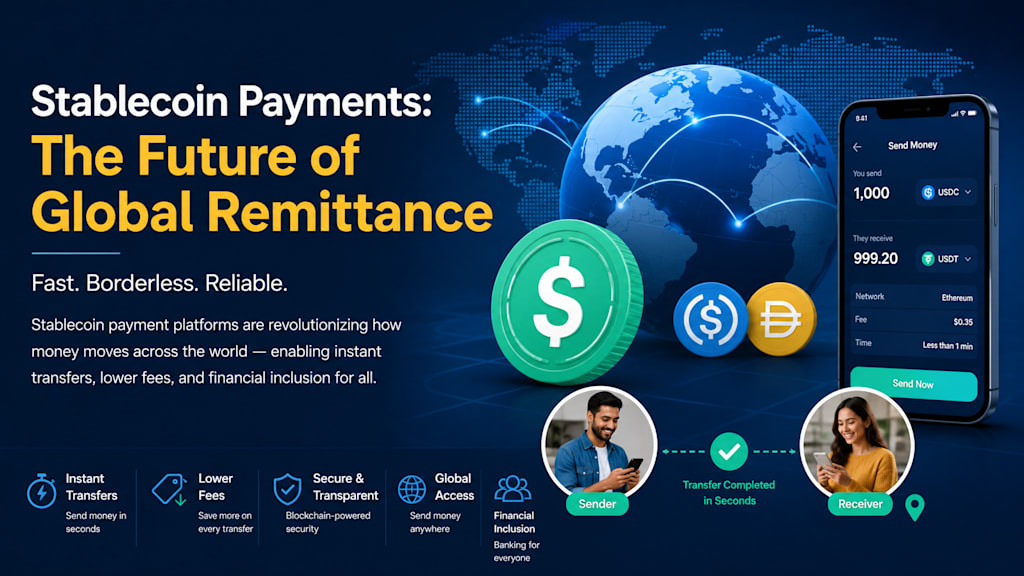
The global remittance industry is undergoing a major transformation as digital technologies reshape how money moves across borders. Traditional remittance systems have long been associated with high fees, slow processing times, and limited accessibility. In contrast, stablecoin payments are emerging as a faster, cheaper, and more efficient alternative. As businesses and financial institutions explore blockchain-powered solutions, stablecoin remittance platforms are quickly becoming the future of global payments.
What Are Stablecoin Payments?
Stablecoins are a type of cryptocurrency designed to maintain a stable value by being pegged to assets such as fiat currencies, commodities, or other reserves. Unlike volatile cryptocurrencies, stablecoins provide price stability, making them ideal for everyday transactions and cross-border payments.
Stablecoin payments leverage blockchain technology to enable instant and secure transactions without relying on traditional banking intermediaries. This innovation is particularly valuable in the remittance sector, where speed and cost efficiency are critical.
Challenges with Traditional Remittance Systems
Before understanding the impact of stablecoins, it is important to look at the limitations of traditional remittance systems. Sending money internationally through banks or money transfer services often involves:
High transaction fees
Delays ranging from hours to several days
Multiple intermediaries increasing costs
Limited access in underserved regions
Currency conversion complexities
These challenges create inefficiencies for individuals and businesses, especially in developing economies where remittances play a vital role.
How Stablecoin Payments Solve These Problems
Stablecoin payment platforms address many of the issues associated with traditional remittance systems. By using blockchain networks, these platforms enable direct peer-to-peer transactions, eliminating the need for intermediaries.
One of the biggest advantages is speed. Transactions can be completed within minutes, regardless of geographical location. This is a significant improvement over traditional systems that may take days.
Cost reduction is another key benefit. Stablecoin transactions typically involve minimal fees compared to banks or remittance providers. This makes them highly attractive for individuals sending money regularly.
Accessibility is also improved. Anyone with a smartphone and internet connection can use stablecoin payment platforms, making financial services more inclusive.
Key Features of Stablecoin Remittance Platforms
Modern stablecoin remittance and payment platform development focuses on building scalable and secure systems that support global transactions. Some of the essential features include:
Multi-currency support for both crypto and fiat
Digital wallets for storing and transferring stablecoins
Real-time transaction processing
Integration with payment gateways
Compliance with KYC and AML regulations
Advanced security protocols such as encryption and multi-signature authentication
These features ensure that stablecoin platforms can compete with traditional financial systems while offering superior efficiency.
Use Cases of Stablecoin Payments
Stablecoin payments are being adopted across various industries and use cases. One of the most prominent applications is cross-border remittance. Migrant workers can send money to their families instantly and at a lower cost.
Businesses are also using stablecoins for international trade, reducing dependency on traditional banking systems. E-commerce platforms benefit from faster payment settlements and lower transaction costs.
In addition, stablecoins are being integrated into decentralized finance ecosystems, enabling lending, borrowing, and yield generation. This further expands their utility beyond simple payments.
Stablecoin Payment Platform Development
As demand grows, many businesses are investing in stablecoin payment platform development to create customized solutions tailored to their needs. Developing such a platform involves several key steps.
The first step is choosing the right blockchain network. Popular options include Ethereum, Binance Smart Chain, and other scalable networks that support smart contracts.
Next comes wallet integration, allowing users to store and manage their digital assets securely. Payment gateway integration is also crucial for enabling seamless transactions between users and merchants.
Security is a top priority in platform development. Implementing encryption, multi-factor authentication, and secure APIs ensures the safety of user funds and data.
Compliance is another important aspect. Platforms must adhere to regulatory requirements, including KYC and AML guidelines, to operate legally in different regions.
Benefits for Businesses
For businesses, adopting stablecoin payments offers several strategic advantages. It reduces transaction costs, improves cash flow, and enhances customer experience. Faster settlements allow businesses to operate more efficiently and expand globally.
Stablecoin payment platforms also open new revenue streams by enabling innovative financial services such as digital wallets, cross-border payments, and DeFi integrations.
Moreover, businesses can gain a competitive edge by offering modern payment solutions that meet the evolving expectations of customers.
Future of Stablecoin Remittance
The future of stablecoin payments looks promising as adoption continues to grow. Governments and regulatory bodies are also recognizing the potential of stablecoins, leading to clearer guidelines and increased trust.
Technological advancements will further enhance scalability, security, and interoperability between different blockchain networks. This will make stablecoin remittance platforms even more efficient and widely accessible.
As more businesses invest in stablecoin remittance and payment platform development, the gap between traditional finance and digital finance will continue to narrow.
Conclusion
Stablecoin payments are redefining the global remittance landscape by offering faster, cheaper, and more accessible financial solutions. By eliminating intermediaries and leveraging blockchain technology, they address many of the inefficiencies of traditional systems.
With the growing demand for digital payment solutions, stablecoin payment platform development is becoming a key focus for businesses looking to innovate in the financial sector. As adoption increases, stablecoin remittance platforms are set to become a cornerstone of the future global economy.
About the Creator
Enjoyed the story? Support the Creator.
Subscribe for free to receive all their stories in your feed.
Comments
There are no comments for this story
Be the first to respond and start the conversation.