
Spatial Genomics and Transcriptomics Market Is Set to Hit $1.90 Billion by 2035
From tumor microenvironments to precision oncology, spatial biology is giving researchers their first clear view of gene expression exactly where it happens in tissue.

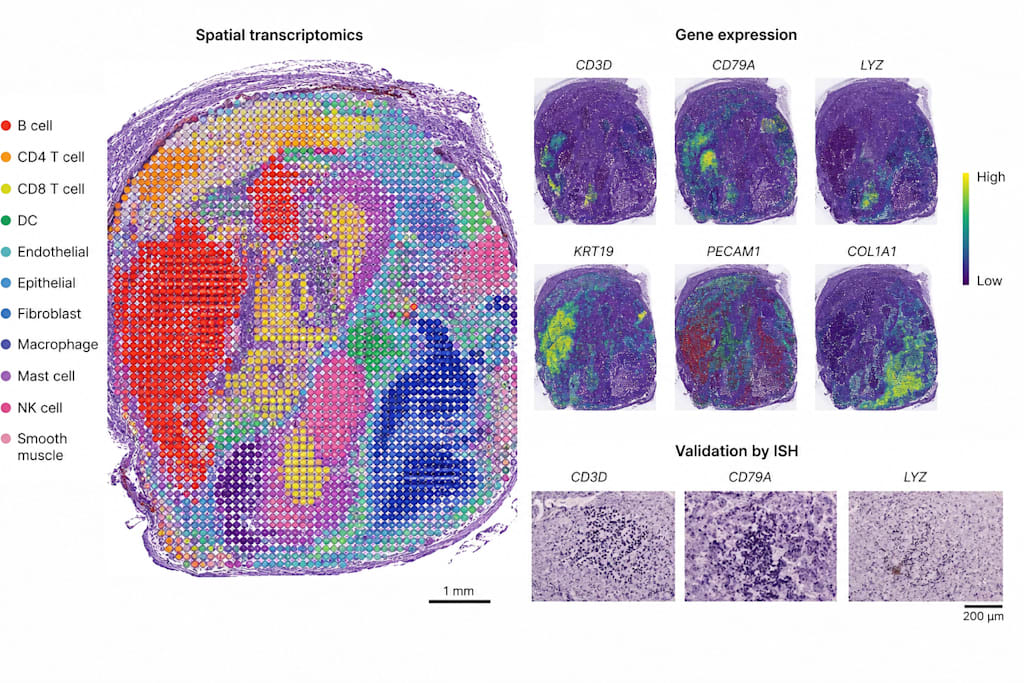
In 2026, cancer researchers at institutions across North America began mapping gene expression not from dissociated cells in a tube, but directly within intact tumor tissue — preserving the spatial relationships between cells that traditional transcriptomics had always destroyed in the process of measuring them. No loss of biological context. No flattening of tissue architecture into an average signal. The result was a fundamentally different picture of how tumors behave, how immune cells respond, and where therapeutic targets actually live. The spatial genomics and transcriptomics market has been building toward this moment for years, but the convergence of AI analytics, high-resolution imaging, and next-generation sequencing is making it feel genuinely new.
Global revenues for spatial genomics and transcriptomics market stood at roughly USD 0.60 billion in 2025. Forecasters now project the market will reach USD 1.90 billion by 2035 — a compound annual growth rate of 12.23%. That trajectory puts it alongside single-cell sequencing and AI-driven drug discovery as one of the defining platform stories in life sciences this decade.
Consumables Run the Revenue, Spatial Transcriptomics Is Closing Everything Else
The consumables and reagents segment dominated in 2025, accounting for 42% of total revenue. That dominance is structural. Every spatial biology experiment — from tissue preparation through sequencing and imaging — requires assay kits, probes, barcoding chemistries, and staining solutions at each stage. Research laboratories and pharmaceutical organizations purchase these repeatedly, at scale, generating the kind of recurring revenue that makes the segment both the largest and the fastest-growing, at a projected CAGR of 13.50% through 2035.
But spatial transcriptomics is where the scientific competition is most intense. Holding 38% of the technology segment in 2025 and projected to grow at 13.09%, it offers something traditional transcriptomics never could: a complete map of gene expression with precise spatial coordinates preserved within the tissue. Researchers studying tumor microenvironments, cell-to-cell interactions, and disease mechanisms are no longer averaging signals across thousands of dissociated cells. They're reading the molecular state of each cell exactly where it sits. That capability is not an incremental improvement. It is a different kind of question being asked — and answered.
Oncology Leads, But the Platform Is Expanding
Oncology research captured 34% of the application segment in 2025, and holds the fastest growth projection at 13.22% CAGR through 2035. That dominance reflects the convergence of two forces: rising cancer incidence globally, and the growing recognition that tumor heterogeneity — the fact that different cells within the same tumor behave differently — cannot be understood without spatial context. Pharmaceutical companies and cancer institutes are now using spatial biology for biomarker discovery, companion diagnostics development, and precision oncology in ways that were technically impossible five years ago.
The broader platform, however, is expanding into neuroscience, immunology, and rare disease research with equal momentum. More than 190 active global clinical trials were running programs that depend on spatial molecular profiling by 2025. As those trials mature and generate commercial demand, the application mix will diversify significantly.
Prototyping gave way to production in manufacturing. In spatial biology, research is giving way to clinical translation.
The Bioinformatics Problem Nobody Has Fully Solved
The tension at the center of this market isn't demand. Demand is unambiguous. It's the computational infrastructure required to make sense of the data — and the cost and expertise barriers that come with it.
Spatial biology experiments generate enormous datasets. Analyzing them requires sophisticated bioinformatics pipelines, advanced computing hardware, and analytical expertise that smaller research institutions frequently don't have in-house. The absence of globally harmonized validation frameworks for AI-based spatial analysis results creates regulatory and reproducibility concerns that mirror the raw material standardization problem in mRNA manufacturing. In 2026, regulatory agencies and pharmaceutical companies were still actively debating standards for AI transparency and validation in genomics research environments.
Large players are responding by pushing toward automation and cloud-based analytics. 10x Genomics expanded its high-resolution spatial transcriptomics workflows in 2026 to generate more comprehensive tissue-level gene expression maps. Vizgen introduced multiplex spatial transcriptomics enhancements designed to improve cellular resolution and large-scale tissue profiling efficiency. The direction is clear: reduce the bioinformatics burden through platform integration, so that spatial biology becomes accessible to the institutions that need it most — not just the ones that can afford a dedicated computational biology team.
Geography and the Infrastructure Signal
North America held 46% of global revenue in 2025, with the United States accounting for 94% of the regional share — anchored by pharmaceutical companies, cancer research institutes, and academic medical centers that have built spatial biology into their core research workflows. Government investment in genomics research and oncology pipeline development has sustained upstream demand in ways that compound over time.
Europe's story is Germany. BioNTech's research footprint and sustained government investment in biotech infrastructure have made it the regional center of gravity, holding 27% of European consumption. The UK is the region's fastest-growing market, driven by government-backed precision medicine initiatives and collaborations between academic institutions and biotech firms.
Asia Pacific is accelerating fastest overall, projected at a CAGR of 16.69% — the highest of any region. China leads by market share, with state-backed investment in genomics infrastructure and precision medicine platforms. India is scaling rapidly through pharma R&D expansion and rising cancer research investment. Japan and South Korea are focusing on high-purity reagent supply and AI-integrated spatial biology workflows for precision therapeutics. The competitive geography of this market over the next decade will be substantially shaped by which countries close the gap between genomics ambition and domestic analytical capability.
The question for the next phase isn't whether spatial biology will become standard practice in oncology and translational research. With platforms maturing, AI integration accelerating, and CROs projected to grow at 14.63% CAGR as outsourcing of spatial biology workflows expands, that outcome looks settled. The real question is whether the bioinformatics infrastructure, regulatory frameworks, and trained workforce beneath it can mature fast enough to keep pace — and which platforms, and which regions, will own that capability when clinical translation arrives at scale.
About the Creator
Mayur Pande
Mayur Pande is an experienced SEO Specialist with 7 years of experience in Digital Marketing. Throughout his career, he has developed strong expertise in client relationship management, achieving business targets.
Enjoyed the story? Support the Creator.
Subscribe for free to receive all their stories in your feed.
Comments
There are no comments for this story
Be the first to respond and start the conversation.