
Spatial Computing Market Analysis: Smart Cities, IoT Integration & Industry Forecast to 2033
How spatial computing is driving innovation in smart cities through real-time monitoring, urban planning simulations, and intelligent infrastructure management

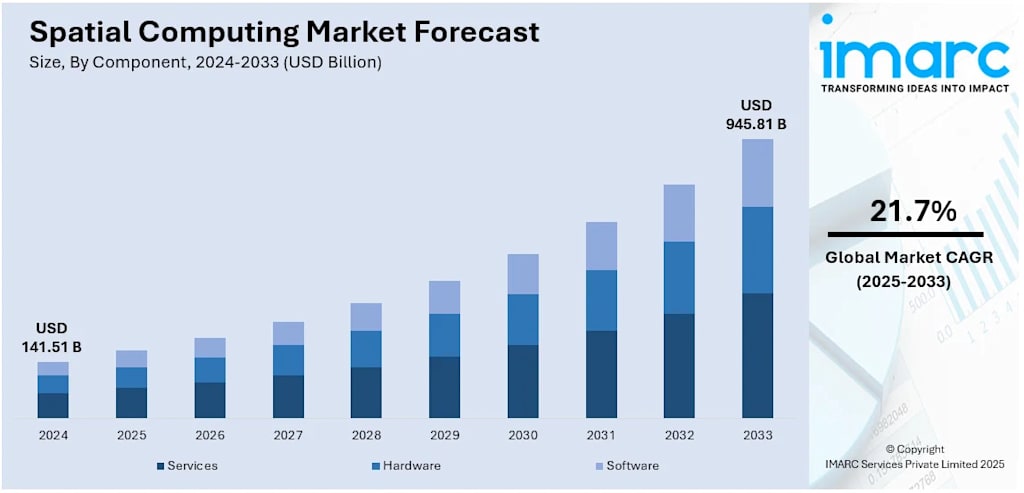
The spatial computing landscape is undergoing a radical transformation as the boundaries between physical and digital environments dissolve, driven by breakthroughs in hardware and AI-integrated software. According to IMARC Group’s latest data, the global spatial computing market size was valued at USD 141.51 Billion in 2024. Looking forward, IMARC Group estimates the market to reach USD 945.81 Billion by 2033, exhibiting a CAGR of 21.7% from 2025-2033.
Spatial computing now represents a powerhouse in the global tech economy, moving well beyond its early roots in gaming to become an essential industrial and enterprise tool. The market is propelled by the convergence of high-speed 5G connectivity, advanced sensor fusion, and the integration of digital twins in manufacturing and logistics. Major segments include Augmented Reality (AR), Virtual Reality (VR), and Mixed Reality (MR), with AR currently leading due to its versatile applications in retail and field services.
Spatial Computing Market Growth Drivers:
- Integration with Artificial Intelligence and Autonomous Systems
Artificial intelligence is acting as the "brain" for spatial computing, enabling real-time environmental mapping and object recognition that was previously impossible. In logistics, AI-powered spatial tools allow automated guided vehicles (AGVs) to navigate complex warehouse floors with millimeter precision, optimizing inventory paths instantly. Currently, the industrial sector sees a massive shift where AI-integrated headsets provide workers with real-time data overlays, reducing assembly errors by up to 30%.
- Revolutionizing Enterprise Training and Remote Collaboration
The shift toward decentralized workforces has made spatial computing an indispensable tool for high-stakes training and global collaboration. In healthcare, surgical teams use mixed reality to overlay 3D anatomical models onto patients during pre-operative planning, which has been shown to reduce surgical time and improve outcomes. Similarly, the aerospace and defense sectors utilize fully immersive VR environments to train pilots and engineers in risk-free, simulated scenarios.
- Expansion of Consumer Electronics and Immersive Retail
The consumer market is being reshaped by lightweight, high-performance wearables that bridge the gap between high-end headsets and everyday glasses. Major tech players are launching devices that focus on "infinite canvas" productivity, allowing users to replace multi-monitor setups with a single wearable device. In the retail world, brands are deploying AR "try-on" features that have increased conversion rates by nearly 40% for apparel and home furnishings.
Request Your Free Sample Report on the “Spatial Computing Market” Now!
Spatial Computing Market Trends:
- Advancements in Haptic Feedback and Sensory Immersion
A major trend shaping the current market is the move toward "full-sensory" immersion, where visual data is paired with sophisticated haptic feedback. New wearable gloves and suits allow users to "feel" the texture and resistance of virtual objects, which is critical for specialized training like hazardous material handling or remote robotic surgery. This trend is moving spatial computing from a purely visual medium to a physical experience.
- The Rise of Digital Twins and Urban Planning
Governments and urban planners are increasingly adopting spatial computing to create "Digital Twins" of entire cities. By overlaying real-time IoT data onto 3D spatial maps, officials can simulate traffic flow, energy consumption, and the impact of new construction projects before a single brick is laid. For example, several smart city initiatives in Europe and Asia are using these models to optimize emergency response routes, cutting down arrival times by nearly 15%.
- Sustainability through Virtual Prototyping and Reduced Travel
Sustainability is becoming a core driver as companies use spatial computing to hit ESG (Environmental, Social, and Governance) targets. By conducting product design and stress testing in a purely spatial environment, manufacturers significantly reduce the need for physical prototypes, which slashes material waste and carbon emissions. Automotive and fashion industries are leading this charge, reporting up to a 50% reduction in physical waste during the design phase.
Recent News and Developments in Spatial Computing Market
- September 2025: Apple rolled out visionOS 2.4, integrating "Apple Intelligence" directly into the Vision Pro ecosystem. This update introduced a suite of AI-powered writing tools and spatial search capabilities, allowing users to interact with their digital environment using more sophisticated natural language processing and personalized AI-generated imagery.
- October 2025: Microsoft expanded its partnership with NVIDIA to bring "Omniverse Cloud" to the frontline workforce via the HoloLens 2. This development enables industrial workers to stream massive 3D digital twins from the cloud directly to their headsets without losing frame rate or detail, facilitating complex engine repairs in real-time.
- January 2026: Meta Platforms announced a successful pilot program with the U.S. Department of Education to integrate spatial computing headsets into 500 public high schools. The program uses VR-based laboratories to provide students with access to high-cost chemistry and physics equipment in a safe, cost-effective digital environment.
Note: If you require specific details, data, or insights that are not currently included in the scope of this report, we are happy to accommodate your request. As part of our customization service, we will gather and provide the additional information you need, tailored to your specific requirements. Please let us know your exact needs, and we will ensure the report is updated accordingly to meet your expectations.
About the Creator
Andrew Sullivan
Hello, I’m Andrew Sullivan. I have over 9+ years of experience as a market research specialist.
Enjoyed the story? Support the Creator.
Subscribe for free to receive all their stories in your feed.
Comments
There are no comments for this story
Be the first to respond and start the conversation.