
Soybean Oil Market 2026-2034: Rising Demand for Plant-Based Oils and Biofuels Drives Global Expansion
Growing consumption of processed foods, renewable fuel initiatives, and demand for healthier cooking oils are strengthening the global soybean oil industry across food and industrial applications.

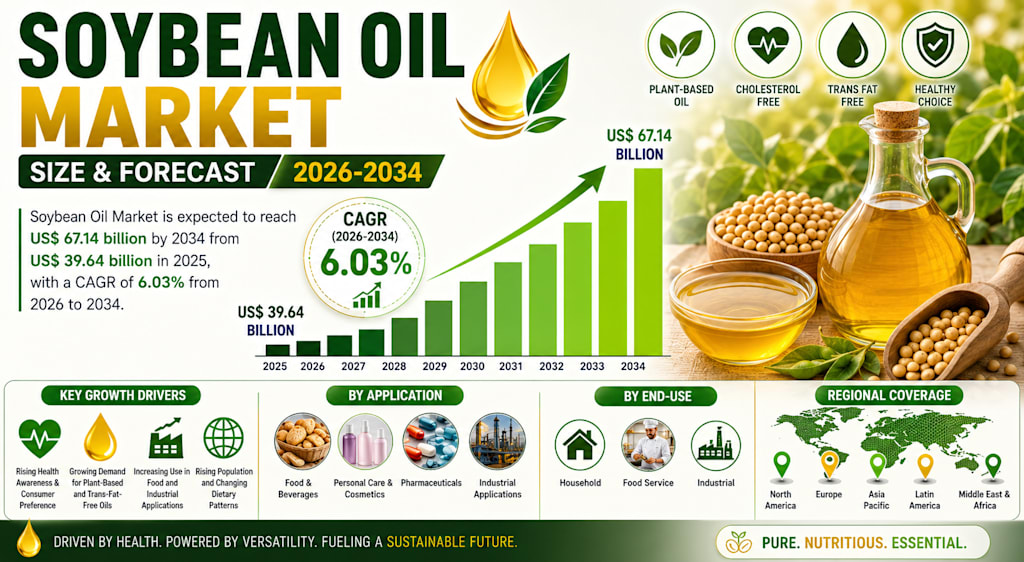
The global soybean oil market is witnessing significant growth as demand rises across food manufacturing, biofuel production, and industrial applications. According to Renub Research, the soybean oil market is expected to increase from US$ 39.64 billion in 2025 to US$ 67.14 billion by 2034, growing at a CAGR of 6.03% between 2026 and 2034.
Soybean oil remains one of the most widely consumed vegetable oils globally because of its affordability, versatility, and broad industrial utility. It is extensively used in frying, baking, salad dressings, margarine production, packaged foods, processed snacks, biodiesel manufacturing, cosmetics, and industrial lubricants.
As consumers increasingly prefer plant-based, trans-fat-free, and affordable cooking oils, soybean oil is strengthening its position within the global edible oil industry. At the same time, renewable fuel initiatives and rising industrial applications are opening new long-term growth opportunities for producers worldwide.
Why global soybean oil demand is increasing
One of the strongest drivers behind soybean oil market expansion is the growing global demand for processed and convenience foods. Urbanization, dual-income households, and changing dietary habits are increasing consumption of packaged meals, snacks, bakery products, and restaurant foods that heavily rely on refined vegetable oils.
Renub Research notes that global per-capita vegetable oil consumption increased from 24.1 kilograms in 2020 to 26.3 kilograms in 2025, with soybean oil accounting for 28% of the additional volume growth.
Food manufacturers increasingly prefer soybean oil because of its functionality, neutral flavor, long shelf life, and compatibility with trans-fat reduction requirements. More than 50 countries have implemented trans-fat restrictions, encouraging manufacturers to reformulate products using alternatives such as soybean oil.
Quick-service restaurant chains are also increasing purchases of high-oleic soybean oil because it can withstand longer frying cycles, helping reduce replacement frequency and waste disposal costs.
Biofuel demand is reshaping the industry
Beyond food applications, soybean oil is becoming increasingly important in renewable energy markets. Governments worldwide are promoting biodiesel blending programs and renewable diesel initiatives as part of broader carbon reduction strategies.
This shift is significantly increasing industrial demand for soybean oil, particularly in countries such as the United States where renewable fuel programs are strongly influencing market dynamics.
Renewable diesel producers and biodiesel manufacturers are rapidly expanding soybean oil usage because it serves as a key feedstock for cleaner fuel production.
The combination of food demand and renewable fuel demand is creating a dual-growth structure for the soybean oil industry, helping strengthen long-term market potential.
Technology is improving soybean oil production
Technological innovation is playing a major role in improving soybean yields, processing efficiency, and oil quality.
Renub Research highlights that precision agriculture technologies such as satellite-guided nutrient application, predictive disease modeling, and variable-rate seeding increased average U.S. soybean yields from 50.2 bushels per acre in 2020 to 52.8 bushels in 2025.
High-oleic soybean varieties are also gaining popularity. According to the report, high-oleic soybean acreage in the United States reached 1.2 million acres in 2025, tripling 2023 levels. These soybean variants contain significantly higher oleic acid levels, improving frying stability and allowing premium pricing within foodservice markets.
Processing technology improvements are also helping reduce energy consumption and carbon intensity within soybean oil production. Innovations such as membrane filtration, counter-current washing, enzyme-assisted extraction, and near-infrared spectroscopy are improving operational efficiency while supporting sustainability goals.
These advancements are becoming increasingly important as governments and consumers place greater emphasis on environmentally responsible food and industrial production systems.
Soybean meal demand is indirectly boosting oil production
The soybean oil market is closely tied to soybean meal demand because both products are generated during soybean crushing operations.
Soybean meal remains one of the world’s most important animal feed ingredients, particularly for poultry, livestock, and aquaculture industries. Rising meat consumption across Asia is increasing soybean crushing activity, which in turn boosts soybean oil supply.
Renub Research notes that China imported around 100 million metric tons of soybeans in 2025, with approximately 78% crushed domestically to support animal feed production. This generated nearly 18 million metric tons of soybean oil as a byproduct.
India’s poultry industry is also expected to increase soybean meal demand significantly through 2030, creating additional soybean oil production as crushers expand processing capacity.
This relationship between protein demand and oil production explains why soybean oil pricing is often influenced not only by edible oil demand but also by global livestock feed markets.
Health trends are supporting consumer demand
Consumer health awareness is increasingly influencing edible oil purchasing decisions worldwide.
Soybean oil is benefiting from rising demand for plant-based cooking oils, low-trans-fat products, and affordable healthier alternatives. Food manufacturers are introducing high-oleic soybean oil formulations with improved nutritional profiles and better frying performance.
In many developing economies, consumers are gradually shifting away from heavily processed fats toward vegetable oils perceived as healthier and more versatile.
At the same time, the rise of vegan and flexitarian eating habits is increasing consumption of plant-based food products that rely heavily on soybean oil in production and processing.
Supply chain volatility remains a major challenge
Despite strong growth prospects, the soybean oil market continues facing serious supply chain and pricing challenges.
Soybean production is highly dependent on weather conditions, climate variability, agricultural productivity, and global trade flows. Droughts, floods, crop diseases, and unfavorable farming conditions can significantly reduce soybean yields and increase procurement costs.
Geopolitical tensions, export restrictions, transportation disruptions, and fluctuating logistics costs can further destabilize global supply chains.
Manufacturers must balance rising raw material and distribution costs while maintaining competitive retail pricing in highly price-sensitive food markets.
This operational pressure is particularly challenging for food manufacturers and biodiesel producers operating under tight margin conditions.
Competition from other edible oils is intensifying
Soybean oil also faces strong competition from other vegetable oils including palm oil, sunflower oil, canola oil, corn oil, and olive oil.
Consumer preferences often vary by region based on pricing, health perceptions, availability, and culinary traditions. Palm oil remains highly competitive in food manufacturing because of its low cost, while premium consumers increasingly prefer oils such as olive oil and avocado oil.
The rise of specialty oils and functional food trends is forcing soybean oil producers to focus more heavily on product quality, nutritional positioning, and sustainability initiatives.
Manufacturers are increasingly emphasizing sustainable sourcing practices and cleaner production methods to strengthen competitiveness in evolving consumer markets.
United States remains a dominant market
The United States continues to play a major role in the global soybean oil industry due to its advanced agricultural infrastructure, large-scale soybean production, and expanding renewable fuel sector.
Soybean oil demand in the country is strongly supported by food processing, biodiesel manufacturing, restaurant cooking, and industrial applications. Government renewable fuel policies such as the Renewable Fuel Standard are significantly boosting industrial demand.
According to the USDA Crop Production report referenced by Renub Research, U.S. soybean production was projected to reach 4.58 billion bushels in October 2024, representing a 10% increase compared to 2023.
This production scale continues strengthening the country’s leadership within the global soybean processing industry.
India and UAE markets continue expanding
India’s soybean oil market is growing due to rising consumption of processed foods, expanding middle-class populations, and increasing demand for affordable edible oils.
Renub Research notes that India imported 357,890 tonnes of crude soybean oil by August 2023, accounting for 48% of total vegetable oil imports.
Domestic refining capacity is also expanding as companies such as Adani Wilmar and Ruchi Soya strengthen processing operations to meet rising local demand.
In the UAE, increasing urbanization, growth in hospitality sectors, and rising consumption of international cuisines are supporting greater soybean oil usage across households and foodservice industries.
recent company developments
Scoular opened a new oilseed crushing facility in Goodland, Kansas, in September 2024 with annual processing capacity of 11 million bushels.
Louis Dreyfus Company relaunched its edible oil brand “Vibhor” in July 2024 with soybean, palmolein, cottonseed, and mustard oil products.
Nabil Group launched its new soybean oil brand “Foodella” in Bangladesh in March 2024.
Archer Daniels Midland continued investing in sustainable oilseed processing and renewable fuel supply chain expansion.
Bunge Global expanded focus on renewable diesel feedstock partnerships and sustainable soybean sourcing initiatives.
Cargill strengthened high-oleic soybean oil product offerings for foodservice and industrial applications.
Wilmar International continued expanding edible oil refining and distribution capabilities across Asia-Pacific markets.
AAK AB increased focus on specialty vegetable oils and sustainable sourcing programs for food manufacturers.
Associated British Foods strengthened packaged food and ingredient operations utilizing vegetable oil-based production systems.
Unilever continued reformulating food products using plant-based oils aligned with health and sustainability trends.
Final thoughts
The soybean oil market is evolving into a highly strategic industry driven by the combined forces of food security, renewable energy demand, plant-based consumption trends, and industrial growth.
Renub Research’s projection of US$ 67.14 billion by 2034 highlights how soybean oil is becoming increasingly important not only as a cooking ingredient but also as a renewable industrial resource.
As governments promote sustainable fuels and consumers continue shifting toward healthier plant-based food products, soybean oil producers will likely focus heavily on innovation, efficiency, sustainability, and supply chain resilience to maintain long-term market competitiveness.
About the Creator
Enjoyed the story? Support the Creator.
Subscribe for free to receive all their stories in your feed.
Comments
There are no comments for this story
Be the first to respond and start the conversation.