
South Korea Zinc Die Casting Market: Cost Efficiency & Forecast to 2034
How automotive sector demand, precision manufacturing, and durable components are transforming competitive dynamics in the South Korea zinc die casting market.
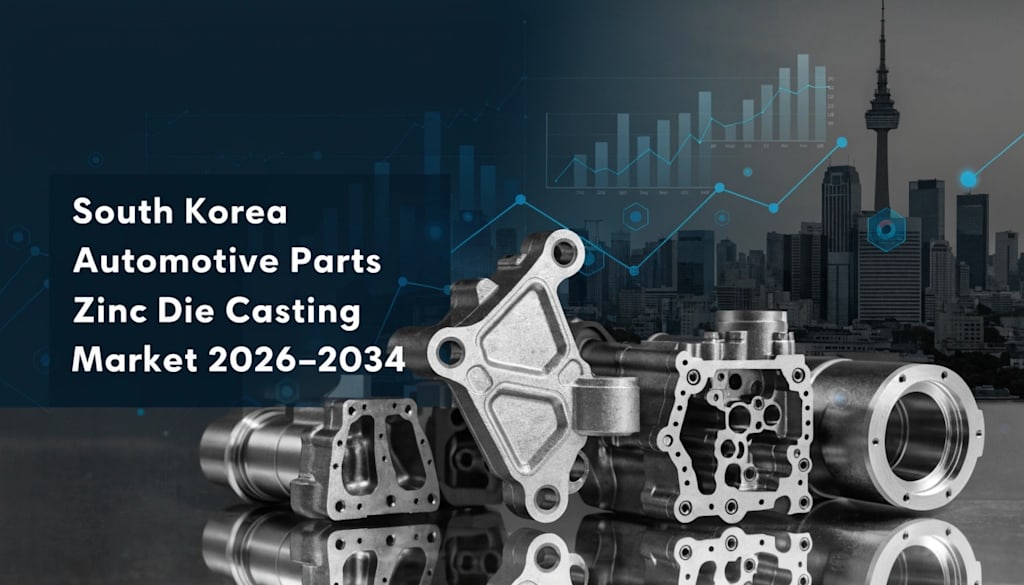
Rising demand for lightweight automotive components, stringent fuel efficiency and emission regulations, and the rapid adoption of electric vehicles are collectively driving the south korea automotive parts zinc die casting market forward. According to IMARC Group's latest data, the South Korea automotive parts zinc die casting market size reached USD 887.2 Million in 2025. Looking forward, IMARC Group expects the market to reach USD 1,130.8 Million, exhibiting strong growth momentum through the forecast period. The country's thriving automotive manufacturing sector, cost-effectiveness of zinc die casting, availability of a skilled labor force, and the rise of electric vehicles are the key forces propelling market expansion.
The south korea automotive parts zinc die casting market represents a precision-driven, high-volume manufacturing segment integral to one of Asia's most competitive automotive ecosystems. Zinc die casting involves injecting molten zinc alloy at high pressure into precisely engineered molds, producing complex, thin-walled components with exceptional dimensional accuracy. The automotive industry relies extensively on this process for engine parts, transmission housings, body assembly components, door handles, and decorative trim. Key advantages include cost-effective mass production with minimal material waste, high-speed output capability, excellent corrosion resistance, and the ability to manufacture intricate geometries that alternative processes cannot match. Two primary casting variants serve the market: hot chamber die casting for lower-melting-point zinc alloys and cold chamber die casting for applications demanding higher thermal thresholds.
South Korea Automotive Parts Zinc Die Casting Market Growth Drivers:
Thriving Automotive Manufacturing Sector
South Korea hosts one of the most advanced and export-oriented automotive industries in the world, anchored by major original equipment manufacturers and their extensive Tier 1 and Tier 2 supplier networks. This deeply established manufacturing ecosystem generates sustained, high-volume demand for precision die cast automotive parts across all vehicle segments. The country's output of passenger cars, commercial vehicles, and increasingly electric vehicle platforms creates a structural foundation that continuously drives procurement of zinc die cast body assembly, engine, and transmission components. Supply chain integration between OEMs and domestic die casting manufacturers is a defining competitive advantage that reinforces market stability and growth.
Escalating Demand for Lightweight and Durable Components
Automakers across South Korea face mounting pressure to reduce vehicle kerb weight in order to improve fuel economy and extend electric driving range. Zinc die casting delivers a compelling answer to this challenge by enabling the production of structural and semi-structural components that are significantly lighter than steel equivalents while retaining high tensile strength and impact resistance. Components such as transmission brackets, motor housings, and chassis connectors benefit directly from zinc alloy's superior strength-to-weight properties. As vehicle platforms evolve toward greater efficiency, the substitution of heavier materials with precision zinc die castings is accelerating across the entire South Korean automotive supply chain.
Stringent Regulations on Emissions and Fuel Efficiency
South Korea's regulatory environment has become increasingly rigorous, with government mandates enforcing tighter limits on vehicle carbon dioxide emissions and minimum fuel efficiency thresholds for both domestic sales and export-bound vehicles. These standards compel automakers and their suppliers to invest in advanced manufacturing techniques that support lighter, more efficient vehicle architectures. Zinc die casting, by enabling component weight reduction without sacrificing mechanical performance, is directly aligned with regulatory compliance requirements. Government policies under the Korean Green New Deal and the country's 2050 Carbon Neutrality roadmap have further reinforced the strategic case for adopting zinc die casting in the design of next-generation automotive parts.
South Korea Automotive Parts Zinc Die Casting Market Trends:
Rise of Electric Vehicles Creating New Component Demand
The growing penetration of electric vehicles across South Korea's domestic automotive market is reshaping the component demand landscape in ways that strongly favor zinc die casting suppliers. EVs eliminate conventional internal combustion engine assemblies but introduce a new generation of precision-cast parts including motor housings, battery management system brackets, onboard charger enclosures, high-voltage connector housings, and thermal management system components. Each of these applications benefits from zinc die casting's ability to produce complex geometries with tight tolerances and excellent corrosion resistance in a single production step. As South Korean OEMs ramp up dedicated EV platform production, zinc die casting manufacturers are repositioning their capabilities to capture this expanding segment.
Emphasis on Quality, Precision, and Advanced Production Process Technologies
The south korea automotive parts zinc die casting market is increasingly defined by a shift toward higher-precision production process types, particularly vacuum die casting and semi-solid die casting, alongside the dominant pressure die casting method. Vacuum die casting reduces internal porosity in components, making it suitable for safety-critical and structural applications where material integrity is non-negotiable. Semi-solid die casting delivers near-net-shape parts with superior mechanical properties, reducing downstream machining costs and improving component consistency. South Korean manufacturers are investing in these advanced process technologies as automakers demand higher quality standards and more complex part geometries across body assembly, engine, and transmission applications.
Cost-Effectiveness of Zinc Die Casting Driving Broader Adoption
Zinc die casting continues to gain recognition as one of the most economically efficient precision manufacturing processes available to the automotive industry. Its ability to produce high volumes of complex components with minimal scrap, short cycle times, and long tooling life translates into a lower total cost per part compared to machining, stamping, or alternative casting methods. South Korean automotive suppliers are expanding their zinc die casting capacity not only to serve domestic OEM demand but also to strengthen their competitiveness in export markets, where cost-efficient, high-quality components are in continuous demand. The combination of economic advantages and technical performance is embedding zinc die casting more deeply across South Korea's automotive parts manufacturing base.
Recent News and Developments in South Korea Automotive Parts Zinc Die Casting Market
January 2026: South Korea's Ministry of Trade, Industry and Energy announced enhanced subsidies under the Advanced Manufacturing Innovation Program to support investments in high-precision vacuum and cold chamber die casting equipment, directly benefiting automotive parts zinc die casting facility upgrades across key manufacturing regions including Yeongnam and Hoseo.
August 2025: A consortium of South Korean die casting manufacturers, in collaboration with the Korea Institute of Industrial Technology, launched a joint research and development initiative focused on semi-solid zinc alloy casting techniques for EV battery enclosure structures, targeting significant component weight reduction compared to conventional aluminum alternatives.
March 2025: A leading South Korean automotive parts supplier secured a multi-year supply agreement covering zinc die cast motor housings and battery system brackets for a new domestic electric vehicle platform, marking a significant expansion of die casting applications within the country's fast-growing EV supply chain.
November 2024: South Korea's K-EV100 initiative progressed with new fleet electrification commitments from major corporate operators, indirectly increasing demand for EV-compatible zinc die cast components including thermal management brackets, high-voltage connector enclosures, and onboard charging system housings across the supplier base.
Note: If you require specific details, data, or insights that are not currently included in the scope of this report, we are happy to accommodate your request. As part of our customization service, we will gather and provide the additional information you need, tailored to your specific requirements. Please let us know your exact needs, and we will ensure the report is updated accordingly to meet your expectations.
About the Creator
Enjoyed the story? Support the Creator.
Subscribe for free to receive all their stories in your feed.
Comments
There are no comments for this story
Be the first to respond and start the conversation.