
South Korea Smart Agriculture Market Trends: Precision Farming, IoT Adoption & Forecast to 2033
How increasing adoption of IoT devices, real-time farm monitoring, and automated irrigation systems is driving sustainable growth in South Korea’s smart agriculture industry.
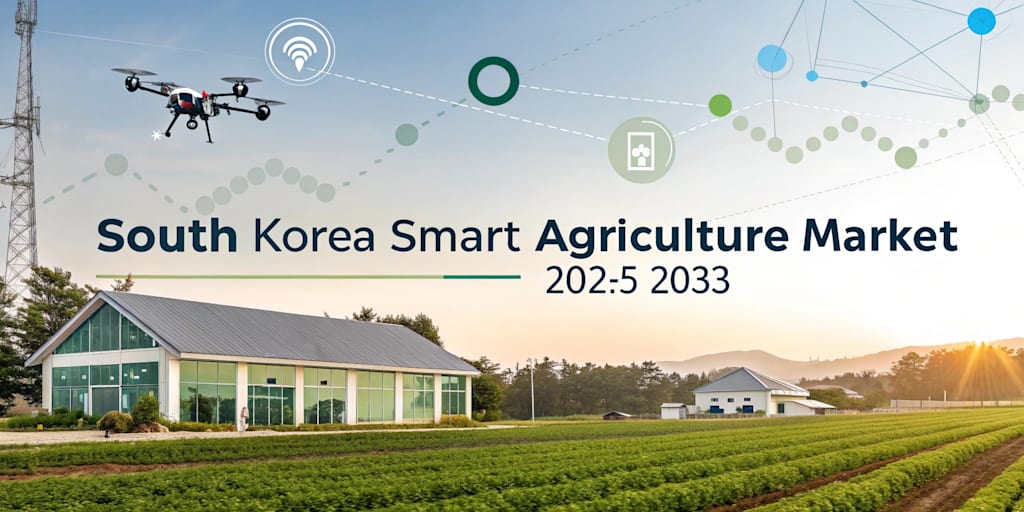
Rising labor shortages, aging rural populations, and the urgent need for food security are pushing South Korea toward a technology-first approach in farming. Advanced tools like IoT, AI, and automation are no longer experimental add-ons but core components of the country's agricultural strategy. According to IMARC Group's latest data, The South Korea smart agriculture market size reached USD 356.39 Million in 2024. Looking forward, the market is expected to reach USD 703.57 Million by 2033, exhibiting a growth rate (CAGR) of 7.85% during 2025-2033. The Seoul Capital Area currently dominates the regional landscape, serving as the primary hub for agri-tech companies, R&D institutions, and government coordination.
The south korea smart agriculture market is undergoing rapid transformation and scale-up, fueled by a convergence of digital infrastructure excellence, proactive government investment, and the pressing need to modernize a workforce where the majority of farmers are aged above 60. Precision farming, smart greenhouses, livestock monitoring, and AI-integrated field management systems are now defining how food is produced across the peninsula. Hardware solutions lead current spending, while software platforms and integrated services are scaling fast as farms seek end-to-end digital solutions. Market fundamentals remain highly favorable across small, medium, and large farm categories, with government subsidies actively bridging the accessibility gap for smallholders.
South Korea Smart Agriculture Market Growth Drivers:
Aging Rural Workforce and Critical Labor Shortages
A significant portion of South Korea's farming population is over the age of 65, and younger generations show minimal interest in traditional agricultural careers. This acute labor gap is directly accelerating investment in automated irrigation, sensor-driven crop monitoring, drone-based field assessment, and AI-powered machinery that reduces dependence on manual labor. The south korea smart agriculture market, currently valued at USD 356.39 Million, is witnessing steady expansion as farms increasingly turn to automation not as a preference but as an operational necessity. Government-supported relocation incentives and training programs for new, tech-savvy farmers are further reinforcing this structural shift across both rural and peri-urban production zones.
Robust Government Policy and Financial Backing
The South Korean government plays a decisive role in driving smart agriculture adoption through coordinated policy, infrastructure investment, and direct financial support. The Ministry of Agriculture, Food and Rural Affairs (MAFRA) and the Ministry of Science and ICT jointly oversee the integration of IoT, AI, and big data into farming operations nationwide. Flagship programs such as the Smart Farm Innovation Valley provide farmers with hands-on training, pilot technology access, and research facilities. Grants, low-interest loans, and equipment subsidies are actively lowering the cost barrier for smallholders and large commercial operations alike, creating a policy ecosystem where modernization is both encouraged and financially supported.
World-Class Digital Infrastructure Enabling Precision Agriculture
South Korea's leadership in 5G connectivity, broadband penetration, and ICT development provides the backbone that makes smart agriculture scalable and commercially viable. Real-time data collection through IoT soil sensors, satellite imaging, and precision monitoring systems is now operationally feasible across both field and controlled-environment settings. AI algorithms analyze weather patterns, detect crop diseases early, and optimize irrigation schedules with measurable accuracy. Major technology companies including SK Telecom, KT Corporation, and Samsung are entering the agri-tech space, accelerating both innovation and the commercial availability of solutions at accessible price points for the broader farming community.
South Korea Smart Agriculture Market Trends:
Rapid Expansion of Smart Greenhouse Systems
Controlled-environment agriculture is gaining significant momentum across South Korea, particularly for high-value vegetables, fruits, and specialty crops that demand precise climate management. Smart greenhouses equipped with automated climate controls, hydroponic systems, and AI-integrated growth monitoring are expanding in both urban and rural settings. The south korea smart agriculture market is experiencing strong growth momentum in this segment, with vertical farming also emerging as a complementary format in land-scarce metropolitan zones. These systems reduce water consumption, minimize pesticide dependency, and deliver consistent yields regardless of seasonal variability, making them a priority investment for both government-backed programs and private agri-tech operators.
Precision Farming Adoption Across Field Crop Operations
GPS-guided machinery, drone-based aerial imaging, and sensor-integrated soil management tools are becoming standard practice across Korean field crop operations. Precision farming allows producers to apply inputs such as water, fertilizer, and pesticide only where and when needed, directly reducing operational costs while improving yield quality. The sector continues to attract significant investment as data platforms mature and become more accessible to mid-sized farms. AI-powered advisory services offered by companies like KT Corporation are enabling even smaller operations to access analytical insights previously available only to large commercial producers, democratizing precision agriculture at a meaningful scale.
International Collaboration and Export of Agri-Tech Expertise
South Korea's smart agriculture model is increasingly attracting international interest, with the country actively partnering with food-insecure nations to deploy its technology frameworks beyond its own borders. This international dimension is opening new revenue streams for Korean agri-tech companies while validating domestic solutions on the global stage. Demand dynamics are signaling a robust growth trajectory for South Korean firms offering end-to-end smart farming systems, particularly in arid and climate-stressed regions where conventional agriculture faces existential pressure. These collaborations are also feeding innovation back into the domestic market as companies scale and refine their offerings for diverse agricultural environments.
Recent News and Developments in South Korea Smart Agriculture Market
April 2025: South Korea and Saudi Arabia partnered to establish a cutting-edge smart farming complex in central Riyadh, a significant bilateral initiative to advance sustainable agriculture and address food security challenges across the Middle East through Korean agri-tech expertise and technology deployment.
March 2025: MAFRA announced an expanded funding round for the Smart Farm Innovation Valley program, increasing budget allocations toward next-generation greenhouse automation and AI-driven farm management systems across the Honam and Yeongnam agricultural regions.
November 2024: KT Corporation launched an upgraded AI-powered digital farming advisory platform integrating satellite data, field sensor feeds, and predictive analytics, targeting mid-sized farms across the Hoseo Central Region with subscription-based precision agriculture services.
August 2024: South Korea's Rural Development Administration introduced a new national curriculum for young agri-tech entrepreneurs, combining hands-on smart greenhouse training with business development support to accelerate the entry of technology-oriented farmers into the sector.
Note: If you require specific details, data, or insights that are not currently included in the scope of this report, we are happy to accommodate your request. As part of our customization service, we will gather and provide the additional information you need, tailored to your specific requirements. Please let us know your exact needs, and we will ensure the report is updated accordingly to meet your expectations.
About the Creator
Enjoyed the story? Support the Creator.
Subscribe for free to receive all their stories in your feed.
Comments
There are no comments for this story
Be the first to respond and start the conversation.