
South Korea Automotive Battery Market Trends: EV Demand, Fast Charging & Forecast to 2034
How gigafactory investments, lithium-ion demand, and export strength are transforming competitive dynamics in the South Korea automotive battery market.
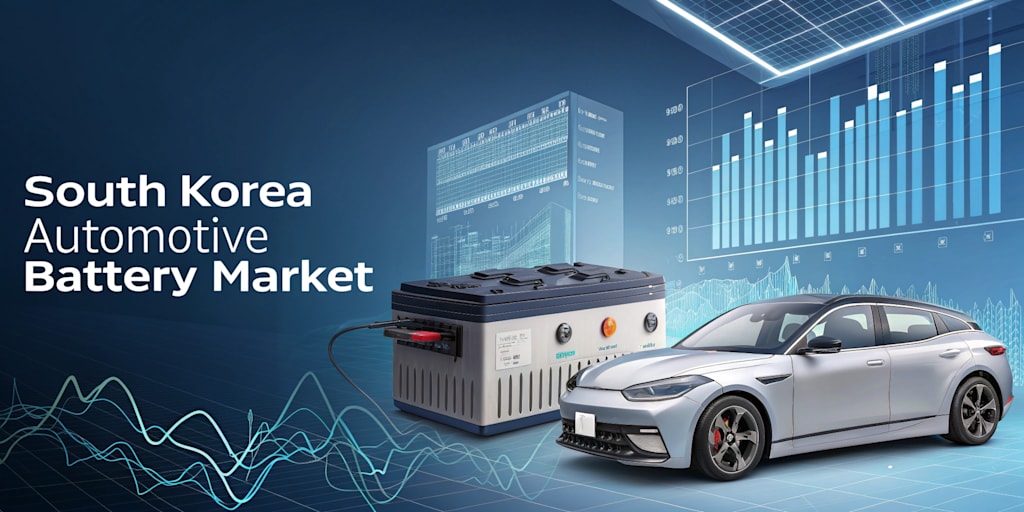
Rising EV adoption, strengthened safety regulations, and strategic industry collaborations between automakers and battery manufacturers are driving the South Korea automotive battery market, supported by government-backed certification systems, domestic LFP technology development, and expanding battery recycling infrastructure. According to IMARC Group's latest data, The South Korea automotive battery market size reached USD 1,053.34 Million in 2025. Looking forward, IMARC Group expects the market to reach USD 1,536.16 Million by 2034, exhibiting a growth rate (CAGR) of 4.28% during 2026-2034.The market is driven by government safety certification reforms, cross-industry collaboration to enhance competitive positioning against Chinese rivals, and the advancement of battery recycling infrastructure supporting the circular economy.
The South Korea automotive battery market has emerged as one of Asia's most strategically significant sectors, anchored by globally recognized manufacturers including LG Energy Solution, Samsung SDI, and SK On. Demand is driven by accelerating EV penetration across passenger and commercial vehicle segments, tightening government regulations that mandate advanced battery safety standards, and a national push to secure domestic supply chains for critical battery materials. Key segments include lithium-ion and lead acid batteries applied across passenger vehicles, commercial fleets, battery electric vehicles (BEV), and plug-in hybrid electric vehicles (PHEV), with manufacturers prioritizing safety compliance, lifecycle traceability, and functional performance across all platforms.
South Korea Automotive Battery Market Growth Drivers:
Strengthened Government Safety Regulations and Battery Certification
The South Korean government has introduced comprehensive regulatory reforms to enhance EV battery safety standards, driven by growing public concern following high-profile battery fire incidents. A new Battery Safety Certification System under the revised Automobile Management Act replaced the previous self-certification model with government-led certification administered by the Ministry of Land, Infrastructure, and Transport. Batteries must now pass rigorous performance tests including thermal shock, combustion, overcharging, over-discharging, overcurrent, vibration, impact, compression, drop, and water immersion evaluations before installation approval. The government also introduced a Battery Tracking System that assigns each battery a unique identification number registered in official vehicle records, enabling full lifecycle monitoring from production through disposal. EV purchase subsidies have additionally been restructured so that only vehicles transmitting real-time battery state-of-charge data to charging stations remain eligible, directly addressing overcharging risks.
Strategic Industry Collaboration for Competitive Positioning
Unprecedented strategic partnerships between domestic automakers and battery manufacturers are significantly shaping the South Korea automotive battery market. In August 2025, Hyundai Motor, Kia, LG Energy Solution, Samsung SDI, and SK On signed a memorandum of understanding at Hyundai Motor Group's Namyang R&D Center, marking the first formal collaboration between domestic automakers and battery producers on safety technology. The initiative originated from a Battery Safety Task Force established following major battery fire incidents and focuses on developing new safety patents, implementing digital battery passports aligned with EU regulations, enhancing design and manufacturing quality standards, and advancing firefighting technology for electric vehicle batteries. Industry leaders described the global EV battery market as a "national competition" where cooperation beyond traditional competitive boundaries is essential for survival.
Advancement of Battery Recycling and Circular Economy Infrastructure
South Korea is investing heavily in battery recycling infrastructure as a core pillar of its EV transition strategy. The development of circular economy frameworks for end-of-life batteries reduces raw material dependency, lowers production costs over time, and positions South Korean manufacturers favorably against competitors. Recycling capabilities also complement the government's Battery Tracking System by enabling accurate material recovery and disposal records. These combined investments support long-term sustainability targets while reinforcing the domestic supply chain against global commodity price volatility.
South Korea Automotive Battery Market Trends:
Domestic LFP Battery Technology Development
South Korea is actively reducing its reliance on Chinese-dominated lithium iron phosphate (LFP) battery cathode materials by investing in local manufacturing capabilities. Hyundai and Kia launched a four-year joint development project with Hyundai Steel and EcoPro BM to manufacture LFP cathode materials domestically, supported by South Korea's Ministry of Trade, Industry, and Energy under the LFP Battery Technology Development plan. This initiative targets cost-sensitive commercial vehicle and entry-level EV segments where LFP chemistry is increasingly preferred for its thermal stability and longer cycle life, diversifying the country's battery chemistry portfolio beyond high-nickel NCM variants.
Digital Battery Passports and EU Regulatory Alignment
South Korean manufacturers are proactively implementing digital battery passports to comply with emerging European Union battery regulations that mandate traceability and carbon footprint transparency for batteries entering the EU market. The August 2025 industry collaboration between Hyundai, Kia, LG Energy Solution, Samsung SDI, and SK On explicitly included digital passport implementation as a key focus area. This positions South Korea's battery export ecosystem ahead of regulatory compliance deadlines, maintaining market access to Europe while establishing a data infrastructure that strengthens domestic oversight and quality assurance.
Premiumization Through Safety-Driven Brand Differentiation
As Chinese battery manufacturers aggressively expand global market share through cost advantages, South Korean producers are repositioning on safety, quality, and technological transparency as their primary differentiators. The cross-industry collaboration on patent development, quality controls, and firefighting technology is designed to reinforce premium brand equity for South Korean batteries in international markets. Domestic EV buyers are also responding to safety-linked subsidy restructuring by favoring vehicles from brands that demonstrate real-time battery monitoring compliance, accelerating a market-wide shift toward higher safety performance baselines.
Recent News and Developments in the South Korea Automotive Battery Market
August 2025: Hyundai Motor, Kia, LG Energy Solution, Samsung SDI, and SK On signed a landmark memorandum of understanding at Hyundai Motor Group's Namyang R&D Center to jointly strengthen EV battery safety technologies, covering patent development, digital battery passports, design quality standards, manufacturing controls, and firefighting technology for electric vehicles.
August 2025: Hyundai and Kia launched a four-year joint development project with Hyundai Steel and EcoPro BM to develop domestic lithium iron phosphate (LFP) battery cathode material manufacturing technology, backed by South Korea's Ministry of Trade, Industry, and Energy under the national LFP Battery Technology Development plan.
March 2025: South Korea's Ministry of Land, Infrastructure, and Transport activated the new Battery Safety Certification System under the revised Automobile Management Act, replacing self-certification with mandatory government-administered safety testing across thermal, mechanical, and electrical performance parameters for all EV batteries.
January 2025: South Korea restructured its EV purchase subsidy program to require real-time battery state-of-charge data transmission to charging stations as an eligibility condition, effectively mandating advanced battery management system integration across all subsidy-eligible electric vehicles.
November 2024: LG Energy Solution announced expanded investment in domestic battery recycling facilities as part of South Korea's broader circular economy push, targeting recovery of critical minerals including lithium, nickel, and cobalt from end-of-life EV battery packs to reduce import dependency.
Note: If you require specific details, data, or insights that are not currently included in the scope of this report, we are happy to accommodate your request. As part of our customization service, we will gather and provide the additional information you need, tailored to your specific requirements. Please let us know your exact needs, and we will ensure the report is updated accordingly to meet your expectations.
About the Creator
Enjoyed the story? Support the Creator.
Subscribe for free to receive all their stories in your feed.
Comments
There are no comments for this story
Be the first to respond and start the conversation.