
South Korea Ammunition Market Insights: Smart Ammunition, Precision Systems & Forecast to 2034
How military modernization programs, guided munitions demand, and enhanced accuracy systems are transforming competitive dynamics in the South Korea ammunition market.
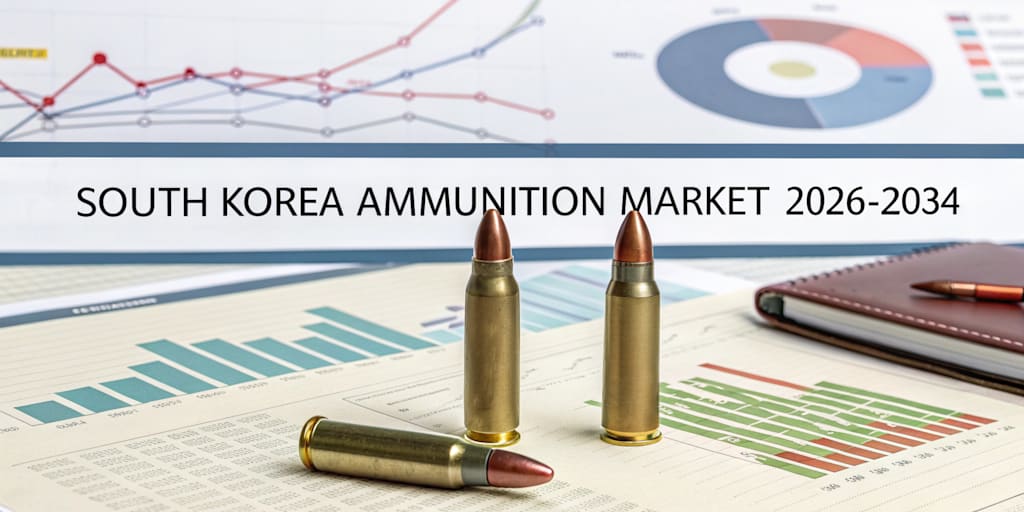
Rising geopolitical tensions, indigenous defense manufacturing initiatives, and growing demand for precision-guided systems are driving the south korea ammunition market, supported by government-led modernization programs, naval upgrades, and expanding export partnerships. According to IMARC Group's latest data, the South Korea ammunition market size reached USD 500.4 Million in 2025. The market is projected to reach USD 605.0 Million by 2034. The defense segment currently dominates the market, with military and homeland security applications accounting for the largest share.
South Korea's ammunition sector represents a strategically critical and rapidly evolving defense industry segment. Demand is driven by escalating regional security concerns, state-backed investment in indigenous weapons development, and a national policy push to reduce dependence on foreign munitions suppliers. Precision-guided systems, naval countermeasure ammunition, and large-caliber artillery shells are at the forefront of market expansion. Major segments include bullets, aerial bombs, grenades, mortars, and artillery shells, with defense stakeholders prioritizing guided munitions, smart kill systems, and export-ready platforms capable of meeting both domestic and allied nation requirements.
Request a Business Sample Report for Procurement & Investment Evaluation
South Korea Ammunition Market Growth Drivers:
Rising Geopolitical Tensions and Defense Budget Expansion
Persistent security threats from North Korea and an increasingly contested regional environment are compelling South Korea to raise defense spending and accelerate procurement of advanced munitions. The government has committed to multi-year force improvement plans that prioritize indigenous precision weapons over imported alternatives. South Korea maintains one of the highest defense budget-to-GDP ratios in the Asia-Pacific region, with the Korea Defense Acquisition Program Administration (DAPA) coordinating long-term procurement schedules. These allocations directly benefit domestic ammunition manufacturers by providing production volume certainty and encouraging capacity investment across caliber categories.
Shift Toward Indigenous Precision-Guided Systems
South Korea is systematically reducing its reliance on foreign-sourced munitions through a domestic-first procurement policy. The government's Defense Reform initiative channels substantial funding into indigenous research and development for guided munitions, cruise missiles, and smart warhead technologies. In June 2025, South Korea successfully completed the first flight test of its air-launched cruise missile (KALCM) using the FA-50 aircraft, a landmark moment confirming the country's ability to deploy long-range precision strike systems without foreign dependency. Planned integration of KALCM with the KF-21 Boramae fighter is expected to further deepen demand for domestically produced guided ammunition platforms.
Naval Modernization and Electronic Warfare Ammunition Demand
South Korea's maritime defense priorities are generating strong demand for specialized naval ammunition systems, particularly those combining kinetic decoy rounds with electronic countermeasure capabilities. In May 2025, the country completed a significant upgrade of its Multi Ammunition Soft Kill System (MASS), enhancing decoy performance accuracy and software integration to counter advanced anti-ship missile threats. This development reflects a broader industry trend where conventional ammunition and electronic warfare technologies are converging into integrated defense platforms. Local manufacturers are expanding naval munitions portfolios in response, supported by state R&D partnerships and long-term DAPA procurement agreements.
South Korea Ammunition Market Trends:
Export-Oriented Joint Ventures and Technology Transfer Agreements
South Korea's leading defense manufacturers are building an international footprint through strategic partnerships that transfer production technology to allied nations. In April 2025, Hanwha Aerospace signed a joint venture agreement with Poland's WB Group to co-produce CGR-080 guided missiles for Chunmoo multiple rocket launcher systems, embedding South Korean missile production expertise directly within a NATO member state's supply chain. This model of technology transfer-based export is becoming a repeatable commercial strategy, positioning South Korean ammunition manufacturers as both suppliers and embedded technology partners for European and Asia-Pacific defense programs seeking rapid rearmament.
Convergence of Guided and Non-Guided Munitions Platforms
Military modernization requirements are accelerating the shift from conventional non-guided ammunition toward precision-guided variants across all caliber categories. South Korea's armed forces are prioritizing guided systems that reduce operational risk, minimize collateral engagement, and improve mission success rates across land, naval, and aerial applications. Defense manufacturers are investing in scalable production lines for guided munitions, along with expanded testing infrastructure and a specialized engineering workforce focused on guidance system integration. This transition is reshaping demand patterns across the south korea ammunition market, with large-caliber guided variants attracting the greatest share of new procurement budgets.
Regional Defense Manufacturing Cluster Development
South Korea's Yeongnam southeastern region is consolidating its position as the industrial backbone of the country's defense manufacturing ecosystem, hosting a dense concentration of ammunition production facilities, component suppliers, and defense-sector research institutions. Government industrial policy actively supports cluster development through infrastructure investment, co-location incentives for suppliers, and funding for testing ranges and quality assurance laboratories. This regional concentration is improving supply chain efficiency, reducing production lead times, and enabling manufacturers to respond more rapidly to both domestic procurement cycles and international export tender requirements.
Recent News and Developments in South Korea Ammunition Market
June 2025: South Korea successfully conducted the first flight test of its air-launched cruise missile (KALCM) using the FA-50 aircraft. This milestone strengthened domestic ammunition capabilities, enhanced long-range strike precision, and supported the country's strategic objective of boosting defense exports through indigenous guided munitions development.
May 2025: South Korea completed a major upgrade of its Multi Ammunition Soft Kill System (MASS) to counter advanced anti-ship missile threats. The enhancement improved decoy performance and software integration, reinforcing naval defense capabilities and positively influencing the country's ammunition and electronic warfare market trajectory.
April 2025: Hanwha Aerospace and Poland's WB Group signed a joint venture agreement to co-produce CGR-080 guided missiles for Chunmoo systems. This collaboration focused on technology transfer, expanded South Korea's export presence in Europe, and strengthened the country's global positioning within the precision ammunition supply chain.
Note: If you require specific details, data, or insights that are not currently included in the scope of this report, we are happy to accommodate your request. As part of our customization service, we will gather and provide the additional information you need, tailored to your specific requirements. Please let us know your exact needs, and we will ensure the report is updated accordingly to meet your expectations.
About the Creator
Enjoyed the story? Support the Creator.
Subscribe for free to receive all their stories in your feed.
Comments
There are no comments for this story
Be the first to respond and start the conversation.