
Sour Cream Powder Market Poised for Steady Expansion as Convenience Foods and Shelf-Stable Dairy Gain Ground
From snack seasonings to foodservice mixes, sour cream powder is moving from a niche dairy ingredient to a practical formulation choice for modern food brands.

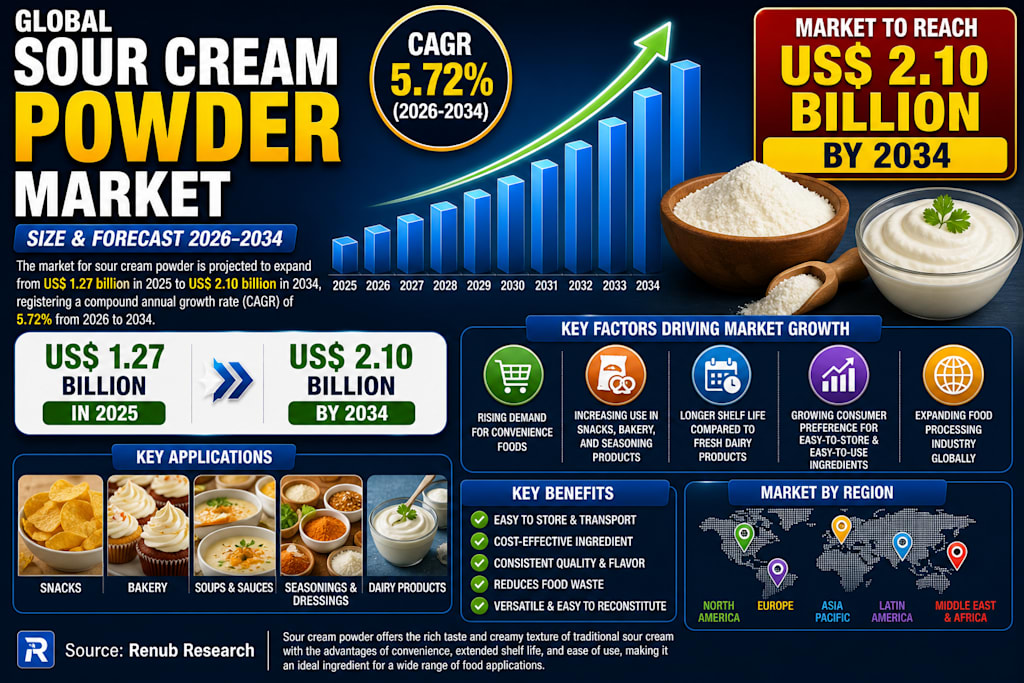
The global sour cream powder market is set for steady expansion, rising from US$ 1.27 billion in 2025 to US$ 2.10 billion by 2034, according to Renub Research. That growth represents a 5.72% CAGR from 2026 to 2034, supported by rising demand for convenience foods, broader use in snacks, bakery items, and seasoning blends, and the practical advantage of a longer shelf life than fresh dairy products.
What makes sour cream powder especially interesting is that it sits at the intersection of two food trends that keep getting stronger: convenience and flavor. Food manufacturers want ingredients that are easy to store, easy to transport, and easy to blend into dry mixes, while consumers continue to want bold, creamy, tangy tastes in snacks and ready-made foods. Sour cream powder fits that brief neatly, which is why it is becoming more visible in product development across the food industry.
At its core, sour cream powder is simply sour cream with the moisture removed, but the commercial value is much bigger than that description suggests. The ingredient delivers the familiar sour cream profile without refrigeration dependence, which makes it useful in snacks, sauces, dips, dressings, baked goods, seasonings, and ready-to-eat meals. In a food market that prizes shelf stability and formulation flexibility, that is a strong advantage.

Why the market is moving upward
One of the biggest growth engines is the global shift toward convenience and processed foods. Busy households, urban lifestyles, and rising demand for ready-to-eat meals have made shelf-stable ingredients more valuable than ever. Sour cream powder helps manufacturers create consistent flavor in instant foods, soups, seasoning mixes, and snack coatings without the complications of refrigerated dairy. That makes production simpler and distribution more efficient.
A second driver is the strong performance of the snack and seasoning industry. Sour cream-and-onion style profiles remain popular, but the application range is broader than that. The ingredient can be folded into savory seasonings, dip mixes, and dry blends for chips, popcorn, crackers, and extruded snacks. As snack makers keep experimenting with bolder, more layered flavors, sour cream powder offers a creamy tang that is easy to formulate into shelf-stable products.
The third major advantage is shelf life and supply-chain efficiency. Compared with fresh sour cream, the powder is easier to store, easier to move, and less likely to spoil. That matters in markets where cold-chain infrastructure is costly or limited, and it also matters for global food brands trying to manage inventory more efficiently. In other words, sour cream powder is not only a flavor ingredient; it is also a logistics-friendly ingredient.
Market challenges are real, but manageable
The market is not without pressure points. The first challenge is the volatility of dairy raw material prices, especially milk and cream. Feed costs, weather, supply-demand imbalance, and trade policy can all influence production costs, which makes pricing more difficult for manufacturers and can squeeze margins.
The second challenge is the consumer preference for fresh, clean-label, and minimally processed foods. Some shoppers still see powdered dairy ingredients as less natural than fresh alternatives. That does not remove demand for sour cream powder, but it does mean manufacturers have to work harder on ingredient transparency, formulation simplicity, and product positioning.
Even with those headwinds, the category has a clear value proposition. Food companies can use sour cream powder to create consistent taste, reduce waste, simplify handling, and build products that perform well across retail, foodservice, and industrial channels. That combination helps explain why the market is expected to keep growing through 2034.
Where the demand is coming from
Renub Research’s market view shows the category is supported by both low-fat and regular product types, with major end-use demand from foodservice, the food industry, and household/retail channels. Distribution is also broad, spanning hypermarkets, supermarkets, convenience stores, online channels, and other outlets. That spread matters because it shows sour cream powder is not dependent on one narrow buyer segment; it is useful wherever convenience and flavor need to meet.
The food industry remains the strongest demand center because manufacturers are constantly looking for ingredients that can be blended into dry applications without compromising texture or taste. Foodservice follows closely because restaurants and institutional kitchens value predictable flavor, reduced spoilage, and easy storage. Meanwhile, household and retail demand is benefiting from the rise of home cooking, snack-making, and interest in international-style flavors.
Online channels are also becoming more important. E-commerce makes bulk sourcing easier for food processors, while smaller retail buyers can access specialty ingredients that may not be available locally. In a market defined by convenience, online distribution is a natural fit.
Regional outlook remains broad
The United States remains a key market because it has a mature processed-food and snack ecosystem, and sour cream has already become a familiar flavor profile in dips, sauces, bakery products, and savory seasonings. The UK is also expanding steadily, driven by demand for convenience foods and international flavors. India is emerging as a growth market as processed foods, urban consumption, and cold-chain limitations all support shelf-stable dairy ingredients. Saudi Arabia is another promising market because sour cream powder works well in warm climates where refrigeration logistics can be more challenging.
That regional spread is important because it suggests the market is not just a North American story. Sour cream powder has use cases that travel well across geographies, especially where food manufacturers want practical dairy flavor without refrigeration burdens.
10 recent company developments shaping the category
Daisy Brand partnered with reality TV personality Daisy Kent in August 2024, using a high-visibility brand tie-up to reinforce its position in sour cream and cottage cheese. For a sour-cream-led category, that kind of brand visibility helps keep the product top of mind with consumers.
Tillamook launched new limited-edition ice cream flavors in April 2025, showing continued appetite for premium dairy innovation. While not sour cream powder specifically, it signals that dairy brands are still leaning into flavor-forward product development.
Tillamook brought four new bold, smoky, and spicy flavors to market in May 2025, reinforcing the idea that consumer demand for stronger seasoning and indulgent dairy profiles remains healthy. That trend supports adjacent ingredients such as sour cream powder in savory formulations.
Tillamook’s new ice cream plant in Decatur, Illinois, entered production in June 2025, marking its first manufacturing site outside Oregon. Capacity expansion like this matters because stronger dairy manufacturing infrastructure often supports ingredient innovation across the wider category.
Organic Valley launched new American cheese blocks in March 2025, highlighting the cooperative’s continued push into recognizable, ingredient-friendly dairy products. The move reflects a broader consumer preference for simple, familiar dairy formats.
Organic Valley introduced oat creamers in January 2025 and later expanded into oat beverages in September 2025, showing how dairy brands are widening their portfolios to meet evolving preferences. That broader competition keeps traditional dairy ingredients under pressure to prove their convenience and functionality.
Danone U.S. launched OIKOS FUSION in August 2025, a cultured dairy drink positioned around protein and functional nutrition. It is another sign that dairy companies are moving toward higher-value, health-oriented innovation.
Forager Project launched a dairy-free Greek-style yogurt in May 2025, adding more competition in the creamy, tangy taste space where sour dairy ingredients have long dominated. Plant-based innovation continues to reshape how consumers think about creamy applications.
Forager Project announced the Cashew Project in August 2025, a sustainability-focused initiative supporting cashew farmers in Côte d’Ivoire. That kind of sourcing story matters because supply-chain responsibility is becoming a bigger part of food-brand positioning.
Horizon Organic launched Real Dairy Creamers in January 2026, bringing another premium dairy option into a category that rewards clean-ingredient messaging and flavor innovation. It shows that dairy brands are still investing in convenient, premium formats that consumers can use every day.
Taken together, these developments show a dairy sector that is still moving fast. The biggest message is not that every launch is about sour cream powder directly, but that the broader market is rewarding products that are convenient, flavorful, shelf-friendly, and easy to use in modern food formats.
Final thoughts
The sour cream powder market may not be the loudest segment in dairy, but it is one of the more practical ones. Its value comes from utility: long shelf life, easy handling, broad formulation use, and strong fit with today’s convenience-driven food economy. As snack makers, foodservice operators, and packaged-food brands keep chasing stable flavor solutions, sour cream powder is well positioned to benefit. Renub Research’s projection of growth from US$ 1.27 billion in 2025 to US$ 2.10 billion by 2034 captures that direction clearly.
The bigger story is that the market sits at the intersection of taste and efficiency. That is a powerful place to be in modern food manufacturing, and it is why sour cream powder is likely to remain relevant well beyond the next forecast cycle.
About the Creator
Enjoyed the story? Support the Creator.
Subscribe for free to receive all their stories in your feed.
Comments
There are no comments for this story
Be the first to respond and start the conversation.