
Soup Market Outlook: Rising Demand for Convenient Ready-to-Eat Foods and Growth Opportunities
The Soup Market is experiencing steady growth driven by increasing consumer demand for convenient, ready-to-eat (RTE) food products and changing lifestyles.

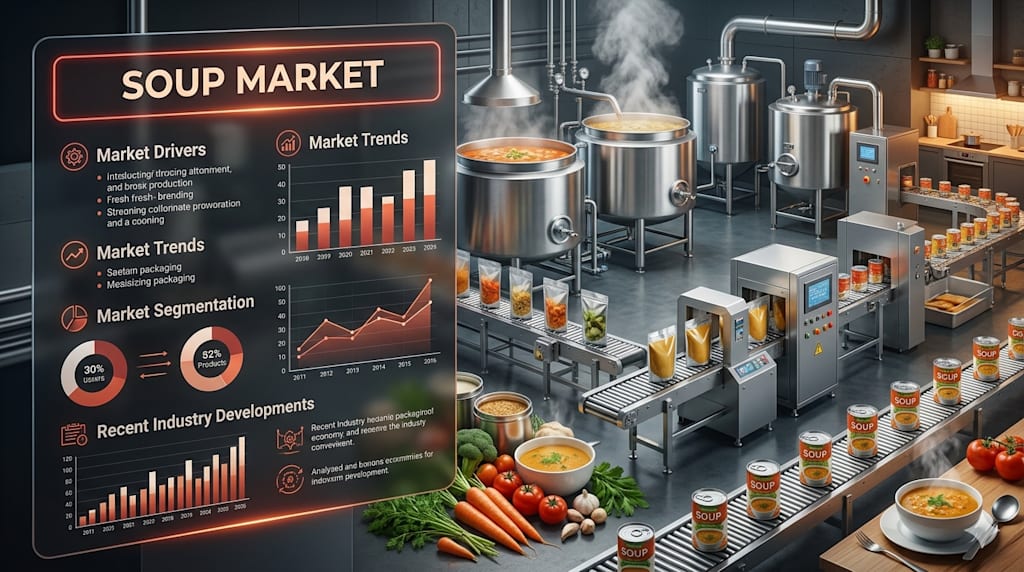
According to IMARC Group's latest research publication, The global soup market size was valued at USD 12.6 Billion in 2025. Looking forward, IMARC Group estimates the market to reach USD 17.2 Billion by 2034, exhibiting a CAGR of 3.38% during 2026-2034
How AI is Reshaping the Future of Soup Market
- Demand prediction and consumer perception: Artificial Intelligence is a growing trend in the soup industry‚ used for understanding consumer preference and demand․ It utilizes large-scale retail data‚ social media channels‚ and consumer behavior data to analyze demand intelligence for organic‚ low-sodium‚ plant-based‚ and ready-to-eat soups․ Manufacturers use predictive analytics to schedule production‚ minimize waste and excess inventory‚ optimize the supply chain‚ and ensure that they are producing the right products at the right times‚ thus lowering expenses and maximizing profitability in the worldwide soup market․
- AI in Manufacturing and Quality Control : Machine learning is used in the soup industry to improve production efficiency‚ consistency‚ and food safety․ In soup manufacturing‚ algorithms monitor the production lines‚ the mixing of the ingredients‚ the temperature‚ and the packaging process to ensure that the same flavor and quality are maintained․ Computer vision can detect packaging defects‚ contamination‚ and incorrect labeling faster than human inspection‚ and reduce the need for human intervention․ The speed and relative cost savings of automation along the production line allow soup manufacturers to meet their quality assurance standards and to produce increasing amounts of packaged and ready-to-eat food to meet world demand․
- AI is also being applied to the soup industry‚ through research for product development and customization․ Food companies use AI technologies to analyze the flavor‚ nutrients‚ and consumers' preferences to develop new soup recipes․ AI may also be used to analyze data and create low sodium and nutritionally fortified soups․ Companies are also exploring the use of AI to automatically recommend soup products based on consumer dietary preferences such as high-protein or vegan․ It is helping soup manufacturers stand out from their competitors‚ and to win over health-conscious and convenience-seeking consumers․

Soup Market Industry Overview:
The global soup market is a major sector under the packaged food market‚ driven mainly by consumer demand for convenience‚ easy-to-cook and ready-to-eat food products‚ which has gained traction in recent years․ Urbanization‚ busy lifestyles‚ and a greater population of working people have led to a growing consumption of instant soup‚ canned soup‚ dehydrated soup and frozen soup․ As more people have become health-conscious‚ other types of soups have become more popular‚ such as organic‚ low-sodium‚ gluten-free‚ and plant-based soups․
Soup Market Trends & Drivers
Demand for convenience food and ready to eat food products is one of the key drivers for the growth of the global soup market․ Changing lifestyles in urban areas and the rise in the number of people in jobs have driven the demand for convenient food products․ Globally‚ instant soups‚ canned ready to eat soups‚ and dehydrated soup mixes are widely consumed by students‚ working people‚ and geriatric consumers․ The growth in the number of supermarkets‚ convenience stores‚ and online grocery stores in the world is supporting the growth of the soup products market․
Health-conscious customers looking for low-calorie‚ low-sodium‚ organic‚ and preservative-free soups have contributed to the growth of the soup market․ In response to changing consumer preferences‚ soup producers are developing soups with natural ingredients‚ vegetables‚ plant-based protein and functional ingredients‚ such as probiotics and vitamins that improve gut health and help increase immunity․ Furthermore‚ the rising trend of vegan and vegetarian diets is increasing the demand for plant-based soups․ Further‚ growing demand for clean-label products‚ i․e․‚ directly communicating about the food products‚ is increasing the demand for healthy packaged food․
Innovation and the introduction of premium product categories in soups is another driver for the market․ New flavors‚ international cuisine soups‚ gourmet soups‚ and high-protein/functional soups are being introduced in a bid to attract new consumers․ High-end soups typically prepared from organic sources‚ exotic spices‚ and specialty preparation are growing increasingly popular in most major markets‚ particularly the developed world․ Several new packaging technologies‚ including microwaveable or heat and serve containers‚ environmental packaging‚ and single-serving sizes‚ are making soups more convenient for consumers and are helping companies differentiate their products․
Leading Companies Operating in the Global Soup Market:
- B&G Foods Inc.
- Baxters Food Group Limited
- Blount Fine Foods
- Campbell Soup Company
- Conagra Brands Inc.
- General Mills Inc.
- Nestlé S.A.
- Ottogi Corporation
- Premier Foods Group Limited
- The Hain Celestial Group Inc.
- The Kraft Heinz Company
- Unilever plc
Soup Market Report Segmentation:
By Type:
- Canned/Preserved Soup
- Chilled Soup
- Dehydrated Soup
- Frozen Soup
- UHT Soup
Canned/preserved soup stands as the largest component, holding around 44.9% of the market, due to extended shelf life, convenience, minimal preparation requirements, and widespread accessibility without refrigeration needs.
By Category:
- Vegetarian Soup
- Non-Vegetarian Soup
Non-vegetarian soup leads the market with around 55.0% of market share, offering rich savory flavors, high protein content, and appealing to meat-loving consumers seeking satisfying, nourishing meal options.
By Packaging:
- Canned
- Pouched
- Others
Canned leads the market due to durable, airtight containers that protect contents from contamination, provide extended shelf life without refrigeration, and enable safe transportation and widespread distribution.
By Distribution Channel:
- Supermarkets and Hypermarkets
- Convenience Stores
- Online Stores
- Others
Supermarkets and hypermarkets lead the market with around 52.0% market share, providing extensive shelf space, diverse brand selections, massive product visibility, and convenient one-stop shopping experiences for consumers.
Regional Insights:
- North America (United States, Canada)
- Asia Pacific (China, Japan, India, South Korea, Australia, Indonesia, Others)
- Europe (Germany, France, United Kingdom, Italy, Spain, Russia, Others)
- Latin America (Brazil, Mexico, Others)
- Middle East and Africa
North America exhibits a clear dominance in the soup market, accounting for over 28.7% market share, driven by deeply entrenched soup consumption culture, seasonal demand patterns, premiumization trends, and innovative product launches.
Recent News and Developments in Soup Market
- 2026 - Product Launches and Industry Restructuring: Major food corporations continued introducing new soups‚ reducing their market share in the industry‚ and reducing their food operations․ PepsiCo added to its snack and food portfolio with new ready-to-heat vegetable soup under its Alvalle brand to keep up with growing consumer demand for healthful and convenient meals․ The soups were first launched into Spain‚ from where they were to be rolled out across Europe․
- 2025 - Demand for Inexpensive and Homemade Food: Soup companies benefited from a trend towards home cooking and inexpensive foods in 2025‚ with Campbell Soup reporting an increase in canned soup demand as people cooked more at home amid economic uncertainty and rising food prices․ However‚ demand for some soup products was negatively affected by increased manufacturing costs and higher prices․
- 2025 - Product Innovation and Flavor Innovation: A major trend in 2025 was product innovation and brand collaborations to attract younger consumers․ An example of this trend is Campbell's Soup partnering with Pabst Blue Ribbon to create beer-flavored soups (beer cheese soup‚ beef chili with beer flavor)․
Note: If you require specific details, data, or insights that are not currently included in the scope of this report, we are happy to accommodate your request. As part of our customization service, we will gather and provide the additional information you need, tailored to your specific requirements. Please let us know your exact needs, and we will ensure the report is updated accordingly to meet your expectations.
About the Creator
James Whitman
With years of experience in analyzing global industries, I specialize in delivering actionable market insights that help businesses stay ahead in an ever-changing landscape.
Enjoyed the story? Support the Creator.
Subscribe for free to receive all their stories in your feed.
Comments
There are no comments for this story
Be the first to respond and start the conversation.