
Solar Farm Market Trends: Agrivoltaics Adoption, Sustainable Land Use & Industry Forecast to 2034
How agrivoltaics adoption, sustainable land use practices, and dual-purpose farming models are redefining land utilization and environmental impact in solar farm development

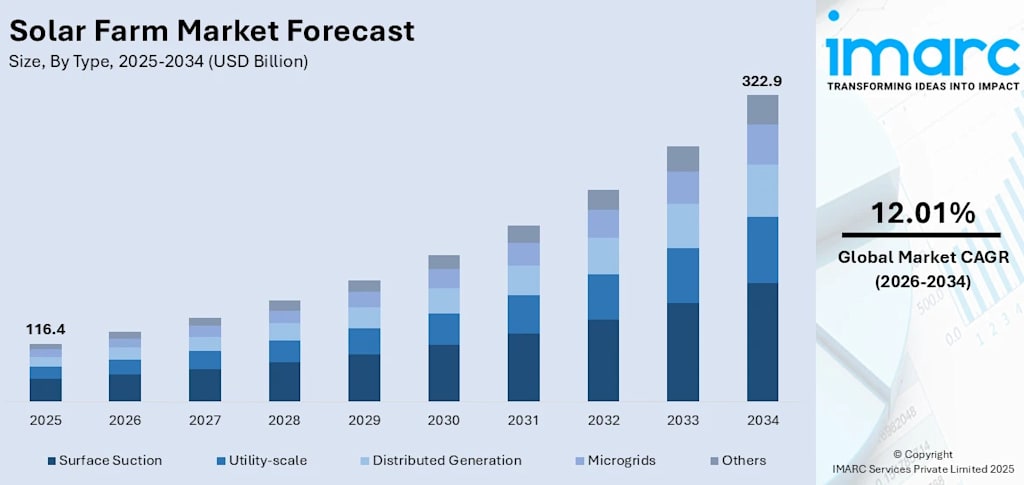
The transition toward renewable energy is no longer a distant goal but a present-day industrial shift, with solar farms at the forefront of this global movement. Rapidly decreasing costs of photovoltaic (PV) hardware and an urgent need to decarbonize electrical grids are propelling the expansion of large-scale solar installations. According to IMARC Group’s latest data, The global solar farm market size was valued at USD 116.4 Billion in 2025. Looking forward, IMARC Group estimates the market to reach USD 322.9 Billion by 2034, exhibiting a CAGR of 12.01% from 2026-2034.
Solar farms now represent a massive infrastructure segment, with utility-scale projects alone accounting for nearly 45% of global capacity. Growth is fueled by massive capital investments in "mega-farms" that can generate hundreds of megawatts, providing a reliable alternative to coal and gas. Key sectors contributing to this expansion include the industrial and commercial segments, where businesses are securing long-term Power Purchase Agreements (PPAs) to stabilize energy costs. Technological breakthroughs in bifacial panels and automated tracking systems are further enhancing the efficiency of these assets, ensuring they remain the most cost-competitive source of new electricity generation worldwide.
Solar Farm Market Growth Drivers:
- Global Push for Decarbonization and Energy Security
Governments are aggressively pivoting toward renewables to meet climate targets and reduce reliance on volatile fossil fuel markets. With renewable sources currently accounting for roughly 29% of global electricity, solar farms are seen as the most scalable solution to bridge the gap. In the United States, solar accounted for 54% of all new electricity-generating capacity added to the grid in 2025. This massive scale-up is supported by international agreements to limit temperature rises, forcing a rapid phase-out of conventional power plants in favor of high-output solar utility projects.
- Decreasing Levelized Cost of Energy (LCOE)
The financial viability of solar farms has reached a tipping point where solar is often cheaper than existing coal or gas generation. Significant drops in the price of polysilicon and silver, alongside improved manufacturing processes, have slashed the initial capital required for installations. Large-scale utility projects benefit from economies of scale, allowing developers to produce power at a fraction of the cost of residential systems. This cost-efficiency attracts institutional investors and pension funds looking for stable, long-term infrastructure assets with predictable returns in an increasingly electrified global economy.
- Favorable Government Incentives and Subsidy Schemes
Legislative support remains a powerhouse for market expansion, with programs like the PM Surya Ghar Muft Bijli Yojana in India recently distributing over USD 54 billion in subsidies to accelerate solar adoption. In the U.S., the Inflation Reduction Act and the subsequent One Big Beautiful Bill Act (OBBBA) have created tax credit frameworks that de-risk multi-billion dollar projects. These policies, combined with Feed-in Tariffs (FiTs) in Europe and Southeast Asia, provide the financial floor necessary for developers to break ground on massive grid-connected solar arrays.
Solar Farm Market Trends:
- Advancements in Agrivoltaics and Floating Solar Technology
Land scarcity is driving the adoption of innovative installation methods, such as floating solar farms (floatovoltaics) and agrivoltaics. Floating projects, like the 120 MWp plant recently completed at Omkareshwar in India, utilize water bodies to conserve land and improve panel cooling. Similarly, agrivoltaics allow for dual land use by elevating panels above crops, providing shade while generating power. This trend is particularly dominant in regions like Europe and Asia-Pacific, where balancing food security and energy production is a critical policy priority for regional governments.
- Integration of Battery Energy Storage Systems (BESS)
To combat the intermittency of solar power, developers are increasingly pairing solar farms with large-scale battery storage. This "solar-plus-storage" model allows farms to dispatch energy during peak demand hours or at night, making solar a "baseload" equivalent. A prime example is the Cleve Hill Solar Park in the UK, which combines 373 MW of solar capacity with a 150 MW battery system. This trend is transforming solar farms from simple energy generators into sophisticated grid-stabilization assets that can participate in frequency regulation and ancillary services.
- AI-Driven Predictive Maintenance and Robotics
The industry is shifting toward "smart" solar farms that utilize artificial intelligence and robotics for operational excellence. Autonomous inspection robots and drones are now used to detect micro-cracks or "hot spots" in panels that are invisible to the human eye, preventing significant energy loss. Furthermore, AI algorithms analyze weather patterns to optimize the tilt of tracking systems, maximizing sunlight capture throughout the day. These technologies reduce labor costs and extend the lifespan of the assets, which is essential for maintaining the 20-to-25-year service life expected of modern solar infrastructure.
Recent News and Developments in Solar Farm Market:
- July 2025: The United Kingdom officially launched the Cleve Hill Solar Park, the nation’s largest solar installation to date, featuring 373 MW of solar capacity integrated with substantial battery storage to support grid resilience.
- August 2025: Tata Power initiated its "Ghar Ghar Solar" campaign in India, focusing on expanding the network of smaller distributed solar farms to bring affordable renewable energy to a wider demographic through specialized financing.
- September 2025: Trina Solar partnered with Lodestone Energy to complete a major agrivoltaics project in New Zealand, demonstrating the commercial viability of combining utility-scale solar generation with active agricultural land use.
Note: If you require specific details, data, or insights that are not currently included in the scope of this report, we are happy to accommodate your request. As part of our customization service, we will gather and provide the additional information you need, tailored to your specific requirements. Please let us know your exact needs, and we will ensure the report is updated accordingly to meet your expectations.
About the Creator
Andrew Sullivan
Hello, I’m Andrew Sullivan. I have over 9+ years of experience as a market research specialist.
Enjoyed the story? Support the Creator.
Subscribe for free to receive all their stories in your feed.
Comments
There are no comments for this story
Be the first to respond and start the conversation.