
Software Market Witnesses Strong Growth Through AI-Led Innovation
How AI integration, cloud computing adoption, and enterprise digital transformation are accelerating innovation and driving long-term growth in the software market.

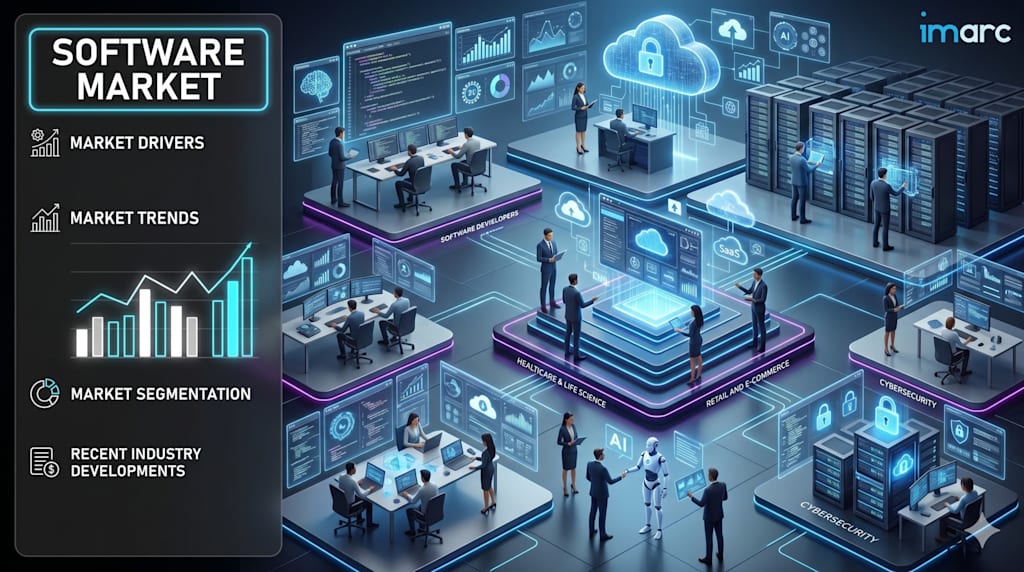
According to IMARC Group's latest research publication, The global software market size reached USD 715.1 Billion in 2025. Looking forward, IMARC Group expects the market to reach USD 1,193.8 Billion by 2034, exhibiting a growth rate (CAGR) of 5.68% during 2026-2034.
How Technology is Reshaping the Future of the Software Market
- AI-Powered Automation and Agentic Capabilities: Artificial intelligence is fundamentally transforming how software is built, deployed, and consumed. Gartner predicts that 40% of enterprise applications will be integrated with task-specific AI agents by the end of 2026, up from less than 5% in 2025. Major vendors are already monetizing agentic offerings, with Microsoft expanding Copilot capabilities across Microsoft 365 and Azure to deliver deeper workflow orchestration and real-time analytics for enterprise users. CrowdStrike's Charlotte AI platform further demonstrates this shift, deploying autonomous agents that triage thousands of security alerts and handle routine responses that previously required around-the-clock human analyst teams.
- Cloud-Native and SaaS Transformation: The Software-as-a-Service model has redefined software accessibility, eliminating upfront infrastructure investments and enabling subscription-based access at scale. Salesforce generated USD 41.5 billion in FY2026 revenue and holds approximately 20.7% of the global CRM market, reflecting the depth of enterprise adoption for cloud-native platforms. The SaaS model's cost-effectiveness and rapid deployment advantages have lowered barriers to entry for businesses of all sizes, particularly small and medium enterprises that previously lacked the capital for traditional enterprise software licensing.
- Generative AI Integration into Creative and Productivity Workflows: Leading software companies are embedding generative AI directly into existing product suites to compress development and creative timelines. Adobe integrated its Firefly generative AI engine into Experience Cloud, with early enterprise adopters reporting 20 to 30% reductions in creative production costs. Salesforce exposed Einstein GPT across Marketing Cloud and recorded 15 to 25% improvements in open rates during pilot deployments with retail and financial services clients. These integrations are converting AI from a standalone tool into a built-in capability across mainstream software platforms.
- Cybersecurity Software and AI-Driven Threat Response: Rising sophistication of cyberattacks is accelerating demand for intelligent security software. AI-enabled attacks increased by 89% in 2025, forcing enterprises to invest heavily in automated threat detection and response platforms. CrowdStrike now protects nearly 60% of Fortune 500 companies through its AI-driven security platform, and its three acquisitions in 2025 and 2026, totaling USD 1.4 billion, reflect aggressive investment to expand coverage across AI applications, user identity management, and browser security. Security software has emerged as one of the fastest-growing verticals within the broader market.
- Low-Code and Custom Software Development Acceleration: The shortage of trained software developers globally is driving explosive growth in low-code platforms, which are expanding at the fastest rate within the broader market. There are currently 20.8 million software developers worldwide, with China leading at 4.04 million, India at 3.85 million, and the United States at 3.18 million. As demand for custom applications outpaces developer supply, 72% of organizations now outsource some or all of their software development work, per Deloitte data, while low-code tools are enabling non-technical teams to build and deploy applications independently. This democratization of software development is accelerating digital transformation across industries that historically lacked technical resources.
Software Industry Overview
The global software industry stands at a pivotal juncture driven by the convergence of artificial intelligence, cloud computing, and an accelerating need for digital transformation across every sector of the economy. Global IT spending on software is projected to exceed USD 6 trillion in 2026, representing a 9.8% increase over the prior year and marking the largest single-year spending increase across all IT segments tracked by Gartner. This momentum is underpinned by enterprises in industries ranging from BFSI and healthcare to retail and government modernizing legacy infrastructure, automating operations, and adopting data-driven decision-making frameworks.
North America remains the dominant regional market, contributing more than 44% of global software revenue in 2025. The United States alone is projected to generate over USD 379 billion in software revenue, the highest of any single country globally, supported by its concentration of major technology hubs in Silicon Valley, Seattle, and Boston, along with a deep venture capital ecosystem and early enterprise adoption of emerging platforms. Companies such as CoreWeave exemplify the pace of growth, reporting USD 5.1 billion in 2025 revenue, the fastest any cloud infrastructure company has reached that milestone, with projected revenue more than doubling in 2026 and a contract backlog of USD 66.8 billion.
Software Market Trends and Drivers
Digital transformation initiatives across industries represent the single most consistent driver of software demand globally. Organizations across manufacturing, financial services, healthcare, and retail are investing in automation, data analytics platforms, and cloud infrastructure to modernize operations and maintain competitive relevance. This has translated into sustained, broad-based demand for software covering everything from enterprise resource planning systems and business intelligence tools to collaboration platforms and customer engagement solutions. The shift is structural rather than cyclical, as businesses recognize that software-driven efficiency and insight are no longer optional capabilities but baseline requirements for operating at scale in a digitally connected economy.
The proliferation of mobile devices and the permanent establishment of hybrid and remote work models have created an additional layer of structural demand. Organizations now require software that enables seamless communication, data access, and collaboration across geographically distributed teams. This has elevated demand for mobile-first applications, cloud-hosted productivity suites, and secure remote access platforms. Food delivery platforms integrating dynamic pricing algorithms, healthcare providers adopting telemedicine software, and logistics companies deploying route optimization tools all illustrate how the mobile and remote paradigm has expanded the software footprint well beyond traditional enterprise computing into everyday operational workflows across industries.
Leading Companies Operating in the Global Software Industry
- Adobe Inc.
- International Business Machines Corporation
- Intuit Inc.
- McAfee Corp.
- Microsoft Corporation
- NortonLifeLock Inc.
- Oracle Corporation
- SAP SE
- Synopsys Inc.
Software Market Report Segmentation
Breakup by Type:
- Application Software
- Enterprise Resource Planning (ERP)
- Customer Relationship Management (CRM)
- Supply Chain Management (SCM)
- Enterprise Collaboration Software
- Enterprise Content Management (ECM) Software
- Education Software
- Others
- System Infrastructure Software
- Network Management Systems (NMS)
- Storage Software
- Security Software
- Development and Deployment Software
- Enterprise Data Management (EDM)
- Business Analytics and Reporting Tools
- Application Servers
- Integration and Orchestration Middleware
- Data Quality Tools
- Productivity Software
- Office Software
- Creative Software
- Others
By Deployment Mode:
- On-premises
- Cloud-based
By Enterprise Size:
- Small and Medium-sized Enterprises
- Large Enterprises
By Industry Vertical:
- IT and Telecom
- BFSI
- Retail
- Government/Public Sector
- Energy and Utilities
- Healthcare
- Others
Regional Insights
- North America
- United States
- Canada
- Europe
- Germany
- France
- United Kingdom
- Italy
- Spain
- Others
- Asia Pacific
- China
- Japan
- India
- South Korea
- Australia
- Indonesia
- Others
- Latin America
- Brazil
- Mexico
- Others
- Middle East and Africa
Recent News and Developments in the Software Market
- January 2026: Microsoft expanded its AI-powered enterprise software ecosystem by enhancing Copilot capabilities across Microsoft 365 and Azure platforms, introducing deeper automation for workflow orchestration and real-time data analytics to improve enterprise productivity and decision intelligence.
- January 2026: McAfee Corp. focused on strategic changes to feature behavior in McAfee security software for Windows, reviewing its product portfolio including LiveSafe and Total Protection to better align with evolving customer security needs.
- April 2025: CoreWeave went public and reported USD 5.1 billion in 2025 revenue, the fastest any cloud infrastructure company has reached that milestone. The company, which serves clients including OpenAI, Microsoft, Meta, Mistral, and IBM, reported a contract backlog of USD 66.8 billion, reflecting accelerating demand for AI-optimized cloud infrastructure underpinning major software platforms.
- March 2025: Adobe embedded its Firefly generative AI engine into Experience Cloud, with early enterprise adopters reporting 20 to 30% reductions in creative production costs. This integration marked a major step in Adobe's initiative to embed generative AI capabilities across the Creative Cloud platform as a co-pilot for creative professionals.
- February 2025: Salesforce exposed Einstein GPT across Marketing Cloud, achieving 15 to 25% improvements in email open rates during pilot deployments with retail and financial services clients, marking a significant expansion of AI-powered capabilities within its enterprise software ecosystem.
- November 2024: CrowdStrike completed its third major acquisition in a span covering 2025 and 2026, with the combined value of three deals totaling USD 1.4 billion. These acquisitions expanded its AI-driven security platform across AI application security, user identity, and web browser security, reinforcing its coverage of nearly 60% of Fortune 500 companies.
Note: If you require specific details, data, or insights that are not currently included in the scope of this report, we are happy to accommodate your request. As part of our customization service, we will gather and provide the additional information you need, tailored to your specific requirements. Please let us know your exact needs, and we will ensure the report is updated accordingly to meet your expectations.
About the Creator
Abhay Rajput
I am working in market research company that provides market and business research intelligence across the globe.
Enjoyed the story? Support the Creator.
Subscribe for free to receive all their stories in your feed.
Comments
There are no comments for this story
Be the first to respond and start the conversation.