
Software Defined Networking Market Witnesses Strong Growth Globally
The Software Defined Networking Market is experiencing rapid growth driven by increasing demand for agile, scalable, and automated network management solutions.

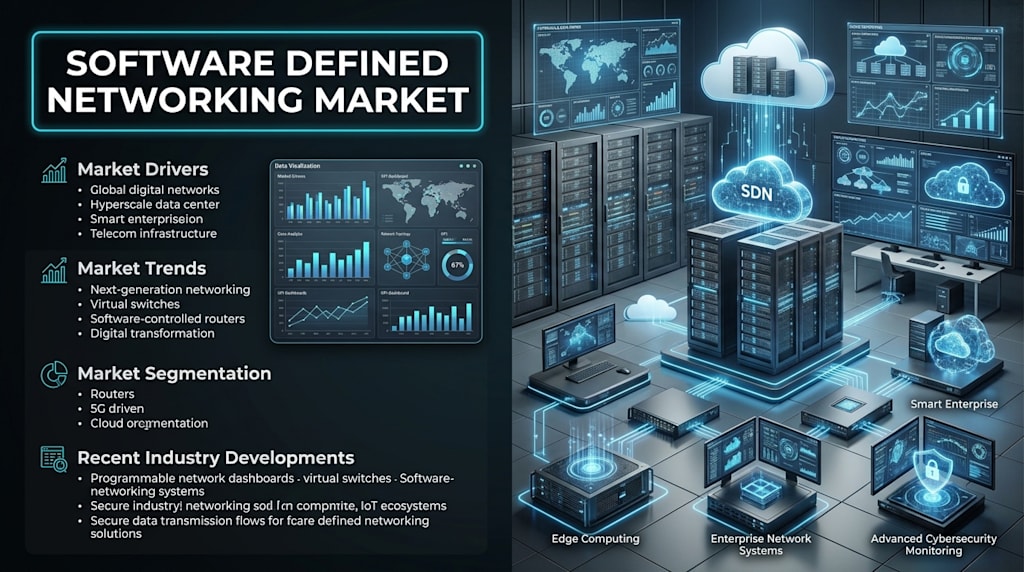
According to IMARC Group's latest research, The global software defined networking market size reached USD 33.1 Billion in 2025. Looking forward, IMARC Group expects the market to reach USD 128.0 Billion by 2034, exhibiting a growth rate (CAGR) of 15.73% during 2026-2034. Rising demand for network automation and programmability, widespread adoption of cloud computing services, accelerating digital transformation across enterprises, and the expansion of 5G infrastructure deployments are driving significant growth in the SDN market globally.
How AI is Reshaping the Future of Software Defined Networking Market
- Intelligent Network Traffic Management and Optimization: AI algorithms analyze traffic patterns and automatically adjust routing decisions to minimize latency and optimize bandwidth utilization. Machine learning models predict network congestion before it occurs, enabling proactive rerouting and preventing performance degradation across distributed networks.
- Autonomous Network Security and Threat Detection: AI-powered security systems monitor network behavior in real-time to detect anomalies and potential cyberattacks with remarkable accuracy. Automated response mechanisms isolate suspicious traffic and implement security policies dynamically, reducing breach response times from hours to seconds.
- Self-Healing Network Infrastructure: AI continuously monitors SDN controller health and network device performance, automatically detecting failures and initiating recovery procedures without human intervention. Predictive analytics identify potential issues before failure, reducing network downtime and improving overall system resilience significantly.

Software Defined Networking Industry Overview
North America leads global SDN adoption through strong technology investments and established cloud infrastructure ecosystems. Enterprise data centers, telecommunications providers, and cloud service providers are aggressively deploying SDN to modernize legacy networks and enable 5G capabilities. The region's mature IT infrastructure combined with government digital transformation initiatives creates favorable conditions for widespread SDN expansion across financial services, retail, healthcare, and government sectors.
Software Defined Networking Market Trends & Drivers
Network Automation and Digital Transformation Acceleration: Organizations increasingly prioritize network automation to reduce operational complexity and accelerate service delivery. Network administrators seek centralized control mechanisms that enable dynamic provisioning without manual configuration. SDN delivers precisely this capability by decoupling control planes from data planes, enabling programmable infrastructure that responds to business demands in real-time. Enterprise investments in digital transformation initiatives continue surging, with nearly 68 percent of organizations prioritizing SDN deployment to improve network efficiency, scalability, and agility across hybrid cloud environments.
5G Network Deployment and Cloud-Native Architecture Adoption: The rapid rollout of 5G networks demands sophisticated management infrastructure that traditional networking cannot provide. SDN provides centralized control and automation capabilities essential for handling diverse applications, devices, and services that 5G networks support. Cloud service providers increasingly leverage SDN to optimize data center operations, reduce infrastructure costs, and deliver advanced network services to customers. Integration of SDN with cloud-native architectures enables organizations to manage dynamic workloads efficiently while maintaining security and compliance standards across global distributed networks.
Enhanced Security and Network Visibility Requirements: Organizations face escalating cybersecurity threats driving demand for advanced network security capabilities. SDN enables micro-segmentation, policy-based access control, and centralized threat monitoring features that traditional networking architectures cannot match. The ability to implement security policies uniformly across entire network infrastructures appeals to highly regulated industries including banking, healthcare, and government. Rising security concerns combined with compliance mandates are accelerating SDN adoption among enterprises seeking greater network visibility and automated threat response capabilities that protect critical business infrastructure.
Leading Companies Operating in Global Software Defined Networking Industry
Arista Networks Inc.
Cisco Systems Inc.
Citrix Systems Inc.
Cloudgenix Inc. (Palo Alto Networks Inc.)
Cumulus Networks Inc. (Nvidia Corporation)
Dell Technologies Inc.
Extreme Networks Inc.
Hewlett-Packard Enterprise Company
International Business Machines Corporation
Juniper Networks Inc.
NEC Corporation
Oracle Corporation
Software Defined Networking Market Report Segmentation
By Component
Solution: Physical Network Infrastructure, SDN Controller, SDN Application, Others
Services: Integration and Deployment, Training and Consulting, Support and Maintenance
SDN solutions provide flexible, centralized, and programmable approaches to managing network infrastructure by decoupling control planes from data planes. Services complement these solutions by offering expertise, tools, and ongoing support to help organizations implement, manage, and optimize their SDN deployments. Integration and deployment services ensure smooth transitions from legacy systems to SDN architectures.
By Organization Size
Small and Medium Enterprises: Adopting SDN to reduce infrastructure costs and improve network management efficiency
Large Enterprises: Leading SDN adoption through complex networking needs and demand for network performance and security
Large enterprises drive SDN market growth through aggressive adoption in finance, healthcare, manufacturing, and telecommunications sectors. SMEs increasingly recognize cost-reduction benefits from centralized network management even with conservative adoption rates due to budget constraints.
By Application
Enterprises: Optimizing internal networks and improving agility with centralized management
Telecommunication Service Providers: Transforming legacy networks into agile, scalable, cost-effective infrastructures supporting 5G deployment
Cloud Service Providers: Leveraging SDN for data center optimization and advanced network service delivery
Enterprises use SDN to automate network provisioning and enforce policies across data centers. Telecom operators deploy SDN with network function virtualization to support service provisioning and 5G infrastructure. Cloud providers utilize SDN to optimize large-scale cloud infrastructures and deliver flexible network services efficiently.
By End Use Industry
BFSI: Improving agility, security, and compliance in complex multi-site networks
IT and Telecom: Early SDN adopters modernizing infrastructure and enhancing service delivery
Consumer Goods: Optimizing supply chain visibility and logistics networks
Government and Defense: Enhancing network security and modernizing infrastructure
Healthcare: Improving network performance and enabling secure data sharing
Others: Various sectors adopting SDN for network modernization
By Region
North America: Dominant region with early SDN adoption and strong technology infrastructure
Europe: Significant growth driven by digital transformation and network virtualization adoption
Asia Pacific: Rapidly expanding market fueled by cloud infrastructure development
Latin America: Emerging region with growing enterprise digitalization
Middle East and Africa: Developing market driven by telecom modernization initiatives
North America maintains market leadership through abundant IT investments and established cloud ecosystems. Europe demonstrates strong adoption momentum across finance and telecom sectors. Asia Pacific emerges as fastest-growing region with increasing cloud service provider expansion and enterprise digital transformation initiatives.
Recent News and Developments in Software Defined Networking Market
- January 2024: Hewlett-Packard Enterprise completed acquisition of Juniper Networks for USD 14 billion, combining HPE's edge-to-cloud portfolio with Juniper's AI-native networking and Mist SDN platforms to deliver unified enterprise solutions for modern network architecture.
- March 2024: IBM acquired Pliant, a network and IT automation platform, to enhance SDN capabilities. The acquisition integrates with IBM Cloud Pak for Network Automation and Hybrid Cloud Mesh, enabling improved observability, control, and automation across hybrid cloud environments.
- September 2024: Airtel Business partnered with Cisco to launch Airtel Software-Defined Branch, a cloud-based, end-to-end-managed network solution designed for organizations seeking simplified, secure, cloud-native branch networking with enhanced connectivity and reduced operational complexity.
- September 2024: IBM and NTT DATA partnered to introduce SimpliZCloud, a fully managed cloud service combining AI and hybrid cloud technologies specifically designed for Indian financial services sector. The solution leverages Software Defined Networking for specialized computation and storage resources.
- Q3 2024: Arrcus secured USD 65 million in Series D funding to accelerate development and expand its software-defined networking platform globally, supporting enterprises seeking flexible, cost-effective SDN solutions for modern network infrastructure.
- Q4 2024: Cisco announced acquisition of Isovalent, a company specializing in cloud-native software-defined networking, to enhance its enterprise and cloud customer offerings with advanced SDN capabilities for containerized and cloud-native environments.
Note: If you require specific details, data, or insights not currently included in the scope of this report, we are happy to accommodate your request. As part of our customization service, we will gather and provide the additional information you need, tailored to your specific requirements. Please let us know your exact needs, and we will ensure the report is updated accordingly to meet your expectations.
About the Creator
Michael Richard
Michael Richard is a Market Research Expert specializing in market intelligence, competitive analysis, and data-driven insights. He helps organizations understand trends and emerging opportunities through in-depth research.
Enjoyed the story? Support the Creator.
Subscribe for free to receive all their stories in your feed.
Comments
There are no comments for this story
Be the first to respond and start the conversation.