
Sodium Silicate Market Benefits from Innovation and Automation
How rising demand for eco-friendly chemicals and sustainable manufacturing practices is accelerating innovation across the global sodium silicate market

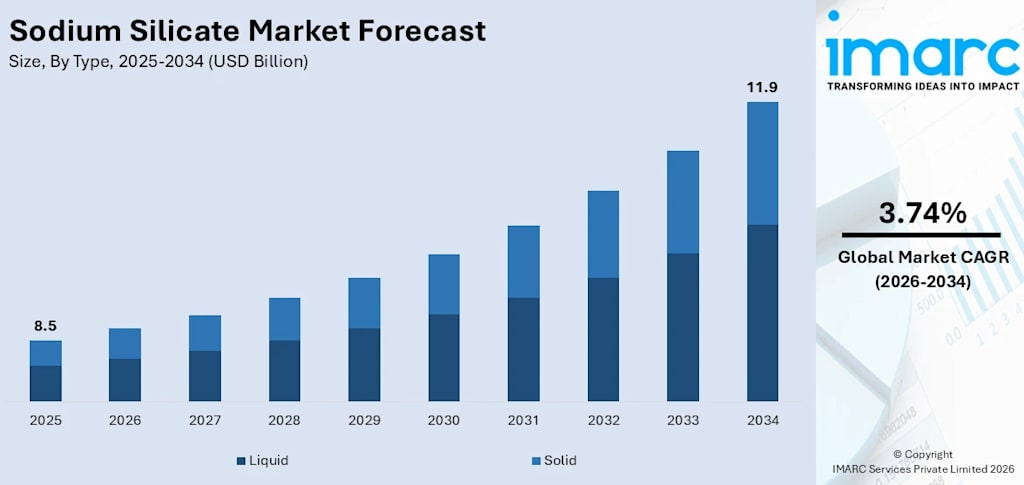
The global sodium silicate market is witnessing significant growth, driven by its extensive applications across key industrial sectors including detergents, construction, and elastomers. Known commonly as water glass, this versatile chemical compound serves as an essential binder, builder, and stabilizing agent, making it highly valuable in both consumer goods and heavy manufacturing. According to IMARC Group’s latest data, the global sodium silicate market size was valued at USD 8.5 Billion in 2025. Looking forward, IMARC Group estimates the market to reach USD 11.9 Billion by 2034, exhibiting a steady compound annual growth rate during the forecast period.
Sodium silicate now represents a multi-billion-dollar global industrial chemical sector, characterized by its reliable year-on-year demand across both emerging and mature markets. Market expansion is primarily propelled by the booming laundry and household detergent industries, where the compound is utilized to maintain pH balance and prevent corrosion in processing equipment. Furthermore, the global shift toward green chemicals has led manufacturers to substitute environmentally harmful phosphates with sodium silicate in cleaning formulations.
Sodium Silicate Market Growth Drivers:
- Surging Demand in Detergent and Soap Manufacturing
The household cleaning sector remains the primary engine of global demand, particularly as manufacturers ramp up capacities to meet consumer hygiene requirements. Sodium silicate serves as an indispensable builder in laundry powders and liquids, functioning as a water softener, emulsifier, and buffering agent that prevents dirt from redepositing on fabrics. The ongoing industry shift toward eco-friendly and phosphate-free formulations heavily favors the compound due to its natural biodegradability and safety profile. Trade statistics highlight a parallel increase in cleaning chemical consumption, with global detergent exports reaching billions annually, heavily reflecting the steady volume requirements for sodium silicate processors worldwide.
- Rapid Expansion in the Construction and Infrastructure Sectors
Urbanization and large-scale infrastructure developments are driving substantial consumption of sodium silicate as an additive in concrete and masonry treatments. In civil engineering, the compound reacts chemically with calcium hydroxide in concrete to form an impermeable gel, significantly hardening the surface, reducing porosity, and improving chemical resistance. It is also extensively deployed in tunnel drilling and mining operations as a high-performance soil grout and fast-setting accelerator for shotcrete. Ongoing government infrastructure funding across developing regions ensures a consistent procurement pipeline for industrial silicates used in durable structural materials.
- Growing Integration into High-Performance Elastomers and Tires
The automotive and manufacturing sectors are increasingly utilizing sodium silicate as a vital precursor for precipitated silica, which acts as a crucial reinforcing filler in tire production. This green tire technology replaces traditional carbon black, enhancing structural durability while significantly reducing rolling resistance to improve vehicle fuel efficiency. As regulatory standards across the European Union and North America push for stricter tire labeling and lowered automotive carbon emissions, vehicle manufacturers are altering rubber formulations.
Sodium Silicate Market Trends:
- Regulatory Pressures and the Shift Toward Phosphate-Free Formulations
Environmental watchdogs and regulatory bodies globally are tightening restrictions on phosphate usage in household cleaning products due to its role in causing water eutrophication. Sodium silicate has emerged as the premier ecological alternative, maintaining washing machine efficiency and protecting metallic components from corrosion without damaging aquatic ecosystems. Major consumer goods corporations are completely reformulating their flagship laundry detergents to feature higher silicate contents, aligning with green chemical certifications.
- Dominance of Liquid Formulations in Specialized Industrial Processes
The market is experiencing a pronounced shift toward liquid sodium silicate over solid forms, with liquid applications commanding a significant majority of the global market volume. Industrial end-users favor liquid silicates due to their instant blendability, precise alkalinity levels, and reduced material handling complexity in manufacturing plants. This trend is particularly evident in the paper and pulp industry, where liquid silicates are heavily utilized as peroxide stabilizers during eco-friendly paper bleaching.
- Strategic Regional Capacity Expansions by Major Chemical Players
To optimize supply chains and minimize heavy bulk shipping costs, leading chemical manufacturers are focusing on regional capacity expansions near high-demand industrial hubs. Major entities like Qemetica, PQ Corporation, and Occidental Petroleum Corporation are implementing strategic local plant expansions to directly feed downstream detergent and elastomer factories. This localization trend is supported by national economic development incentives designed to strengthen domestic chemical supply chains. By establishing integrated production networks, manufacturers are insulating their operations from global freight volatility while reliably meeting the strict quality standards of regional buyers.
Recent News and Developments in Sodium Silicate Market
- August 2025: Qemetica finalized a comprehensive expansion of its silicate manufacturing facilities, implementing advanced furnace technologies designed to optimize energy efficiency and lower the overall carbon footprint of bulk liquid production lines.
- September 2025: A leading global consumer goods corporation announced the complete removal of phosphates from its regional cleaning products portfolio, replacing them with customized sodium silicate blends to comply with updated environmental regulations.
- September 2025: PQ Corporation expanded its strategic distribution network across high-growth industrial corridors, improving localized supply security for automotive elastomer producers requiring premium-grade reactive silicates.
Note: If you require specific details, data, or insights that are not currently included in the scope of this report, we are happy to accommodate your request. As part of our customization service, we will gather and provide the additional information you need, tailored to your specific requirements. Please let us know your exact needs, and we will ensure the report is updated accordingly to meet your expectations.
About the Creator
Andrew Sullivan
Hello, I’m Andrew Sullivan. I have over 9+ years of experience as a market research specialist.
Enjoyed the story? Support the Creator.
Subscribe for free to receive all their stories in your feed.
Comments
There are no comments for this story
Be the first to respond and start the conversation.