
Sodium Salt Battery Market Impressive Growth at 19.8%
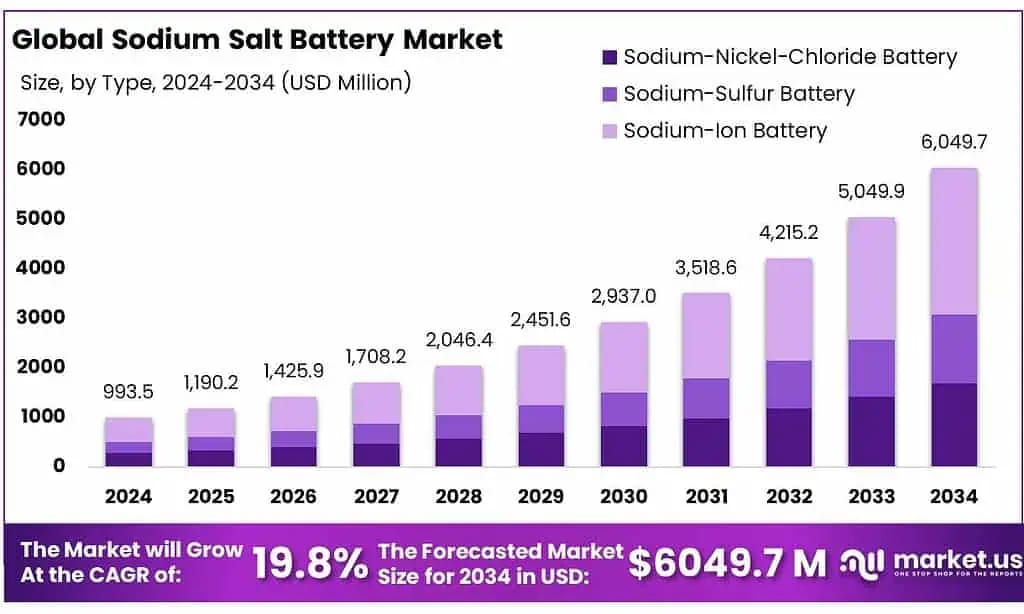
Sodium Salt Battery Market is expected to USD 6049.7 Mn by 2034, up from USD 993.5 Mn in 2024, CAGR of 19.8%

Market Overview
The global sodium salt battery market is projected to reach USD 6,049.7 million by 2034, increasing from USD 993.5 million in 2024, and is expected to grow at a strong CAGR of 19.8% from 2025 to 2034. In 2024, Asia Pacific led the market with a 48.9% share, accounting for nearly USD 485.8 million, supported by strong battery manufacturing ecosystems and large-scale grid storage investments across China, Japan, and other regional markets.
Government policy remains a major structural growth driver. China’s 14th Five-Year Plan for New Energy Storage Development targets more than 30 GW of new energy storage capacity by 2025, compared with 3.3 GW in 2020, while explicitly identifying sodium-ion batteries as a key technology direction.
Provincial plans, such as Shanxi’s 6 GW storage target by 2025, further strengthen regional demand for affordable and scalable battery chemistries. Similar momentum is visible in Japan, where METI’s FY2025 storage subsidy program allocated 36.3 billion yen across 37 grid-scale battery and electrolysis projects, supporting domestic capability development that can directly benefit sodium-based storage systems.
Key Takeaways
- Sodium Salt Battery Market is expected to be worth around USD 6049.7 Million by 2034, up from USD 993.5 Million in 2024, and is projected to grow at a CAGR of 19.8%.
- Sodium-Ion Battery held a dominant market position, capturing more than a 49.7% share.
- Medium-Capacity Sodium Salt Batteries (5 kWh to 100 kWh) held a dominant market position, capturing more than a 47.6% share.
- Energy Storage System held a dominant market position, capturing more than a 48.1% share.
- Utilities held a dominant market position, capturing more than a 34.5% share.
- Asia Pacific is the dominating region in the Sodium Salt Battery market, holding 48.9% share and reaching USD 485.8 Mn.
Segmentation Deep Dive
By Type Analysis
In 2024, sodium-ion batteries led the global sodium salt battery market with a 49.7% share, supported by their cost advantage, wide sodium availability, and lower exposure to lithium raw material volatility.
By Battery Capacity Analysis
By battery capacity, medium-capacity sodium salt batteries (5 kWh to 100 kWh) dominated the market in 2024 with a 47.6% share, driven by increasing demand from commercial buildings, telecom infrastructure, small industrial sites, community solar systems, and distributed renewable projects.
By Application Analysis
In 2024, the energy storage system (ESS) segment held the leading 48.1% share of the sodium salt battery market, emerging as the primary application area for this chemistry. The segment’s growth was mainly supported by rising investments in grid stabilization, renewable energy storage, microgrids, and commercial backup systems.
By End Use Analysis
By end use, utilities accounted for the largest 34.5% share in 2024, reflecting the growing role of sodium salt batteries in grid resilience, renewable balancing, and peak demand management.
Top Use Cases
Grid-Scale Energy Storage for Utilities: The biggest use case for sodium salt batteries is utility-scale energy storage. Utilities need batteries to store electricity when supply is high and release it when demand rises. This is becoming more important as wind and solar grow. Global grid-scale battery capacity reached 55.7 GW in 2023, up about 120% year over year. China alone reached 27.1 GW, while the United States reached 16.2 GW. That scale makes lower-cost battery chemistries more attractive, especially for stationary projects where space is less constrained.
Renewable Energy Integration and Peak Shifting: A second major use case is renewable energy integration. Solar and wind do not generate power at a constant rate, so battery systems are needed to smooth output, shift electricity into evening hours, and support grid stability. The IEA notes that annual grid-scale battery additions must rise to an average of nearly 120 GW per year during 2023–2030 to stay on track with net-zero goals, and installed grid-scale battery storage could reach nearly 970 GW by 2030 in that pathway. This creates strong demand for battery types that can be produced at scale and deployed at predictable cost.
Commercial and Industrial Backup Power: Sodium salt batteries also have a strong use case in commercial and industrial backup power. Businesses increasingly want battery systems that can reduce peak demand charges, improve reliability, and provide electricity during outages.
Notable Company Developments
In 2025, GE Vernova reported total revenues of USD 38.068 billion, free cash flow of USD 3.710 billion, and a backlog of USD 150.238 billion, highlighting the scale of its global utility, grid modernization, and power infrastructure pipeline.
In the same year, Altech reported further progress in its sodium-based prototype battery program, demonstrating more than 650 charge–discharge cycles with no detectable capacity loss, along with energy efficiency of up to 92% and nearly 100% coulombic efficiency at the cell level. For its 60 kWh battery pack, the company highlighted around 88% round-trip efficiency and over 110 cycles without observable capacity fade, even under varied load conditions including current pulses of up to 50 A.
Conclusion
In conclusion, sodium salt batteries are becoming one of the most practical next-generation battery options for large-scale stationary energy storage, especially where cost stability, safety, and raw material availability are more important than ultra-high energy density.
About the Creator
Hayden Kulas
I am blogger, digital marketing pro since 5 years and writes for Market.us. Computer Engineer by profession. I love to find new ideas that improve websites' SEO. He enjoys sharing knowledge and information about many topics.
Enjoyed the story? Support the Creator.
Subscribe for free to receive all their stories in your feed.
Comments
There are no comments for this story
Be the first to respond and start the conversation.