
Social Listening Metrics That Matter
Moving Beyond Mentions to Measure Brand Health and Business Impact

Social listening has evolved far beyond counting how many times a brand appears on social media. Done well, it can reveal changes in customer sentiment, emerging reputation risks, competitor momentum, unmet customer needs and even opportunities for product, content and customer experience improvements.
The challenge is deciding which signals deserve attention.
A dashboard might show thousands of mentions, millions of impressions and a sudden increase in engagement. None of those numbers necessarily means the brand is performing better. The real value of social listening comes from understanding who is talking, what they are saying, why the conversation is changing and whether that information should change a business decision.
That distinction is increasingly important as consumers discuss companies across social platforms, forums, review sites, blogs, news publications, search engines and AI-powered discovery environments.
Mention Volume: Useful Signal, Poor Measure of Success
Mention volume measures how frequently a company, product, competitor or relevant topic appears in online conversations.
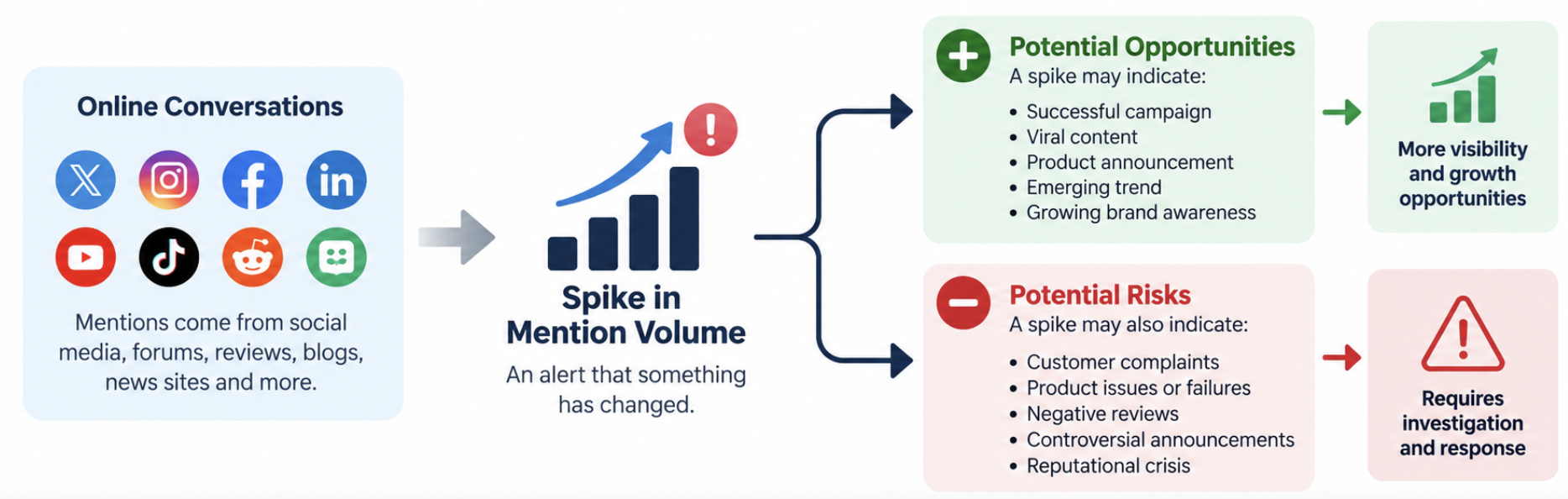
It is useful as an alert mechanism. A sudden increase can indicate a successful campaign, viral content, product announcement, emerging trend or growing brand awareness. But it can just as easily signal customer complaints, a product failure or a reputational crisis.
Hootsuite makes essentially this distinction in its 2026 guidance: volume by itself cannot tell marketers whether a spike is good or bad; instead, it tells them that something has changed and deserves investigation. That is also central to the perspective of Brandon George, Director of Demand Generation & Content at Thrive Internet Marketing Agency.
“Mention volume is often overvalued. Every marketer loves when mentions spike, but unless you’re digging into whether those mentions are positive or negative, or from influencers or actual purchasers, an increase in volume can be misleading.”
George recalls working with brands that initially celebrated trending on social media before discovering that complaints were responsible for much of the increased conversation.
In one case, a consumer brand experienced a sudden surge in mentions following a product change. The team initially interpreted the attention as a major win. Social listening showed that much of the conversation was actually negative and driven by frustrated customers.
That changed the business response. The company paused a planned paid campaign, publicly addressed the product problem and changed its messaging. According to George, sentiment subsequently improved over the following months.
The lesson is straightforward: mention volume identifies movement; context determines whether that movement matters.
1. Sentiment and Sentiment Shift
If mention volume answers how much people are talking, sentiment attempts to answer how they feel.
Search Engine Journal describes evaluating positive, negative and neutral conversations as one of social listening's important functions because it helps businesses understand public perception rather than simply count brand references.
Hootsuite similarly identifies sentiment as one of seven core listening metrics and recommends examining it over time to evaluate changes in brand perception, campaign response and potential reputational threats. This makes sentiment shift particularly useful.
A single sentiment score provides a snapshot. Tracking it over weeks or months reveals direction.
For example, a company might see:
Month 1: 65% positive / 20% neutral / 15% negative
Month 2: 58% positive / 20% neutral / 22% negative
Month 3: 49% positive / 18% neutral / 33% negative
Total mentions could remain unchanged while the underlying health of the brand deteriorates substantially.
That is why George puts sentiment shift over time among the three metrics he would prioritize if a team could track only a handful.
2. Share of Voice Against Direct Competitors
Social listening becomes considerably more useful when brand performance is placed in competitive context.
Share of voice (SOV) measures how much of the relevant conversation belongs to one brand compared with its competitors.
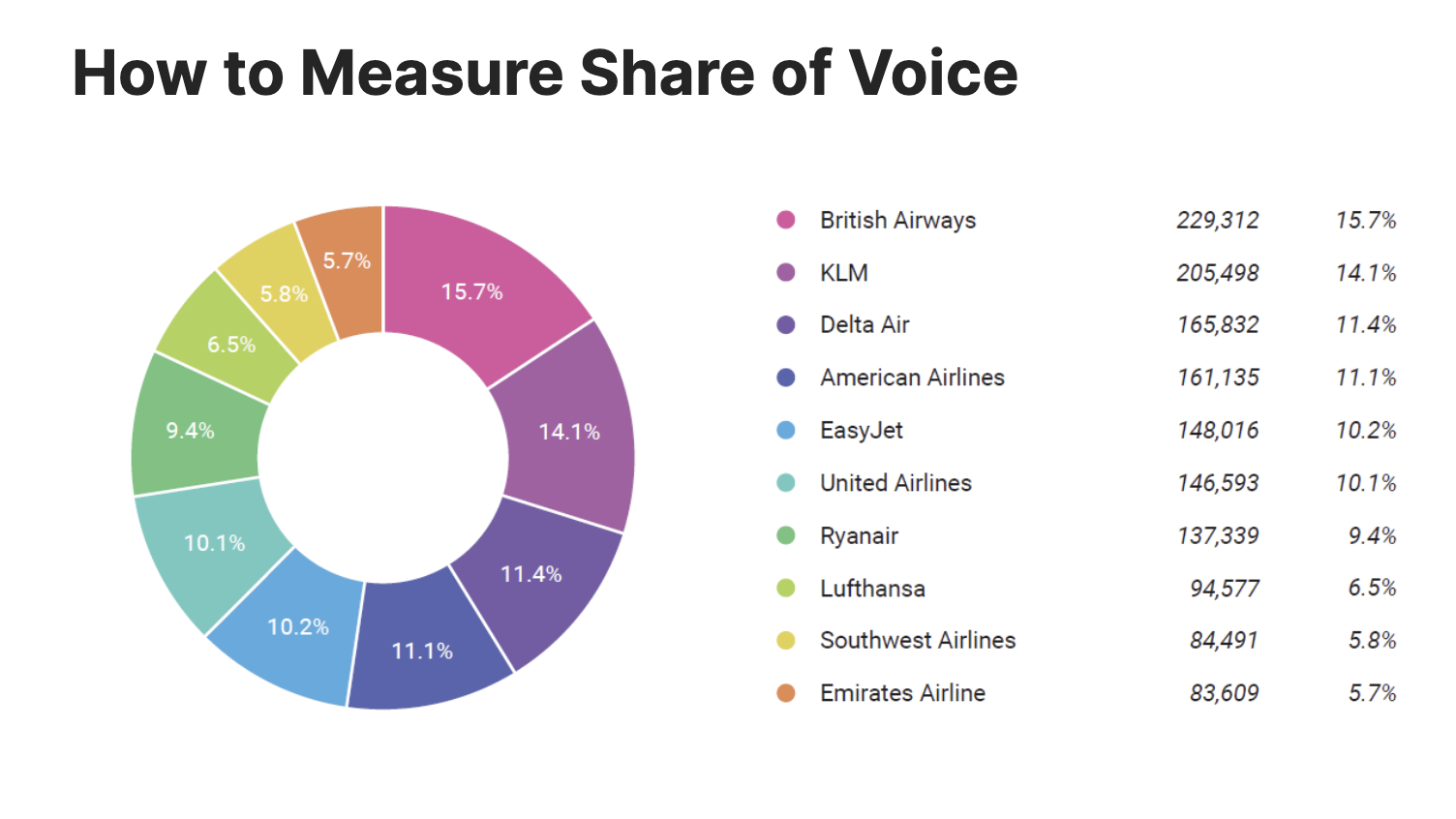
Search Engine Journal describes the basic calculation as:
Share of Voice = Brand Mentions ÷ Total Market Mentions
But the deeper analysis goes beyond calculating the percentage. SEJ recommends investigating differences between brands such as platforms, positive versus negative mentions, geography and the influencers discussing competitors.
Sprout Social takes a similar position, describing SOV as a way to contextualize other social metrics and identify competitors' strengths, weaknesses and opportunities within relevant market conversations. Importantly, Sprout argues that the objective should not necessarily be dominating every conversation, but participating meaningfully in conversations relevant to the target audience.
This is also why George includes competitor share of voice among his top three metrics.
A company generating 20,000 monthly mentions might appear successful in isolation. If competitors generate 200,000 relevant mentions, the picture changes.
Conversely, a company could grow from 5% to 12% of category conversation without generating enormous absolute numbers. That shift could be strategically significant.
3. Engagement Quality, Not Just Engagement Quantity
Engagement is another metric that becomes misleading when stripped of context.
Likes are easy to count. But marketers should ask whether the people interacting with the content actually matter to the business.
Search Engine Journal's analysis of social media measurement recommends looking deeper than likes and examining meaningful actions. Comments are particularly useful because they provide qualitative feedback and can reveal genuine positive or negative reactions.
George makes the distinction even sharper:
“10 comments on a post from category purchasers is far more valuable than 1,000 likes from random people who probably buy nothing from anyone.”
That suggests engagement should be evaluated across at least two dimensions:
Depth of engagement: Like → comment → share → recommendation → inquiry → conversion.
Quality of participant: Random user → relevant audience member → prospect → customer → industry authority or category influencer.
A smaller amount of interaction from high-intent prospects may therefore represent substantially greater business value than viral engagement from an irrelevant audience.
4. Conversation Themes and Topics
Numbers reveal that something changed. Conversation analysis can reveal why.
Hootsuite includes conversation themes and trend/topic volume among its seven most important social listening measures. Recurring topics can reveal what customers repeatedly ask about, praise or complain about and can subsequently influence content, FAQs, messaging and other business decisions.
Search Engine Journal likewise argues that social listening can uncover audience interests, frustrations and emerging themes, with applications extending beyond marketing into customer service and product development.
Suppose negative sentiment toward a software company increases 15%.
Knowing that number is useful.
Knowing that 70% of the increase involves customers complaining about a new pricing model is actionable.
The latter can inform marketing, customer success, product and leadership decisions.
5. Audience and Influencer Quality
Another important question is who is driving the conversation?
Ten thousand mentions from low-relevance accounts and 500 mentions from existing customers, qualified prospects, journalists and respected industry voices are not equivalent.
Search Engine Journal's guidance on share of voice specifically recommends examining which influencers discuss a brand or its competitors, while its social listening coverage emphasizes using conversations to better understand who audiences are and where they spend their time.
Marketers can therefore segment mentions by:
Existing customers versus prospects
Industry professionals
Journalists and publications
Creators and influencers
Employees
Partners
High-intent category buyers
General audiences
This adds an important layer of source quality to raw mention data.
6. Reach and Potential Exposure
Reach estimates how many people could potentially have encountered a conversation.
It helps distinguish between a discussion occurring among a few dozen users and one spreading across much larger audiences.
Hootsuite includes reach among its seven priority listening metrics, but its usefulness becomes much greater when interpreted alongside sentiment and audience quality.
For example:
High reach + positive sentiment can signal an amplification opportunity.
High reach + negative sentiment can indicate reputational risk.
Low reach + negative sentiment from important customers can warrant intervention before the issue becomes larger.
Reach therefore provides scale, while other metrics provide meaning.
7. Competitive Sentiment
Share of voice alone can also create the wrong impression.
A competitor might own 40% of category conversation while your brand owns only 20%. But if much of the competitor's conversation is negative, its apparent advantage may actually represent vulnerability.
Sprout recommends combining share-of-voice analysis with sentiment to understand not only how much people discuss competitors but also the quality of those conversations.
This produces a more useful competitive question:
Who owns the greatest share of positive, relevant conversation among potential customers?
That is considerably more meaningful than asking who simply generates the most mentions.
8. Social Listening and Search Behavior Should Be Connected
One particularly useful extension comes from Search Engine Journal: marketers should not analyze social conversation in isolation from search behavior.
SEJ argues that search data can function as a brand-health signal because consumers do not always publicly post what they think. They may instead search privately when they become curious or concerned about a company. Changes in branded searches, negative reviews, online mentions and search associations can therefore reveal shifts in perception.
Imagine social listening detects growing complaints about a product.
At the same time, Google Search Console or search trend data shows increasing searches such as:
“[brand] problems”
“[brand] alternatives”
“[brand] reviews”
“is [brand] worth it”
Together, those signals tell a much richer story than social mentions alone.
SEJ's broader enterprise intelligence guidance similarly recommends combining social listening with review sentiment, purchase behavior, cross-platform mentions, consumer journey data and competitive intelligence rather than treating each dataset independently.
9. Business Outcomes Should Ultimately Close the Loop
This leads to the metric that matters most: what happened to the business?
Social listening should eventually connect with outcomes such as leads, conversions, customer retention, revenue, brand preference or reduced customer-service issues.
George summarizes the principle well:
“Social listening should always be used as a directional signal to inform decision-making, not a vanity number you report on monthly.”
His point is that metrics become meaningful when they change the course of action.
That same emphasis on quality over raw volume appears in Thrive's own performance research.
What Thrive's Q2 2026 Study Shows About Volume vs. Quality
In its Q2 2026 Performance Report, Thrive analyzed performance across its client portfolio and ranked industries primarily by 90-day conversion growth, with sessions and revenue used as supporting metrics.
The aggregate result is particularly relevant to George's argument.
Across Thrive clients, conversions increased approximately 53% while average website sessions fell roughly 13%. Thrive interprets that divergence as evidence that businesses were increasingly attracting higher-intent visitors rather than merely increasing traffic.
Several individual results reinforce the point. Clinical services produced 115% conversion growth despite a 4% decline in sessions. A professional tree-service client generated 66% more conversions while sessions fell 11%, while a hospice and elderly-care client recorded 946% conversion growth despite a 17% session decline.
The study is not a social-listening experiment, so it should not be presented as proof that particular listening metrics cause better results. It does, however, provide a useful parallel to George's argument: volume and business value are not interchangeable.
A More Complete Social Listening Measurement Framework
Rather than selecting one "best" metric, marketers can organize social listening around a simple hierarchy:
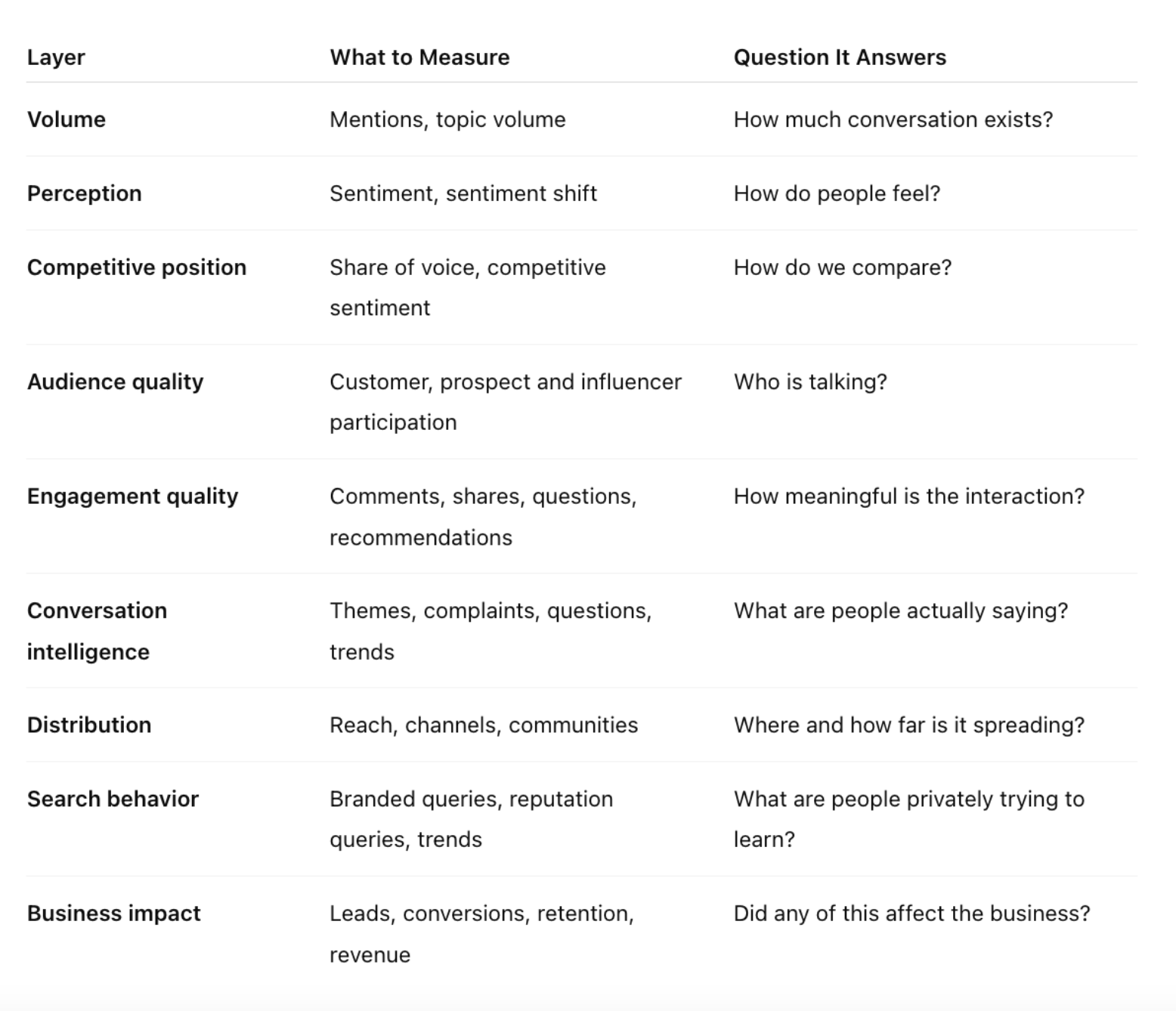
The framework also helps prevent a common reporting problem: confusing an activity metric with an outcome metric.
A spike in mentions is an observation.
A spike in negative sentiment explains that observation.
Finding that the complaints concern a specific product change identifies the problem.
Discovering that high-value customers are driving the criticism establishes its importance.
Changing the product or messaging in response turns listening into strategy.
Measuring subsequent improvements in sentiment, retention or conversions closes the loop.
The Most Important Social Listening Metrics Depend on the Decision
There is therefore no universal metric that should dominate every social listening dashboard.
For brand awareness, mention volume and reach can be valuable.
For brand health, sentiment and sentiment shift matter more.
For competitive intelligence, share of voice and competitive sentiment become important.
For content strategy, engagement quality, questions and recurring conversation themes can uncover what audiences actually care about.
For reputation management, negative sentiment velocity, conversation themes, influential participants and reach deserve close attention.
And for executive reporting, the strongest social listening program ultimately connects these signals to customer acquisition, retention, revenue or another measurable business objective.
That broader approach is consistent with Search Engine Journal's description of social listening as going beyond monitoring individual mentions. Its value comes from analyzing conversations to produce insights capable of influencing brand strategy, content, customer experience and broader decision-making.
George's recommendation, therefore, works particularly well as the foundation rather than the entirety of the measurement framework. If forced to prioritize only three metrics, he chooses sentiment shift over time, share of voice against direct competitors and meaningful engagement from category-relevant audiences.
But the larger principle behind those choices matters most.
Do not measure conversation simply because it can be counted. Measure it because understanding that conversation can help the business make a better decision.
About the Creator
Dan Woodland
Dan is a freelance writer and contributor who explores a wide range of topics, from business, entrepreneurship, technology, design, marketing, and finance to emerging trends, culture, and everyday ideas that spark curiosity.
Enjoyed the story? Support the Creator.
Subscribe for free to receive all their stories in your feed.
Comments
There are no comments for this story
Be the first to respond and start the conversation.