
Smart Water Management Market Trends: IoT Integration, Leak Detection Systems & Forecast to 2034
How IoT-enabled monitoring systems, smart metering technologies, and real-time analytics are improving efficiency and sustainability in the smart water management market

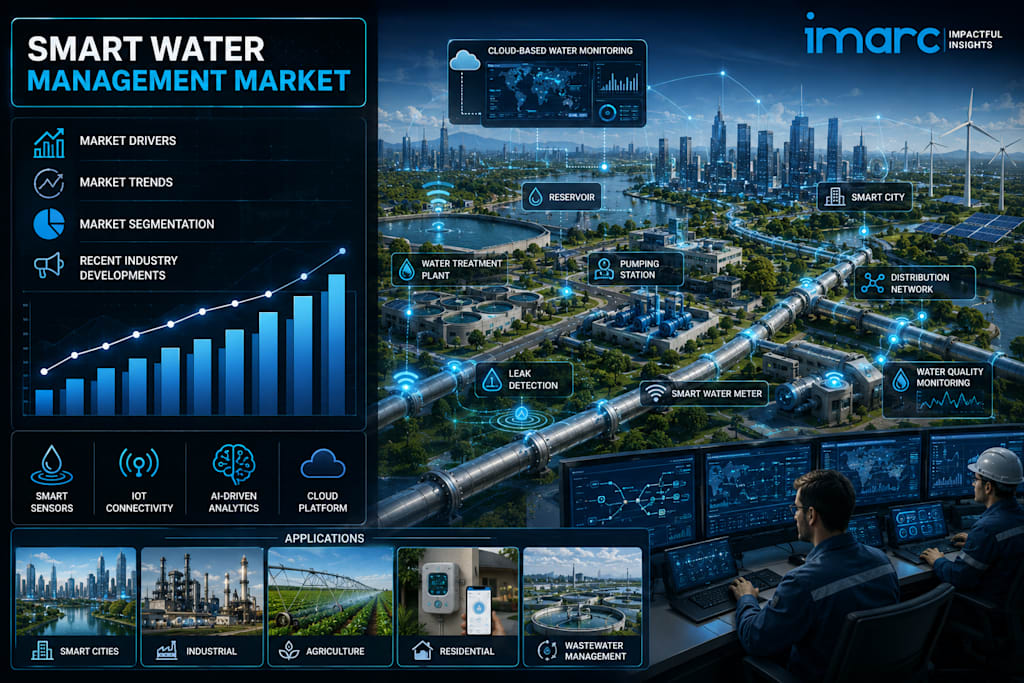
According to IMARC Group's latest research publication, The global smart water management market size reached USD 21.5 Billion in 2025. Looking forward, IMARC Group expects the market to reach USD 47.2 Billion by 2034, exhibiting a growth rate (CAGR) of 8.87% during 2026-2034.
How Technology Is Reshaping the Future of the Smart Water Management Market
- IoT-Enabled Real-Time Network Monitoring: Internet of Things solutions integrated with cloud computing platforms are transforming how water utilities detect and respond to network anomalies. Connected sensors deployed across distribution pipelines transmit continuous pressure, flow, and quality data to centralized dashboards, enabling operators to pinpoint leakage points, unauthorized consumption, and pressure irregularities within minutes rather than days. Utilities adopting IoT-driven monitoring frameworks have reported leak detection improvements that reduce non-revenue water losses by up to 30%, translating into significant cost savings and resource conservation across both municipal and industrial water networks.
- Advanced Metering Infrastructure and Two-Way Communication: Smart water management platforms are being built around advanced metering infrastructure (AMI) that enables two-way communication between utilities and end-users. These systems support time-synchronized meter readings, remote valve shut-off capabilities, and tamper detection alerts without requiring physical field visits. In commercial and industrial settings, AMI solutions allow facilities managers to track consumption patterns at granular intervals, identify usage anomalies linked to equipment faults, and implement demand response strategies that align operational schedules with tariff structures for measurable cost efficiency.
- SCADA and GIS Integration for Operational Intelligence: Supervisory Control and Data Acquisition (SCADA) systems combined with Geographic Information Systems (GIS) are enabling water utilities to visualize, control, and optimize their entire distribution networks from centralized command centers. These integrated platforms support hydraulic modeling, pressure zone management, and predictive maintenance scheduling by correlating sensor data with spatial asset maps. Water authorities in regions such as the Middle East and South Asia are deploying SCADA-GIS combinations to manage vast pipeline networks spanning hundreds of kilometers, reducing manual inspection costs while significantly improving response times during infrastructure failures.
- AI-Powered Predictive Analytics and Demand Forecasting: Machine learning algorithms embedded within smart water management software analyze historical consumption data, seasonal usage patterns, and environmental variables to generate accurate demand forecasts. These predictive capabilities help utilities optimize reservoir levels, pump scheduling, and energy consumption across water treatment and distribution operations. AI-driven analytics also power predictive maintenance modules that flag pumps, valves, and meters approaching failure thresholds, allowing maintenance teams to intervene proactively before service disruptions occur and before costly emergency repair scenarios materialize.
- Sustainable Water Governance Through Smart Irrigation and Residential Efficiency Programs: Smart water management systems are being extended beyond utility infrastructure into agricultural and residential domains through intelligent irrigation controllers and residential water efficiency platforms. Soil moisture sensors, weather-adaptive scheduling algorithms, and automated shut-off valves are reducing agricultural water consumption by up to 40% in pilot deployments across water-stressed geographies. At the household level, smart meters paired with mobile consumption dashboards are empowering residents to monitor usage in real time, enabling behavioral changes that collectively reduce urban residential water demand and support municipalities in meeting sustainability mandates.
Smart Water Management Industry Overview
Global water stress is intensifying as population growth, climate change, and industrial expansion place unprecedented pressure on finite freshwater resources. Over 2 billion people currently live in water-stressed countries, and the United Nations estimates that global water demand will outpace supply by approximately 40% within this decade, creating an urgent structural case for intelligent water infrastructure investment. Governments, regulators, and utilities worldwide are responding by channeling substantial capital into smart water management frameworks that combine metering, monitoring, analytics, and automation to maximize the efficiency of every cubic meter of water processed.
In India, the AMRUT 2.0 mission with an outlay exceeding Rs. 2.99 lakh crore is specifically mandating smart metering and automated network monitoring across 500 cities, making it one of the world's largest government-driven smart water deployments. The United States Infrastructure Investment and Jobs Act allocated USD 55 billion toward water infrastructure modernization, a significant portion of which is directed toward digital metering systems, leak detection technologies, and advanced treatment monitoring solutions. The European Union's Water Framework Directive continues to push member states toward measurable improvements in distribution efficiency, incentivizing utilities to adopt district metering areas, pressure management zones, and data-driven network optimization tools.
In the Middle East, where per capita water availability is among the lowest globally, nations including Saudi Arabia, the UAE, and Qatar are integrating smart water management as a pillar of their national water security strategies. The UAE National Water Security Strategy 2036 targets a 30% improvement in water use efficiency across all sectors, driving procurement of advanced metering infrastructure and AI-powered network analytics at scale. Singapore's national water agency PUB has deployed over 300,000 smart meters across residential and commercial premises as part of its Smart Water Meter Programme, generating granular consumption data that supports both leak management and public water conservation campaigns.
Smart Water Management Market Trends and Drivers
The proliferation of smart city initiatives across developing and developed economies is among the most powerful demand catalysts currently energizing the Smart Water Management Market. Municipal governments are recognizing that intelligent water infrastructure is not an optional upgrade but a prerequisite for urban sustainability, with city planners embedding smart metering and distribution monitoring systems into masterplan frameworks from project inception. Megacity expansions across Southeast Asia, Sub-Saharan Africa, and Latin America are creating large greenfield deployment opportunities where smart water infrastructure is being installed alongside new residential and commercial developments, bypassing legacy analog systems entirely.
Technological convergence between water management and digital infrastructure is accelerating adoption across commercial and industrial end-use segments. Manufacturing facilities, data centers, hospitality complexes, and agricultural operations are integrating smart water management platforms with building management systems, enterprise resource planning tools, and sustainability reporting dashboards to achieve comprehensive visibility over water consumption as part of broader ESG commitments. Corporate sustainability mandates from institutional investors and regulatory disclosure requirements are making water efficiency measurable, auditable, and financially material, driving procurement decisions at the enterprise level.
Water utility financial pressures are further strengthening the investment case for smart management solutions. Non-revenue water, which encompasses physical losses from pipe leaks and commercial losses from meter inaccuracies and billing errors, represents an average of 30% of total water produced globally according to World Bank estimates. For utilities managing water as a cost-intensive resource, recovering even a fraction of non-revenue water through smart detection and monitoring technologies delivers a compelling return on investment that justifies capital expenditure on digital transformation. Service providers are responding by developing SaaS-based deployment models that reduce upfront infrastructure costs and allow utilities of all scales to access advanced analytics capabilities through subscription arrangements.
Regulatory frameworks mandating water quality monitoring, environmental compliance reporting, and service level accountability are simultaneously driving adoption of smart management software across municipalities. Utilities in North America and Europe are required to submit detailed performance data to environmental regulators on parameters ranging from distribution network efficiency to wastewater discharge quality, creating institutional demand for automated data collection, storage, and reporting solutions that smart water management platforms are specifically designed to address.
Leading Companies Operating in the Global Smart Water Management Industry
- ABB Ltd.
- Aclara Technologies LLC (Hubbell Incorporated)
- Badger Meter Inc.
- BWT AG
- Diehl Metering GmbH
- Elster Group (Honeywell International Inc.)
- General Electric Company
- IBM Corporation
- Itron Inc.
- Oracle Corporation
- Schneider Electric SE
- Siemens AG
- Xylem Inc.
Smart Water Management Market Report Segmentation
By Component:
- Devices
- Advanced Water Meters
- Meter Read Technology
- Software Solutions
- Asset Management
- Distribution Network Monitoring
- Supervisory Control and Data Acquisition (SCADA)
- Meter Data Management (MDM)
- Advanced Analytics
- Others
- Services
- Managed Services
- Professional Services
Devices represent the foundational layer of smart water management deployments, as physical metering and sensing infrastructure is the prerequisite for all downstream analytics and optimization capabilities.
By Application:
- Residential
- Commercial and Industrial
The commercial and industrial segment commands significant market share owing to the higher consumption volumes, tighter regulatory compliance requirements, and stronger return-on-investment profile that characterize enterprise-scale water management deployments.
Regional Insights:
- North America (United States, Canada)
- Asia Pacific (China, Japan, India, South Korea, Australia, Indonesia, Others)
- Europe (Germany, France, United Kingdom, Italy, Spain, Russia, Others)
- Latin America (Brazil, Mexico, Others)
- Middle East and Africa
North America exhibits a clear dominance in the Smart Water Management Market due to the presence of advanced utility infrastructure, early IoT adoption, and strong federal investment mandates for water system modernization.
Recent News and Developments in the Smart Water Management Market
- March 2025: Xylem Inc. expanded its digital water solutions portfolio by announcing an enhanced version of its EYDRO analytics platform, incorporating AI-driven pressure management and real-time leak correlation modules designed for large municipal distribution networks. The upgrade targets utilities managing networks with high non-revenue water ratios, offering automated district metering area performance benchmarking and integration with existing SCADA infrastructure.
- January 2025: Itron Inc. secured a large-scale smart metering contract with a major North American water utility to deploy over 500,000 advanced water meters equipped with two-way communication capabilities and integrated leak detection alerts. The deployment represents one of the largest single AMI water rollouts in the region, with full commissioning scheduled across multiple phases through the following year.
- November 2024: Siemens AG announced a strategic partnership with a Southeast Asian municipal water authority to implement an integrated smart water network management solution combining IoT sensor networks, SCADA systems, and AI-powered demand forecasting tools across a distribution network serving over 3 million residents. The project is positioned as a flagship reference deployment for the company's water digitalization capabilities in the Asia Pacific region.
- September 2024: Badger Meter Inc. reported record revenue growth driven by sustained demand for its ORION Cellular endpoint metering solutions, citing strong utility procurement activity in the United States and growing international interest from water authorities in Europe and the Middle East seeking to modernize aging metering infrastructure ahead of regulatory compliance deadlines.
- June 2024: IBM Corporation launched an expanded water intelligence module within its Environmental Intelligence Suite, enabling utilities and large industrial water users to integrate smart meter data, satellite imagery, and climate risk analytics into unified dashboards for comprehensive water stewardship planning and regulatory reporting.
Note: If you require specific details, data, or insights that are not currently included in the scope of this report, we are happy to accommodate your request. As part of our customization service, we will gather and provide the additional information you need, tailored to your specific requirements. Please let us know your exact needs, and we will ensure the report is updated accordingly to meet your expectations.
About the Creator
Abhay Rajput
I am working in market research company that provides market and business research intelligence across the globe.
Enjoyed the story? Support the Creator.
Subscribe for free to receive all their stories in your feed.
Comments
There are no comments for this story
Be the first to respond and start the conversation.