
Smart Thermostat Market Trends: AI-Driven Climate Control, Energy Savings & Forecast to 2034
How increasing focus on energy savings, sustainable living, and smart building technologies is reshaping product adoption in the smart thermostat market

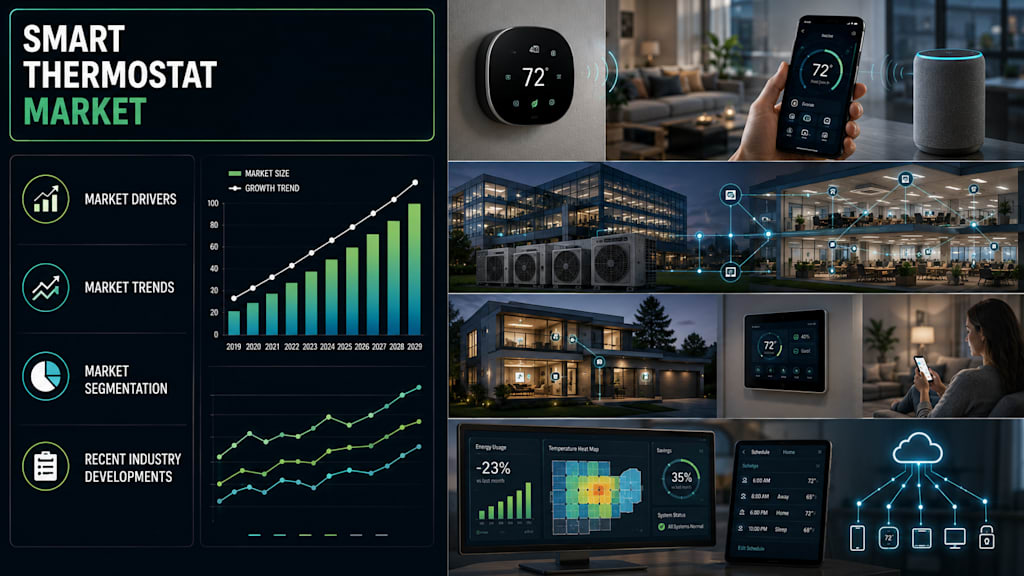
According to IMARC Group's latest research publication, the global smart thermostat market size reached USD 4.2 Billion in 2024. Looking forward, IMARC Group expects the market to reach USD 15.8 Billion by 2033. The widespread product utilization in commercial buildings, the growing product adoption in industrial settings, extensive research and development (R&D) activities, and the implementation of supportive government policies are some of the major factors propelling the Smart Thermostat Market.
How AI Is Reshaping the Future of the Smart Thermostat Market
- AI and Machine Learning for Personalized Climate Control: AI and ML algorithms integrated into learning smart thermostats analyze occupancy patterns, user preferences, and environmental conditions to automatically optimize temperature settings without manual intervention. These systems continuously adapt based on real-world usage data, delivering personalized comfort while maximizing energy efficiency. Companies deploying AI-driven smart thermostats have reported measurable reductions in HVAC energy consumption in residential and commercial settings, as the system eliminates the single largest source of waste which is conditioning unoccupied spaces.
- Geofencing and Predictive Temperature Management: Smart thermostats equipped with geofencing technology leverage smartphone location data to automatically shift into energy-saving modes when occupants leave a defined radius and pre-condition spaces before they return. This eliminates the need for manual scheduling entirely and ensures optimal temperatures are achieved precisely when needed. The integration of geofencing with AI-powered occupancy sensors allows thermostats to distinguish between regular and irregular schedule changes, making real-time adjustments without user input.
- Integration with Building Management Systems for Commercial Optimization: In commercial buildings, AI-enabled smart thermostats are integrated with centralized building management systems to provide unified control over HVAC, lighting, and security infrastructure. This integration enables precise zoning across large commercial spaces, allowing individual floors, departments, or zones to be conditioned independently based on real-time occupancy data. The result is significant energy savings in large office complexes, retail chains, hotels, and institutional facilities where blanket conditioning of unoccupied areas has historically represented a major cost burden.
Smart Thermostat Industry Overview
The global Smart Thermostat Market is experiencing robust momentum, driven by the convergence of energy efficiency mandates, rapid urbanization, and accelerating smart home adoption. Asia Pacific commands the largest regional market share, propelled by large-scale residential and commercial construction activity, supportive government energy efficiency regulations, and the presence of leading technology manufacturers advancing smart home ecosystems across tier-1 and tier-2 cities. The region's surging energy consumption, tied to economic growth and rapid industrialization, is simultaneously creating pressure to optimize that consumption through intelligent climate control devices.
Smart Thermostat Market Trends and Drivers
The rising emphasis on energy efficiency and sustainability is the primary structural driver of the Smart Thermostat Market. Smart thermostats are widely deployed to optimize heating and cooling operations, delivering significant reductions in utility bills and carbon footprints across residential and commercial segments. The growing awareness of climate change and greenhouse gas emissions has accelerated product adoption as consumers and organizations seek practical tools to reduce their environmental impact without sacrificing comfort. Regulatory frameworks mandating energy performance standards in buildings across North America, Europe, and Asia Pacific are further embedding smart thermostat adoption into compliance workflows rather than leaving it as a discretionary upgrade.
The expanding smart home ecosystem represents a powerful secondary growth engine. As voice assistants, smart lighting systems, home security networks, and energy management platforms become mainstream, smart thermostats serve as a natural integration point that enhances the value of the broader connected home. This ecosystem positioning drives both new adoption among first-time smart home buyers and upgrade cycles among existing users seeking greater interoperability. Wireless connectivity standards including Wi-Fi and Zigbee have lowered installation barriers significantly, allowing users to place thermostats optimally without the constraints of complex wiring infrastructure.
Leading Companies Operating in the Global Smart Thermostat Industry
- Nest Labs, Inc.
- Honeywell International Inc.
- Ecobee, Inc.
- Emerson Electric Co.
- Schneider Electric SE
- Tado GmbH
- Control4 Corporation
- Carrier Corporation
- Nortek, Inc.
Smart Thermostat Market Report Segmentation
By Product:
- Standalone Smart Thermostats
- Connected Smart Thermostats
- Learning Smart Thermostats
Learning smart thermostats represent the largest segment, as their machine learning capabilities deliver automated, personalized temperature optimization that eliminates manual scheduling and maximizes energy efficiency over time.
By Component:
- Display
- Temperature Sensors
- Humidity Sensors
- Motion Sensors
- Others
The display component holds a majority market share owing to its central role in enabling users to monitor real-time temperatures, manage schedules, and access energy consumption data through an intuitive interface.
By Technology:
- Wired
- Wireless (Wi-Fi, Zigbee, Others)
Wireless technology dominates the market due to its flexible installation, remote control capabilities, and seamless integration with smart home ecosystems without the constraints of complex wiring infrastructure.
By Application:
- Residential
- Commercial
- Industrial
Residential accounts for the largest application segment, driven by homeowner demand for energy savings, personalized comfort automation, and compatibility with broader smart home platforms.
Regional Insights:
- North America (United States, Canada)
- Asia Pacific (China, Japan, India, South Korea, Australia, Indonesia, Others)
- Europe (Germany, France, United Kingdom, Italy, Spain, Russia, Others)
- Latin America (Brazil, Mexico, Others)
- Middle East and Africa
Asia Pacific exhibits clear dominance in the Smart Thermostat Market due to rapid urbanization, large-scale construction activity, supportive government energy efficiency regulations, and the presence of leading smart home technology manufacturers across the region.
Recent News and Developments in the Smart Thermostat Market
- March 2025: Schneider Electric launched an updated commercial-grade smart thermostat integration for its building management platform, enabling real-time energy dashboards across multi-site enterprise portfolios and targeting hospitality and retail chains seeking centralized HVAC optimization.
- November 2025: Tado GmbH announced the rollout of its next-generation smart thermostat system across key European markets, incorporating geofencing-based automation and enhanced integration with heat pump systems as part of Europe's broader residential decarbonization push under national energy efficiency programs.
- February 2026: Nest Labs expanded its smart thermostat compatibility with third-party home energy management systems in the United States, allowing homeowners enrolled in utility demand response programs to access automated grid-responsive temperature adjustments, directly linking residential comfort management with national grid stability initiatives.
Note: If you require specific details, data, or insights that are not currently included in the scope of this report, we are happy to accommodate your request. As part of our customization service, we will gather and provide the additional information you need, tailored to your specific requirements. Please let us know your exact needs, and we will ensure the report is updated accordingly to meet your expectations.
About the Creator
Abhay Rajput
I am working in market research company that provides market and business research intelligence across the globe.
Enjoyed the story? Support the Creator.
Subscribe for free to receive all their stories in your feed.
Comments
There are no comments for this story
Be the first to respond and start the conversation.