
Smart Thermostat Market Outlook: Energy Efficiency, Smart Homes & Growth Drivers
How rising smart home adoption, energy efficiency awareness, and IoT integration are transforming demand patterns and accelerating growth in the smart thermostat market globally

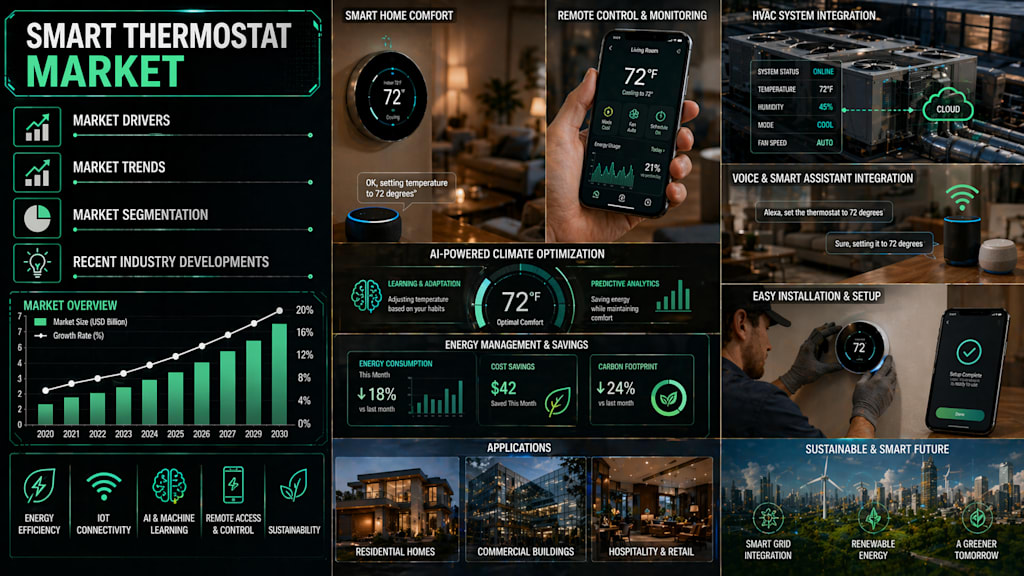
According to IMARC Group's latest research publication, The global smart thermostat market size was valued at USD 4.94 Billion in 2025 and is projected to reach USD 18.21 Billion by 2034, exhibiting a CAGR of 15.05% during the forecast period 2026-2034.
How AI is Reshaping the Future of the Smart Thermostat Market
- AI-Powered Learning and Occupancy Adaptation: Learning smart thermostats utilize artificial intelligence and machine learning algorithms to analyze occupancy patterns, user preferences, and environmental conditions, automatically optimizing temperature settings without manual input. These systems continuously refine their behavior based on real-time data, delivering personalized comfort while maximizing energy efficiency. The integration of geofencing technology further enhances this capability by leveraging user location data to pre-condition spaces before occupants arrive, eliminating unnecessary heating and cooling cycles and contributing to measurable reductions in energy consumption across residential and commercial installations.
- Predictive Maintenance and Real-Time Monitoring: AI-enabled smart thermostats embedded with advanced environmental sensors monitor ambient temperature, humidity, and air quality simultaneously, generating continuous data streams that support predictive maintenance strategies for HVAC systems. By detecting anomalies in equipment performance before failures occur, these intelligent systems reduce costly downtime in industrial settings such as warehouses, factories, and distribution centers. Real-time alerting capabilities ensure that facility managers can respond immediately to deviations, protecting sensitive processes in sectors including food processing, pharmaceuticals, and cold chain logistics where temperature integrity is non-negotiable.
- Demand Response Integration and Grid Optimization: Smart thermostats are increasingly deployed as active participants in utility demand response programs, automatically adjusting temperature settings during peak grid load periods to reduce electricity demand across entire networks. AI-driven demand response coordination allows buildings to contribute to grid stability without compromising occupant comfort, with systems intelligently selecting optimal adjustment windows based on historical usage patterns and real-time pricing signals. Commercial buildings leveraging this capability report measurable reductions in peak demand charges, directly improving operational cost structures for large office complexes, retail chains, and hospitality venues.
- Building Management System Integration and Zoning Intelligence: Advanced smart thermostats integrate seamlessly with broader building management systems to provide centralized control of HVAC, lighting, and security infrastructure from unified platforms. AI-powered zoning capabilities allow large commercial spaces to heat or cool individual areas independently based on real-time occupancy data, eliminating the energy waste associated with conditioning unoccupied zones. These integrated systems generate detailed analytics and reporting on energy usage patterns, enabling facility managers to identify further optimization opportunities, track the effectiveness of energy management strategies, and demonstrate regulatory compliance with evolving building performance standards.
- Voice Assistant and Connectivity Ecosystem Expansion: The incorporation of voice assistant compatibility, enabling hands-free thermostat control through platforms such as Amazon Alexa and Google Assistant, is substantially broadening consumer adoption by lowering the interaction barrier for non-technical users. AI continuously improves voice recognition accuracy and contextual command interpretation, making smart thermostat control increasingly intuitive across residential, commercial, and hospitality applications. Wireless connectivity modules enable seamless retrofitting into existing building stock without rewiring, expanding the addressable market beyond new construction to include the vast global inventory of aging commercial and residential buildings undergoing modernization.
Smart Thermostat Industry Overview
The global smart thermostat market is experiencing strong growth momentum, driven by the convergence of energy efficiency mandates, smart building infrastructure expansion, and accelerating artificial intelligence integration into everyday climate management systems. Governments across major economies are actively accelerating adoption through regulatory frameworks and incentive structures. In the United States, the ENERGY STAR program administered by the Environmental Protection Agency certifies devices meeting strict energy performance criteria, with utility rebates reaching USD 100 or more per device across several jurisdictions. The U.S. Department of Energy's building decarbonization initiatives are embedding HVAC intelligence as a core pillar of national climate policy.
In Europe, the Energy Performance of Buildings Directive requires member states to mandate smart-ready technologies, including intelligent thermostats, across new construction and renovation projects. Countries including Germany, the United Kingdom, and the Netherlands have introduced dedicated subsidy programs incentivizing smart climate control adoption among households and commercial landlords. In Asia, India's Bureau of Energy Efficiency has advanced smart building compliance standards, while China's carbon neutrality commitments are accelerating intelligent HVAC control deployment across commercial real estate at national scale.
The residential segment continues to generate substantial volume as smart home ecosystem adoption pulls thermostat demand, with connected devices integrating into broader platforms covering smart lighting, home security, and voice control. The commercial segment delivers higher per-unit value, with large office complexes, hotel groups, and retail chains deploying enterprise-grade thermostat networks to achieve zone-level precision control. The industrial segment is emerging as a high-growth application area as manufacturers, logistics operators, and pharmaceutical producers recognize the operational and compliance advantages of intelligent temperature management. Wireless technology leads installation volumes due to simplified retrofitting into existing buildings, while wired systems maintain preference in new construction for reliability and consistent connectivity performance.
Smart Thermostat Market Trends and Drivers
The rising emphasis on energy efficiency and cost savings represents the foundational demand driver for the smart thermostat market. Heating and cooling systems account for nearly half of total energy consumption in residential and commercial buildings globally, and smart thermostats are uniquely positioned to optimize this expenditure through data-driven automation. The ability to simultaneously reduce carbon footprints and lower utility bills positions smart thermostats not as a discretionary purchase but as a strategic operational investment across all building categories.
The increasing adoption of smart homes is creating powerful ecosystem pull for thermostat upgrading, as consumers who invest in voice assistants, smart lighting, and home security systems require compatible climate control devices to complete centralized home management platforms. Over 68% of households in major urban centers now interact with at least one smart home device regularly, reflecting a structural behavioral shift that directly expands the addressable base for smart thermostat providers.
Extensive research and development activity is continuously elevating product capability. The integration of advanced occupancy sensors capable of distinguishing between room presence and room activity patterns allows newer learning thermostats to achieve precision conditioning that earlier generations could not replicate. The incorporation of humidity sensing alongside temperature monitoring enables systems to account for perceived comfort beyond simple degree readings, improving occupant satisfaction in climates where humidity management is as important as temperature control. Rapid modernization of aging building stock across North America, Europe, and Asia Pacific is generating a sustained replacement cycle that sustains market volume independent of new construction activity, ensuring that demand fundamentals remain highly favorable across multiple economic conditions.
Leading Companies Operating in the Global Smart Thermostat Industry
- Alphabet Inc. (Google LLC)
- Amazon.com Inc.
- Carrier Global Corporation
- Daikin Industries Ltd.
- Ecobee
- Emerson Electric Co.
- Honeywell International Inc.
- Johnson Controls International plc
- Lennox International Inc.
- Robert Bosch GmbH
- Schneider Electric SE
- Siemens AG
Smart Thermostat Market Report Segmentation
By Product:
- Standalone Smart Thermostats
- Connected Smart Thermostats
- Learning Smart Thermostats
Learning smart thermostats represent the largest and fastest-advancing segment, leveraging AI and machine learning to adapt automatically to occupancy patterns without manual programming.
By Component:
- Display
- Temperature Sensors
- Humidity Sensors
- Motion Sensors
- Others
Temperature and motion sensors collectively drive the highest differentiation value, with occupancy-sensing capability increasingly considered a baseline requirement across premium product tiers.
By Technology:
- Wired
- Wireless
Wireless technology leads adoption due to retrofitting simplicity, while wired installations remain preferred in new commercial and industrial construction.
By Application:
- Residential
- Commercial
- Industrial
Commercial applications generate the highest per-unit value, while residential applications lead in volume, and industrial applications represent the fastest-emerging demand segment.
Regional Insights:
- North America (United States, Canada)
- Asia Pacific (China, Japan, India, South Korea, Australia, Indonesia, Others)
- Europe (Germany, France, United Kingdom, Italy, Spain, Russia, Others)
- Latin America (Brazil, Mexico, Others)
- Middle East and Africa
North America exhibits clear dominance in the smart thermostat market owing to the presence of advanced building infrastructure, high consumer technology adoption rates, and a well-established regulatory environment promoting energy-efficient building systems.
Recent News and Developments in the Smart Thermostat Market
- January 2026: Honeywell International announced the commercial launch of its next-generation T10 Pro smart thermostat series featuring enhanced AI occupancy learning and expanded compatibility with Matter smart home protocol, strengthening its position across both residential and commercial building segments in North America and Europe.
- November 2025: Ecobee introduced its SmartThermostat Premium with built-in air quality monitoring and carbon dioxide sensing, targeting health-conscious homeowners and green-certified commercial building operators seeking comprehensive indoor environment management beyond standard temperature control.
- August 2025: Google expanded its Nest thermostat lineup with a new model incorporating advanced geofencing precision and deeper Google Home integration, enabling automated temperature scheduling based on multiple household member locations simultaneously rather than single-device proximity detection.
- April 2025: Schneider Electric launched its EcoStruxure Building Advisor update, embedding AI-powered smart thermostat analytics directly into its enterprise building management platform, enabling facility managers across commercial and industrial portfolios to access predictive HVAC maintenance alerts from a unified dashboard.
- October 2024: Emerson Electric introduced the Sensi Predict service combining smart thermostat data with HVAC diagnostic algorithms to deliver predictive maintenance subscriptions for residential and light commercial customers, positioning the company at the intersection of connected device hardware and recurring service revenue models.
Note: If you require specific details, data, or insights that are not currently included in the scope of this report, we are happy to accommodate your request. As part of our customization service, we will gather and provide the additional information you need, tailored to your specific requirements. Please let us know your exact needs, and we will ensure the report is updated accordingly to meet your expectations.
About the Creator
Abhay Rajput
I am working in market research company that provides market and business research intelligence across the globe.
Enjoyed the story? Support the Creator.
Subscribe for free to receive all their stories in your feed.
Comments
There are no comments for this story
Be the first to respond and start the conversation.