
Smart Textiles Market Witnesses Strong Growth Through Innovation
How wearable technology integration, smart fabric innovation, and connected healthcare applications are driving demand and transforming the global smart textiles market.

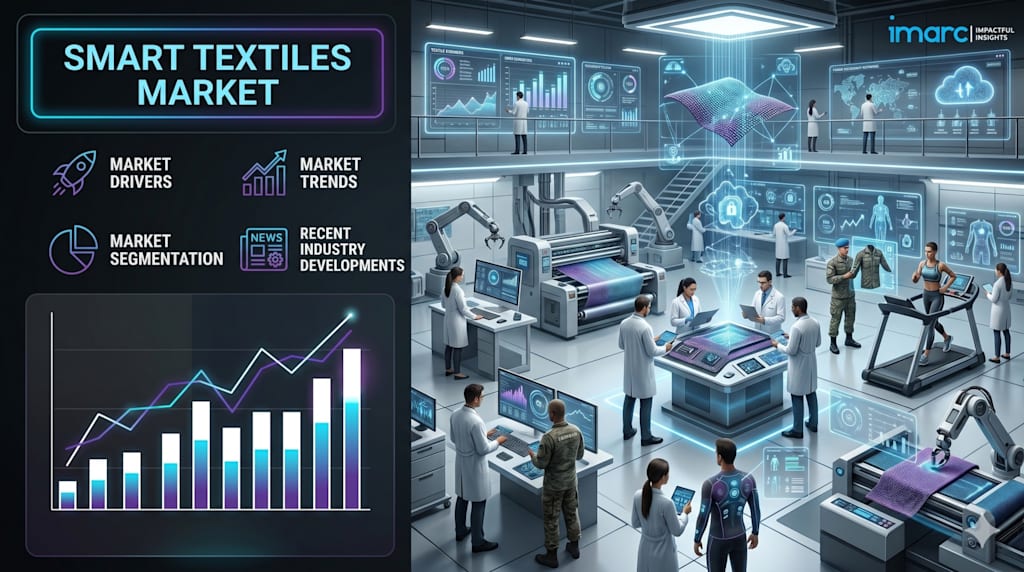
According to IMARC Group's latest research, The global smart textiles market size reached USD 6.0 Billion in 2025. Looking forward, IMARC Group expects the market to reach USD 30.2 Billion by 2034, exhibiting a growth rate (CAGR) of 18.80% during 2026-2034.
How Smart Textiles Are Reshaping the Future of Functional Fabric
- IoT Integration Turning Garments into Data Gateways: Smart textiles are rapidly emerging as a preferred physical interface for Internet of Things ecosystems, embedding sensing, data transmission, and feedback capabilities directly into wearable fabric. Unlike clip-on sensors or wrist-worn devices, these textiles maintain continuous skin contact without disrupting comfort or mobility, making them significantly more effective for continuous physiological monitoring in clinical and athletic settings. Government bodies and institutional research funders are actively channeling grants into scaling IoT-enabled textile applications, recognizing their strategic potential in sectors like defense, elder care, and remote patient monitoring.
- Material Science Breakthroughs Unlocking New Capabilities: Laboratories worldwide are incorporating conductive polymers, nanomaterials, and advanced composite structures into conventional fabric matrices, dramatically expanding what a textile can sense, emit, or respond to. Researchers at the University of Cambridge and Aalto University in Finland jointly developed innovative textiles capable of changing shape in response to temperature variations, while a Stanford University team engineered low-cost plastic clothing material that cools the body more efficiently than synthetic or natural fabrics. These advances are compressing the product development cycle, enabling faster transition from academic prototyping to commercial manufacturing.
- Sustainability Mandates Pushing Eco-Intelligent Design: As environmental accountability becomes a non-negotiable operating standard across global supply chains, smart textile manufacturers are fusing high-performance electronics with eco-responsible materials. Schoeller Textil AG launched its Re-Source collection, built from recycled bio-based and spandex fabrics, demonstrating that advanced functionality and environmental responsibility are no longer competing design priorities. This convergence is attracting a new cohort of institutional buyers in architecture, transportation, and fashion who require both technical performance and verifiable sustainability credentials.
Smart Textiles Industry Overview: Fabric at the Frontier of Innovation
The Smart Textiles Market operates at the intersection of advanced material engineering, wearable technology, and the global push for connected, intelligent infrastructure. North America commands the largest regional share, underpinned by substantial R&D investment in defense and healthcare applications and a mature institutional framework of government grants and collaborative research programs. The Canadian military deployed full-fabric keyboards in its IAV Stryker units, while Acellent Technologies in the United States partnered with the U.S. Army to develop a smart armor system designed to structurally monitor body armor in real time. These deployments illustrate how deeply embedded smart textile adoption has become within defense procurement strategies.
Across the Asia Pacific region, the Indian Institute of Technology signed a memorandum of understanding with Troop Comforts Limited to develop smart protective clothing for Indian security forces, signaling that government-driven adoption is accelerating beyond North American borders. In Europe, innovation ecosystems from Germany to the United Kingdom continue to produce foundational research that feeds directly into commercial product pipelines, sustaining the continent's position as a key contributor to global market momentum.
Forces Driving Smart Textiles Market Demand
The military and protection sector represents the single largest end-use segment in the Smart Textiles Market, a position driven by defense establishments' ongoing requirement for garments that can monitor vital signs, regulate thermal environments, provide camouflage adaptation, and integrate communication systems without adding to a soldier's physical burden. UMass Lowell's work on carbon-based transistors, wearable antennas, and photonic devices for military applications exemplifies the institutional depth of investment in this category. U.S. researchers introduced wearable gas sensors integrated directly into military uniforms to monitor soldier health and safety in hazardous environments, a development that underscores the life-critical value proposition of smart textile technology.
In healthcare, smart textiles are enabling remote patient monitoring, wound care management, and intelligent compression garments that improve patient comfort while reducing reliance on periodic manual assessments. The energy harvesting functionality segment leads the market by share within the functionality breakdown, driven by the healthcare sector's urgent need to power embedded medical sensors continuously without frequent battery replacements. Cambridge University researchers developed a fabric integrating LEDs, energy harvesting, storage capabilities, and sensors simultaneously into a single garment layer, a landmark milestone that points toward fully autonomous, self-powered medical wearables.
In sports and fitness, Nextiles introduced smart thread technology that records biomechanical and physiological data through conventional stitching methods combined with printed circuit boards, while Wearable X launched Nadi X yoga pants that deliver haptic feedback vibrations to guide users through precise posture corrections via a connected app. These commercial implementations signal that smart textiles have progressed from experimental prototypes into mass-market consumer products with clear behavioral engagement value.
Leading Companies Operating in the Global Smart Textiles Market
- AiQ Smart Clothing Inc.
- Hexoskin (Carre Technologies Inc.)
- Interactive Wear AG
- Outlast Technologies GmbH
- Schoeller Textil AG
- Sensoria Health Inc.
- Wearable X
- Xenoma Inc.
- Smart Textiles Market Segmentation
By Type:
- Active Smart Textiles hold the largest market share, driven by their ability to dynamically respond to environmental stimuli including temperature, pressure, and electrical signals. Loomia Technologies' Electronic Layer (LEL) integrates directly into garments to provide a subtle, controllable climate layer for wearers, illustrating the commercial maturity of active textile applications.
- Passive Smart Textiles serve foundational roles in health monitoring and protective applications where reactivity is less critical than durability and consistent sensing performance.
By Functionality:
- Energy Harvesting commands the majority of market share, fueled by the growing dependency on IoT-connected devices that require uninterrupted power and the accelerating healthcare sector demand for self-sustaining wearable sensors.
- Sensing supports critical applications across military, sports, and clinical monitoring, tracking biometric indicators such as heart rate, body temperature, and movement with precision.
- Other functionality segments include Luminescence and Aesthetics, Thermoelectricity, and emerging hybrid configurations being developed for specialized industrial and consumer applications.
By End-Use Sector:
- Military and Protection dominates with the largest share, supported by defense procurement budgets, government-mandated R&D initiatives, and the irreplaceable operational value of in-uniform monitoring and communication systems.
- Healthcare is the most rapidly evolving segment, propelled by aging global populations, the expansion of remote care infrastructure, and the commercial viability of continuous biometric wearables.
- Sports and Fitness is growing at a compelling pace as athlete performance optimization, injury prevention analytics, and consumer wellness culture intersect.
- Additional sectors include Fashion and Entertainment, Transportation, and Architecture, each developing specialized textile applications aligned with their sector-specific performance requirements.
By Region:
- North America leads the global market, backed by extensive defense and healthcare R&D expenditure, a strong institutional grant ecosystem, and the widespread consumer adoption of connected wearable products.
- Asia Pacific is gaining momentum rapidly, supported by government initiatives in India, South Korea, and Japan targeting smart material development and integration into domestic defense and healthcare infrastructure.
- Europe maintains a strong research and innovation foundation, contributing foundational material science breakthroughs that feed the global product pipeline.
- Latin America and the Middle East and Africa represent emerging opportunity zones as awareness of smart textile applications grows alongside infrastructure investments in healthcare and defense.
Recent News and Developments in the Smart Textiles Market
- April 2024: Crystal International Group Limited launched its Smart-Fit denim collection in partnership with LYCRA and Advance Denim, producing nine pairs of jeans combining comfort features with body-enhancing structural design, signaling a notable convergence of fashion aesthetics and functional textile engineering.
- April 2024: Xiaomi introduced the Mijia Smart Invisible Clothes Dryer, featuring a built-in 36W adjustable light system with color temperature control, night light functionality, and full app integration via the Mijia platform, extending smart home connectivity into garment care infrastructure.
- March 2024: The Central Institute of Research on Cotton Technology in Mumbai conducted a three-day training program on Smart Textiles and its Evaluation under the Indian Council of Agricultural Research's Scheduled Caste Sub Plan scheme, a government-backed initiative designed to build specialized technical capacity in smart textile evaluation among underserved professional communities.
Note: If you require specific details, data, or insights that are not currently included in the scope of this report, we are happy to accommodate your request. As part of our customization service, we will gather and provide the additional information you need, tailored to your specific requirements. Please let us know your exact needs, and we will ensure the report is updated accordingly to meet your expectations.
About the Creator
Abhay Rajput
I am working in market research company that provides market and business research intelligence across the globe.
Enjoyed the story? Support the Creator.
Subscribe for free to receive all their stories in your feed.
Comments
There are no comments for this story
Be the first to respond and start the conversation.