
Smart Parking Market Size & Forecast 2026–2034: Why Intelligent Parking Is Becoming a Core Urban Infrastructure Layer
Rising vehicle ownership, urban congestion, smart city spending, and cashless mobility are turning parking from a daily hassle into a data-driven service category.

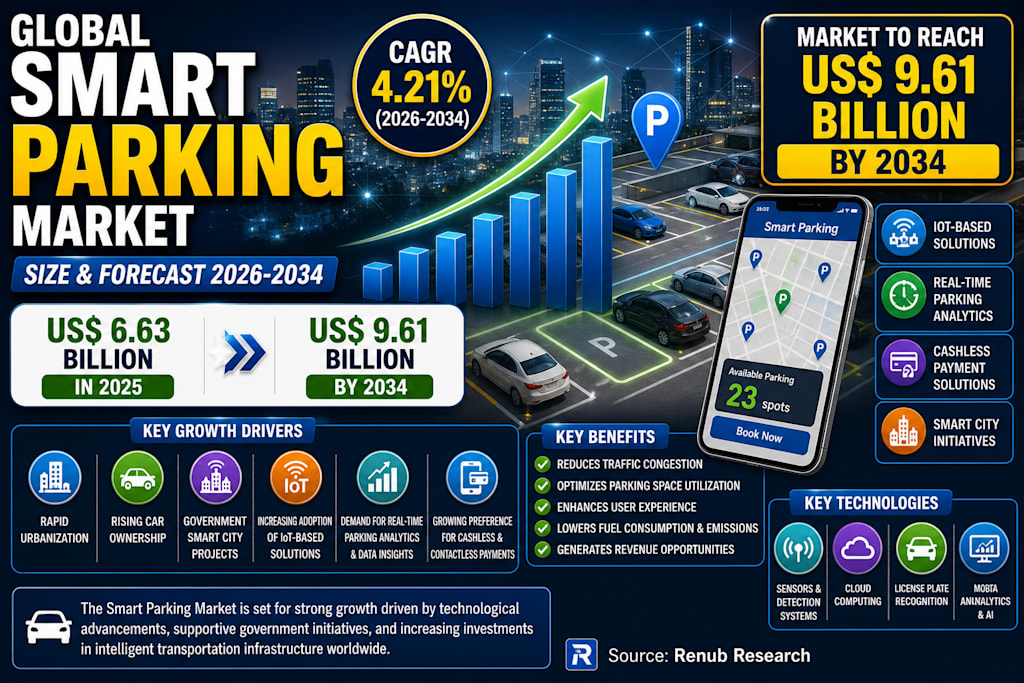
The global smart parking market is moving from a convenience upgrade to a necessity for modern cities and commercial spaces. According to Renub Research, the market is expected to rise from US$ 6.63 billion in 2025 to US$ 9.61 billion by 2034, reflecting a CAGR of 4.21% from 2026 to 2034. The growth story is being shaped by rapid urbanization, higher car ownership, smarter transport planning, and the wider adoption of IoT-based parking tools, real-time analytics, and cashless payment systems.
At its core, smart parking uses digital tools such as sensors, cameras, mobile applications, license plate recognition, cloud software, and data analytics to manage parking spaces more efficiently. These systems help drivers find available spaces faster, support automated payments, improve enforcement, and reduce the traffic created by people circling blocks in search of parking. That makes smart parking relevant not only for cities, but also for airports, malls, office towers, hospitals, hotels, and residential developments.
Why the Market Is Expanding So Quickly
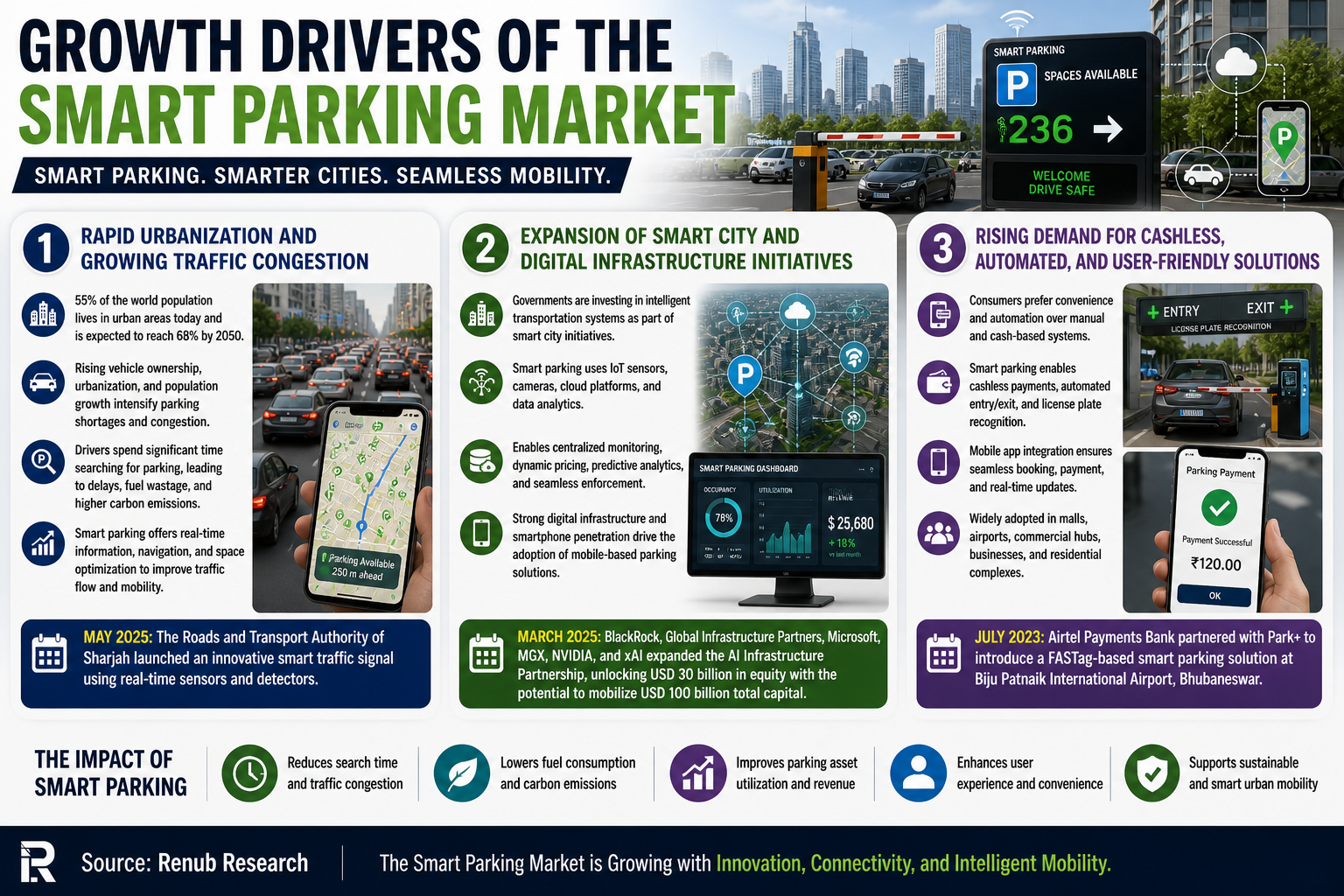
One of the strongest growth drivers is urbanization. As more people move into cities and vehicle ownership keeps rising, parking pressure has become a daily problem in dense urban areas. Traditional parking systems often waste time, create congestion, and increase fuel consumption as drivers search for open spots. Smart parking systems respond to this by showing real-time occupancy, guiding vehicles directly to free spaces, and improving overall traffic flow. In a city environment, even a few minutes saved per driver can create a meaningful impact on congestion and emissions.
Smart city investment is another major catalyst. Governments and municipalities are increasingly building intelligent transportation ecosystems that connect parking, traffic signals, payment platforms, and mobility apps into one digital layer. Because smart parking can be integrated with IoT sensors, cameras, cloud dashboards, and predictive analytics, it fits naturally into broader urban modernization plans. The rise of smartphone use and digital payment habits has also made app-based parking far easier to scale than older manual systems.
Consumer expectations are changing too. Drivers now want convenience, contactless entry, automatic billing, and less time wasted at parking gates or ticket booths. That is why the market is seeing stronger adoption of license plate recognition, FASTag-linked systems, mobile booking, digital validation, and automated access control. For operators, these features can improve efficiency, reduce leakage, and create new revenue opportunities through dynamic pricing and better utilization of space.
Key Challenges Still Holding the Market Back
Even with strong momentum, the smart parking market is not frictionless. The biggest challenge is cost. Installing sensors, cameras, meters, signage, software, and communication infrastructure can be expensive, especially for smaller municipalities and facilities with limited budgets. Integration and maintenance costs can also rise when older parking systems need to be upgraded or connected to new digital platforms.
Privacy and standardization are also important concerns. Smart parking systems handle vehicle details, payment data, location data, and usage patterns, which makes cybersecurity and data governance essential. In markets with strict data protection requirements, public trust can be weakened if users feel that their data is not being handled responsibly. A lack of technical standardization across vendors can also make deployment slower and less consistent.
Segment Trends That Are Defining the Market
The smart parking ecosystem is broader than many people realize. Hardware includes wireless pucks, smart meters, cameras, license plate recognition systems, gates, and signage. Software includes parking guidance, analytics, and centralized management tools. Services cover consulting, engineering, and app-based parking services. The market is also split between on-street and off-street deployments, with applications across commercial, government, and transport-transit settings. That range is one reason the industry is expected to keep expanding across multiple use cases rather than relying on a single revenue stream.
On-street parking is especially important in crowded urban cores because curb space is limited and highly valuable. Smart meters, cameras, and real-time availability tools can reduce illegal parking and improve enforcement while also making pricing more transparent. Off-street parking, meanwhile, is a natural fit for shopping centers, airports, hospitals, and office campuses, where operators want smoother access, better customer experience, and stronger control over traffic entering and leaving the facility.
Among the technology-driven submarkets, parking guidance systems and mobile app parking services are drawing strong attention. Guidance systems help drivers locate free spaces quickly, while mobile apps let users reserve, navigate to, and pay for parking without cash. When these tools are paired with sensors and recognition technology, they create a seamless end-to-end experience that is hard for legacy parking systems to match.
Regional Outlook: Where the Demand Is Strongest
The United States remains one of the most mature smart parking markets, supported by high car ownership, dense cities, airport modernization, and strong adoption of app-based mobility tools. Cities such as New York, Los Angeles, San Francisco, and Chicago have already invested in sensors, cameras, and license plate recognition. Public-private partnerships have also played a major role in rolling out new systems.
The United Kingdom is another important market because of its dense urban centers, parking regulation needs, and strong push toward cashless mobility. London and other major cities are increasingly focused on systems that reduce congestion and simplify payment. China is seeing fast growth as well, driven by large-scale urbanization, parking shortages in megacities, mobile payment dominance, and strong government support for smart city infrastructure.
Saudi Arabia is emerging as a promising market thanks to modernization efforts linked to Vision 2030, smart mobility projects, and new infrastructure investment. Across the Middle East, the combination of commercial expansion, government support, and urban redevelopment is creating more room for smart parking adoption. That pattern is likely to continue as cities look for ways to reduce congestion and make land use more efficient.
Recent Developments From Companies and Market Players
Sharjah’s Roads and Transport Authority announced a smart traffic signal in May 2025 that uses real-time sensors and detectors, showing how parking and traffic management are becoming more connected in the region.
BlackRock, Global Infrastructure Partners, Microsoft, MGX, NVIDIA, and xAI expanded the AI Infrastructure Partnership in March 2025, unlocking US$ 30 billion in equity with the potential to mobilize US$ 100 billion in total capital, a sign that digital infrastructure investment is accelerating across mobility-related systems.
Airtel Payments Bank and Park+ launched a FASTag-based smart parking solution at Biju Patnaik International Airport in July 2023, helping make airport parking more frictionless and cashless.
San Antonio International Airport introduced the first AI-based smart parking system in the United States in November 2024, replacing traditional tickets with checkout-free payment technology from Metropolis Technologies.
The UK government launched the National Parking Platform in May 2025, aiming to simplify parking payment by reducing the need to search for different apps each time a driver parks.
BYD Auto said in July 2025 that it had achieved smart parking comparable to L4 level, underscoring how automated parking capabilities are advancing alongside the broader electric and intelligent vehicle ecosystem.
IPARK, working with PanStreet International, implemented a smart parking enforcement technology project in Buraidah in November 2025, reinforcing the Middle East’s growing interest in managed curbside mobility.
Metropolis continues to position itself as a major operator in checkout-free parking, highlighting AI-powered vehicle recognition, seamless payments, and large-scale deployment across its platform. The company says it has secured US$ 1.6 billion in financing to accelerate its recognition-economy strategy.
Amano reported its FY2025 business results and announced its 10th Mid-Term Business Plan in April 2026, while continuing to emphasize parking systems, cloud services, and maintenance as part of its business portfolio.
Continental showcased assisted and automated driving functions that include parking capabilities at Auto Shanghai 2025, reflecting how smart parking is increasingly tied to in-vehicle intelligence and connected mobility systems.
Final Thoughts
The smart parking market is no longer just about helping drivers find a space. It is becoming part of a larger urban operating system where parking, traffic flow, payment, enforcement, and mobility data all work together. That is why the market’s growth is tied not only to car ownership, but also to city planning, digital infrastructure, and the demand for smoother everyday movement. With Renub Research projecting steady expansion through 2034, smart parking looks set to remain one of the more practical and commercially attractive corners of the smart city economy.
For readers and investors, the clearest takeaway is simple: the future of parking is connected, automated, and increasingly invisible to the driver. The companies that can combine hardware, software, data, and user experience into one reliable platform will likely shape the next phase of this market.
About the Creator
Enjoyed the story? Support the Creator.
Subscribe for free to receive all their stories in your feed.
Comments
There are no comments for this story
Be the first to respond and start the conversation.