
Smart Parking Market Expands as Urbanization, AI, and Cashless Mobility Transform Global Transportation
Rising vehicle ownership, smart city investments, and growing demand for automated parking solutions are accelerating the adoption of intelligent parking systems worldwide.

Market Overview
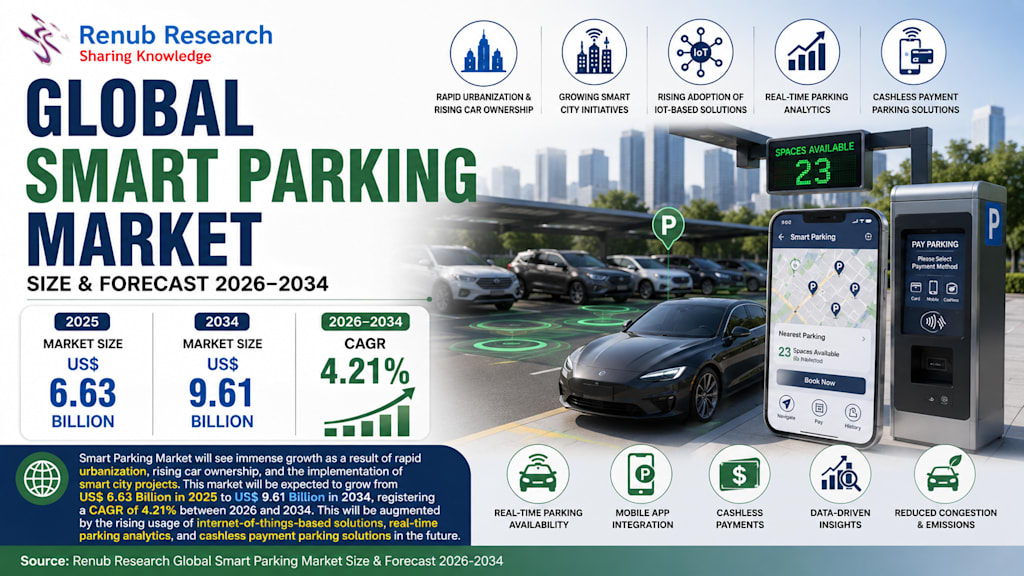
The global smart parking market is witnessing rapid expansion as cities worldwide confront rising traffic congestion, increasing vehicle ownership, and the growing pressure to modernize urban infrastructure. Parking management has become one of the most critical challenges for urban mobility systems, especially in densely populated metropolitan regions where limited parking availability contributes heavily to traffic delays and environmental pollution. According to Renub Research, the global smart parking market is projected to grow from US$ 6.63 billion in 2025 to US$ 9.61 billion by 2034, registering a CAGR of 4.21% during 2026–2034.
Smart parking solutions combine digital technologies such as the Internet of Things (IoT), sensors, cameras, mobile applications, cloud platforms, and data analytics to improve parking management efficiency. These systems provide real-time information about parking availability, guide drivers toward empty spaces, enable cashless payments, and support automated enforcement and dynamic pricing models. Smart parking technologies are now being deployed across on-street, off-street, commercial, residential, and transport transit applications as cities seek more efficient traffic management systems.
The market is benefiting significantly from the global expansion of smart city projects. Governments and municipalities across North America, Europe, Asia Pacific, and the Middle East are investing heavily in intelligent transportation systems designed to reduce congestion, improve environmental sustainability, and optimize urban mobility. Smart parking systems have become an essential component of these initiatives because they reduce the time drivers spend searching for parking spaces, lower fuel consumption, and improve traffic flow efficiency.
Consumer demand for convenience is also reshaping the parking industry. Traditional parking systems involving paper tickets, manual cash payments, and long queues are increasingly viewed as outdated and inefficient. Drivers today expect contactless entry, mobile payment integration, app-based reservations, and automated parking experiences similar to other digital services they use daily. As a result, parking operators, airports, shopping centers, and commercial facilities are rapidly upgrading their infrastructure to meet these expectations.
Growth Drivers
Rapid urbanization remains one of the strongest growth drivers for the smart parking market. According to United Nations estimates mentioned in the report, approximately 55% of the world’s population currently lives in urban areas, and this figure is expected to rise to 68% by 2050. Nearly 2.5 billion additional people are projected to move into urban regions during this period, with Asia and Africa accounting for almost 90% of this increase.
As urban populations expand, traffic congestion and parking shortages are becoming more severe. Drivers searching for available parking spaces contribute significantly to urban congestion, wasted fuel, and carbon emissions. Smart parking technologies address this issue by providing real-time parking availability data, navigation support, and space optimization tools. These solutions improve transportation mobility and reduce unnecessary traffic circulation within cities.
Government-backed smart city initiatives are another major growth catalyst. Cities are increasingly deploying IoT sensors, cloud-based analytics, and AI-powered traffic systems to create more connected and efficient urban environments. Smart parking solutions are being integrated into broader intelligent transportation frameworks that include traffic signals, public transportation, and mobility management systems. In May 2025, the Roads and Transport Authority of Sharjah launched an innovative smart traffic signal system using real-time sensors and detectors, highlighting the broader regional movement toward intelligent transportation infrastructure.
Digital infrastructure expansion is also making smart parking solutions more practical and accessible. Smartphone penetration, mobile payment adoption, and cloud computing capabilities have accelerated the shift toward app-based parking services. Drivers can now locate available parking spaces, reserve spots, receive navigation guidance, and complete cashless payments entirely through mobile applications. These features improve user convenience while helping operators increase efficiency and optimize revenue management.
Consumer preference for automation and frictionless mobility is further strengthening the market. Smart parking systems using license plate recognition (LPR), RFID, QR code readers, and automated gates reduce waiting times and eliminate manual ticket handling. Businesses, airports, shopping malls, and commercial centers are increasingly adopting these systems to improve customer satisfaction and operational efficiency. In July 2023, Airtel Payments Bank partnered with Park+ to introduce a FASTag-based smart parking solution at Biju Patnaik International Airport in Bhubaneswar, enabling seamless automatic cashless parking payments.
Market Challenges
Despite strong growth potential, the smart parking industry faces several important challenges. One of the biggest barriers is the high implementation and integration cost associated with smart parking infrastructure. Advanced parking systems require investment in sensors, cameras, software platforms, networking systems, and ongoing maintenance. For smaller cities and resource-constrained municipalities, these costs can become a major obstacle to adoption.
Technology upgrades also present difficulties because parking infrastructure often requires compatibility with existing transportation systems. Integrating legacy hardware with modern IoT-based platforms can be technically complex and financially burdensome. Frequent software updates and evolving technological standards further increase operational costs for parking operators and municipalities.
Data privacy and cybersecurity concerns represent another significant challenge. Smart parking systems collect large amounts of data, including vehicle details, payment information, and geolocation records. Countries with strict privacy regulations require operators to maintain high standards of data security and compliance. Cybersecurity threats, unauthorized access, and lack of standardization across different platforms can reduce public trust and slow adoption rates.
To achieve sustainable growth, industry participants must strengthen data protection systems, improve interoperability, and establish clearer regulatory frameworks that balance innovation with privacy protection.
Smart Parking Cameras and LPR Market
Smart parking cameras and License Plate Recognition (LPR) systems are becoming one of the most important segments within the broader smart parking ecosystem. These technologies use AI-powered cameras and advanced image-processing software to recognize vehicle license plates in real time. LPR systems enable automated entry and exit, ticketless billing, enforcement management, and enhanced security without requiring physical tickets or access cards.
Airports, office complexes, shopping malls, and urban municipalities are rapidly adopting LPR solutions because they improve operational efficiency and reduce labor costs. Advances in artificial intelligence, machine learning, and image recognition are also improving performance under varying lighting and weather conditions, making the technology more reliable for large-scale deployment.
Smart Parking Gates Market
The smart parking gates market focuses on automated entry and exit systems integrated with technologies such as RFID, QR codes, mobile apps, and LPR systems. Automated gates reduce manual intervention and help minimize congestion at parking facility entrances. These systems are increasingly being deployed across commercial buildings, residential complexes, airports, and corporate campuses where efficiency and security are critical priorities.
The growing demand for touchless and automated mobility experiences is expected to further accelerate adoption of smart parking gate systems worldwide.
Smart Parking Guidance System Market
Smart parking guidance systems help drivers identify available parking spaces quickly using sensors, cameras, and digital signage. These systems are widely used in airports, shopping malls, hospitals, and commercial complexes where parking demand is high and efficient space utilization is essential.
By reducing the time spent searching for parking spaces, guidance systems improve customer satisfaction while helping facilities optimize parking capacity. As urban mobility challenges intensify, parking guidance technologies are expected to become increasingly important in modern transportation management.
Smart Parking Mobile App Parking Service Market
The smart parking mobile app market is expanding rapidly due to growing smartphone adoption and demand for digital convenience. Mobile applications allow drivers to locate parking spaces, reserve spots, receive navigation assistance, and complete cashless payments through integrated platforms.
These applications often work together with sensors, smart meters, and LPR technologies to provide real-time parking information and seamless user experiences. As digital lifestyles continue evolving, app-based parking services are expected to become a standard component of urban transportation systems.
On-Street Smart Parking Market
On-street smart parking systems focus on managing curbside parking in crowded urban areas using cameras, sensors, and digital meters. These solutions monitor real-time space availability, support dynamic pricing models, and improve parking enforcement efficiency.
Cities benefit from increased revenue transparency, reduced illegal parking, and improved traffic management. Smart curbside management is becoming increasingly important as municipalities attempt to optimize limited urban parking space and reduce congestion.
Commercial Smart Parking Market
The commercial smart parking sector serves shopping malls, airports, office buildings, hotels, hospitals, and entertainment venues. These facilities are implementing intelligent parking systems to improve customer convenience, increase operational efficiency, and generate higher revenue.
Commercial smart parking solutions typically combine guidance systems, access control, mobile payments, analytics, and automated enforcement tools into integrated platforms. Rising traffic volumes and growing expectations for seamless customer experiences are expected to continue driving demand across this segment.
United States Smart Parking Market
The United States represents one of the most advanced smart parking markets globally due to high vehicle ownership rates, urban congestion, and widespread adoption of digital technologies. Cities such as New York, Los Angeles, Chicago, and San Francisco have implemented extensive smart parking infrastructure using sensors, cameras, app-based systems, and LPR technologies.
Public-private partnerships have played a major role in accelerating deployment across airports, commercial centers, and urban transportation systems. In November 2024, San Antonio International Airport launched the United States’ first AI-based smart parking system powered by Metropolis Technologies, replacing traditional parking tickets with AI-driven checkout-free payment technology.
United Kingdom Smart Parking Market
The United Kingdom smart parking market is driven by high urban density, strong environmental regulations, and increasing demand for cashless transportation systems. Cities including London, Manchester, Birmingham, and Bristol are integrating smart parking into broader urban mobility strategies aimed at reducing emissions and improving traffic management.
In May 2025, the UK government launched the National Parking Platform, a unified parking payment system designed to eliminate the need for multiple parking apps. The initiative reflects the country’s commitment to improving convenience and simplifying digital parking experiences nationwide.
China Smart Parking Market
China is one of the fastest-growing smart parking markets due to rapid urbanization, increasing vehicle ownership, and severe parking shortages in major cities such as Beijing, Shanghai, Shenzhen, and Guangzhou. The Chinese government strongly supports smart city development, encouraging deployment of IoT-enabled parking systems and AI-powered analytics platforms.
Mobile payment systems are deeply integrated into China’s smart parking ecosystem, while technologies such as cloud computing and big data analytics help optimize parking operations. In July 2025, BYD Auto announced the achievement of smart parking capabilities comparable to Level 4 autonomous parking systems.
Saudi Arabia Smart Parking Market
Saudi Arabia’s smart parking market is expanding steadily due to Vision 2030 modernization initiatives and growing investment in intelligent transportation systems. Major cities including Riyadh, Jeddah, and Dammam are implementing smart mobility projects designed to reduce congestion and improve urban efficiency.
In November 2025, IPARK and PanStreet International implemented advanced smart parking enforcement technology in the city of Buraidah as part of a broader effort to modernize urban mobility infrastructure in the region.
Recent Developments Companies in Vocal Format
- Metropolis Technologies introduced the first AI-powered checkout-free airport parking system in the United States.
- Airtel Payments Bank partnered with Park+ to launch FASTag-enabled smart parking at Bhubaneswar Airport.
- BYD Auto announced achievement of smart parking capabilities comparable to Level 4 autonomous systems.
- IPARK deployed advanced smart parking enforcement technology in Buraidah, Saudi Arabia.
- BlackRock, Microsoft, NVIDIA, and xAI expanded AI infrastructure partnerships supporting smart city technologies.
- Seamless mobile parking platforms continue accelerating adoption of cashless parking solutions worldwide.
- Kapsch TrafficCom AG remains focused on intelligent transportation and parking management technologies.
- Cisco Systems Inc. continues supporting IoT-driven smart city infrastructure and connected parking systems.
- Siemens AG remains active in integrated smart mobility and urban infrastructure development.
- Continental AG continues investing in intelligent mobility technologies including automated parking systems.
Segment Outlook
The smart parking market is segmented by hardware, software, services, type, and application. Hardware components include wireless sensors, cameras and LPR systems, smart meters, signage, and parking gates. Software segments include parking guidance systems and analytics solutions, while services cover consulting, engineering, and mobile app parking services.
By type, the market includes off-street and on-street parking systems. Applications span commercial facilities, government infrastructure, and transport transit systems. Commercial applications remain among the fastest-growing areas due to increasing demand from shopping malls, airports, office complexes, and entertainment venues seeking automated parking management solutions.
Final Thoughts
The global smart parking market is becoming a critical part of the future urban mobility ecosystem. Rising urbanization, expanding smart city projects, increasing vehicle ownership, and demand for frictionless digital experiences are transforming parking management worldwide. Renub Research’s forecast of US$ 9.61 billion by 2034 highlights the long-term growth potential of intelligent parking technologies across both developed and emerging markets. Companies that focus on AI integration, IoT connectivity, automation, cybersecurity, and user-friendly mobile platforms are expected to lead the next phase of innovation in the global smart parking industry.
About the Creator
Enjoyed the story? Support the Creator.
Subscribe for free to receive all their stories in your feed.
Comments
There are no comments for this story
Be the first to respond and start the conversation.