
Smart Lighting Market Records Remarkable Growth Across Global Markets
The smart lighting market is growing due to rising adoption of connected home technologies and energy-efficient lighting solutions worldwide.

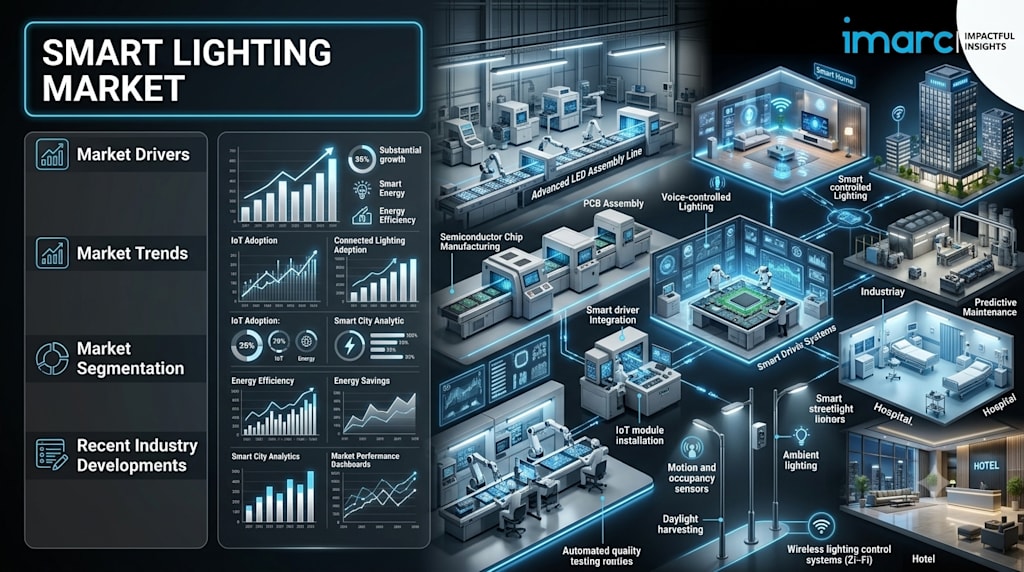
According to IMARC Group's latest research publication, global smart lighting market size reached USD 22.3 Billion in 2025. Looking forward, IMARC Group expects the market to reach USD 85.0 Billion by 2034, exhibiting a growth rate (CAGR) of 15.52% during 2026-2034.
How AI is Reshaping the Future of Smart Lighting Market
- Adaptive Occupancy-Based Control: AI-driven sensors automatically detect room occupancy, dimming or switching off lights instantly, cutting commercial building energy waste by up to 40% without manual intervention.
- Predictive Maintenance and Fault Detection: Machine learning monitors luminaire performance in real-time, flagging failures before they occur and reducing unplanned downtime by nearly 50% across large municipal and commercial deployments.
- Generative Personalization Engines: AI assistants like Philips Hue's generative scene creator let users design custom lighting moods via voice or text, making personalized ambient experiences effortless and energy-efficient.
Smart Lighting Industry Overview:
The global smart lighting industry is undergoing rapid transformation, fueled by the convergence of IoT connectivity, LED technology, and intelligent control systems across commercial, residential, and public infrastructure sectors. Hardware remains the dominant segment, capturing the lion's share of revenue, while LED lamps lead all light source categories owing to their superior energy efficiency and digital compatibility. Europe holds the largest regional share, underpinned by stringent Ecodesign Directive mandates and ambitious net-zero commitments driving widespread adoption.
Smart Lighting Market Trends & Drivers
Government policy is one of the most powerful forces reshaping this market right now. The EU's Ecodesign Directive effectively banned most mercury-based fluorescent lamps at the close of last year, immediately accelerating LED and smart lighting retrofits across Europe. In the United States, the Inflation Reduction Act and the Infrastructure Investment and Jobs Act are channelling federal funds toward energy-efficient public lighting upgrades, while the U.S. Department of Energy's rebate programmes make intelligent LED systems financially accessible for municipalities and commercial operators alike. These policy tailwinds are not incidental; they are structurally embedding smart lighting demand into building codes and infrastructure procurement cycles globally.
The commercial sector is driving the single largest slice of adoption, with offices, retail spaces, hospitals, and hospitality venues all investing heavily in intelligent lighting to reduce energy bills and improve occupant wellbeing. Studies consistently show productivity gains of up to 18% when workplaces adopt human-centric lighting tuned to natural circadian rhythms. Signify's strategic alliance with Honeywell to deploy integrated smart lighting solutions for commercial buildings, announced recently, exemplifies how key players are bundling connectivity, analytics, and lighting management into comprehensive building automation packages. The commercial opportunity is enormous, and competition among suppliers is intensifying as a result.
Smart city initiatives are unlocking another major demand channel, particularly for public infrastructure applications. Governments across Asia Pacific, the Middle East, and Latin America are investing aggressively in intelligent street lighting that adapts to traffic density and pedestrian movement in real time. Itron's partnership with Current Lighting Solutions, announced recently, specifically targets cities and utilities seeking to combine energy efficiency with operational safety. Meanwhile, wireless connectivity standards such as Zigbee 3.0 and Bluetooth Mesh are making large-scale outdoor deployments far simpler to install and maintain, lowering the total cost of ownership and accelerating rollouts across emerging urban markets where legacy infrastructure upgrading is a top priority.
Leading Companies Operating in the Global Smart Lighting Industry:
- Acuity Inc.
- ams-OSRAM AG
- EGLO Leuchten GmbH
- GE Lighting (Savant Systems, Inc.)
- Legrand
- Lutron Electronics Co., Inc.
- Nanoleaf
- Sengled GmbH
- Signify Holding
- Virtual Extension
- Yeelight Global
Smart Lighting Market Report Segmentation:
By Offering:
- Hardware
- Lights and Luminaires
- Lighting Controls
- Software
- Services
- Design and Engineering
- Installation
- Post-Installation
Hardware accounts for the majority of the market share, led by rapid LED adoption and integration with IoT sensors and controls.
By Communication Technology:
- Wired Technology
- Wireless Technology
Wired technology holds the largest share in the industry due to its reliability and stability in large-scale commercial and industrial installations.
By Installation Type:
- New Installation
- Retrofit Installation
New installation represents the leading market segment, driven by rising smart home, commercial building, and urban infrastructure construction projects.
By Light Source:
- LED Lamps
- Fluorescent Lamps
- Compact Fluorescent Lamps
- High Intensity Discharge Lamps
- Others
LED lamps exhibit a clear dominance in the market owing to their superior energy efficiency, digital compatibility, and long lifespan compared to other light sources.
By Application:
- Commercial
- Residential
- Public Infrastructure
- Others
Commercial dominates the market, driven by growing demand for energy-efficient and adaptive lighting in offices, retail spaces, hospitality venues, and healthcare facilities.
Regional Insights:
- North America (United States, Canada)
- Asia Pacific (China, Japan, India, South Korea, Australia, Indonesia, Others)
- Europe (Germany, France, United Kingdom, Italy, Spain, Russia, Others)
- Latin America (Brazil, Mexico, Others)
- Middle East and Africa
Europe exhibits a clear dominance in the smart lighting market due to its early adoption of smart lighting technologies and strong regulatory support for energy-efficient solutions.
Recent News and Developments in Smart Lighting Market
- January 2025: Honeywell and Signify announced a strategic alliance to deploy integrated smart lighting solutions for commercial buildings, combining Honeywell's building management expertise with Signify's connected lighting platforms to deliver enhanced energy efficiency and occupant comfort.
- January 2025: GE Lighting (Savant Systems, Inc.) launched the Cync Reveal HD+ Full Color Undercabinet Fixtures, the first full-color and edge-lit smart undercabinet lights available in the North American market, expanding consumer choice in intelligent residential lighting.
Note: If you require specific details, data, or insights that are not currently included in the scope of this report, we are happy to accommodate your request. As part of our customization service, we will gather and provide the additional information you need, tailored to your specific requirements. Please let us know your exact needs, and we will ensure the report is updated accordingly to meet your expectations.
About the Creator
sujeet. imarcgroup
With 2 years of hands-on experience at IMARC Group, I have conducted in-depth market research and analysis across diverse industries including technology, healthcare, agriculture, and consumer goods.
Enjoyed the story? Support the Creator.
Subscribe for free to receive all their stories in your feed.
Comments
There are no comments for this story
Be the first to respond and start the conversation.