
Smart Homes Market Outlook: Connected Living Solutions and Growth Opportunities
The Smart Homes Market is experiencing rapid growth driven by increasing adoption of connected devices and smart living solutions.

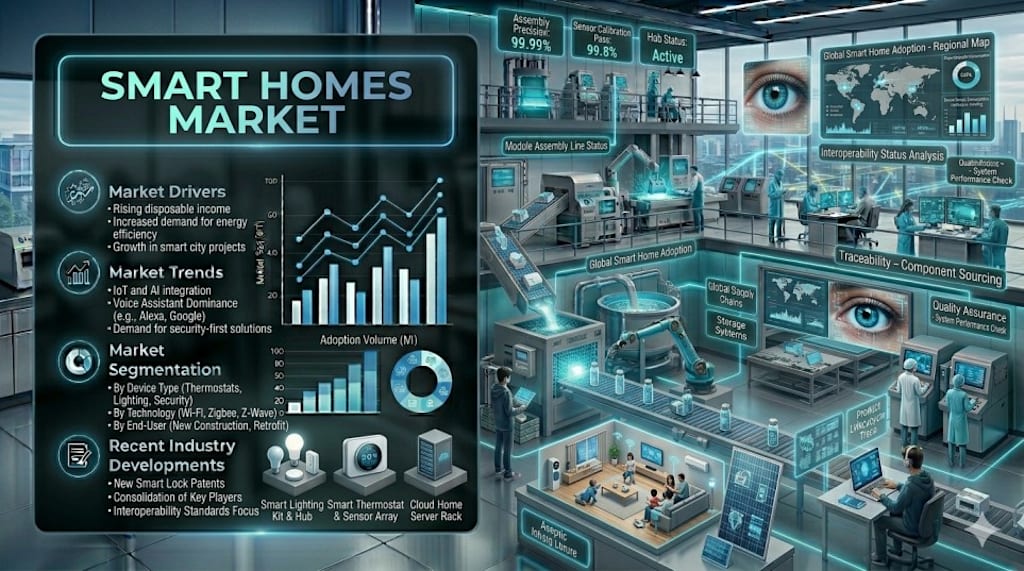
According to IMARC Group's latest research publication, The global smart homes market size was valued at USD 151.5 Billion in 2025. Looking forward, IMARC Group estimates the market to reach USD 351.7 Billion by 2034, exhibiting a CAGR of 9.52% from 2026-2034
How AI is Reshaping the Future of the Smart Homes Market
- AI-Powered Personalization and Behavioral Automation: AI algorithms analyze user routines, preferences, and behavioral patterns to enable smart home systems to anticipate needs and automate responses without manual input. For instance, in January 2025, Amazon's Ring video doorbell introduced AI-generated alerts that notify users of unusual or suspicious activity around their homes, significantly reducing false alarms and enhancing precision.
- Voice and Natural Language Interface Integration: The integration of generative AI into voice-controlled home assistants is transforming how homeowners interact with their smart ecosystems, enabling natural, conversational commands rather than structured instructions. In January 2025, Netherlands-based Philips launched next-generation smart lighting and home security solutions powered by AI, introducing its first generative AI assistant within the Hue app that allows users to create customized lighting scenarios by simply speaking or typing mood-based commands.
- Predictive Security and AI-Driven Threat Detection: Machine learning algorithms equipped with computer vision and radio frequency signal analysis are enabling smart home security systems to identify threats with greater accuracy and fewer false positives. In January 2025, Arlo Technologies formed a strategic alliance with Origin AI to distribute AI-powered technologies, namely TruShield and Allos, which leverage RF signals from existing WiFi devices to detect Verified Human Presence.

Smart Homes Industry Overview
The global smart homes industry is experiencing a structural transformation driven by the convergence of artificial intelligence, 5G connectivity, and the Internet of Things across residential ecosystems. North America leads with a 35.8% market share in 2025, supported by high IoT device penetration, with the number of IoT devices in use in the United States expected to reach 75 Billion in 2025 according to the National Cybersecurity Center of Excellence.
Smart Homes Market Trends and Drivers
The expanding deployment of 5G networks is one of the most consequential structural enablers for smart home adoption globally. In April 2025, global 5G network subscriptions surpassed 2.25 Billion. The United States and Canada together accounted for over 182 Million 5G connections, reflecting an annual growth rate of 20%. High-speed, low-latency connectivity enables smart devices to communicate in real time, supporting seamless remote management of security systems, climate controls, and home appliances via mobile applications.
Growing disposable incomes and a shift in consumer lifestyle preferences are equally driving the mainstreaming of smart home technology. According to the US Energy Information Administration, global disposable income per capita reached USD 10,136, and this figure is expected to grow significantly over the coming decades, expanding the addressable consumer base for premium smart home solutions. The trend is particularly pronounced among technology-oriented younger demographics who prioritize integrated, automated living as a standard of modern comfort rather than a luxury feature.
Government initiatives and regulatory frameworks are providing critical impetus for smart home technology adoption worldwide. India's Smart Cities Mission, launched in 2015, had successfully completed 7,380 out of 8,075 projects as of December 2024, with a total investment of Rs 1,47,704 Crore, reflecting the scale of government commitment to smart urban infrastructure that underpins residential connectivity. In Europe, regulatory mandates on energy efficiency, LEED and BREEAM green building certifications, and national smart grid programs are incentivizing builders and homeowners to incorporate advanced automation and energy management systems.
Leading Companies Operating in the Global Smart Homes Industry
- ABB Ltd.
- Amazon.com, Inc.
- Arlo Technologies, Inc.
- Emerson Electric Co.
- Google LLC (Alphabet Inc.)
- Honeywell International Inc.
- Johnson Controls International plc
- Legrand S.A.
- LG Electronics Inc.
- Panasonic Corporation
- Resideo Technologies, Inc.
- Robert Bosch Smart Home GmbH
- Samsung Electronics Co., Ltd.
- Schneider Electric SE
- Siemens AG
Smart Homes Market Report Segmentation
By Component:
- Hardware
- Security
- Home Automation
- Home Entertainment
- Home Healthcare
- Smart Appliances
- AI Speaker
- Services
- Energy Consumption and Management Services
- Security Services
- Healthcare Services
- Entertainment Services
Hardware stands as the largest component segment, holding 57.6% of the market in 2025, as physical devices form the primary infrastructure layer enabling automation, monitoring, and intelligent control across residential environments.
By Application:
- Security and Surveillance
- Lighting
- Entertainment
- Energy Management
- HVAC
- Smart Kitchen
- Home Fitness and Wellness
Security and surveillance leads the application segment with 35.0% of market share, driven by heightened residential safety concerns, AI-powered threat detection, and real-time remote monitoring through smart cameras, video doorbells, motion sensors, and intelligent access control systems.
Regional Insights:
- North America (United States, Canada)
- Asia Pacific (China, Japan, India, South Korea, Australia, Indonesia, Others)
- Europe (Germany, France, United Kingdom, Italy, Spain, Russia, Others)
- Latin America (Brazil, Mexico, Others)
- Middle East and Africa
North America exhibits clear dominance in the smart homes market with a 35.8% share in 2025, supported by an advanced IoT infrastructure, high consumer purchasing power, and strong investment in research and development by leading technology firms. The US market alone contributes 82% of the North American share.
Recent News and Developments in the Smart Homes Market
- April 2025: Global 5G network subscriptions surpassed 2.25 Billion worldwide, with the United States and Canada together accounting for over 182 Million 5G connections at an annual growth rate of 20%. This milestone significantly enhances the connectivity infrastructure required for large-scale smart home device deployment, real-time automation, and seamless remote management of connected home systems across North America.
- January 2025: Arlo Technologies, Inc. entered into a strategic partnership with Origin AI, securing global exclusive rights to distribute Origin AI's TruShield and Allos technologies. These AI solutions leverage radio frequency signals from installed WiFi devices to detect Verified Human Presence, reducing false alarms and enhancing smart home security precision for service providers and solution companies worldwide.
- January 2025: Google publicly launched the beta version of its Home APIs, attracting interest from nearly 2,000 developers globally. Available initially on Android with iOS availability planned subsequently, the APIs enable developers to build richer, more integrated smart home applications, advancing Google Home's evolution into a more open and interoperable platform across connected device ecosystems.
- January 2025: Netherlands-based Philips launched next-generation AI-powered smart lighting and home security solutions, including the first generative AI assistant within the Philips Hue app. The assistant enables users to create customized lighting scenarios through spoken or typed mood-based commands and includes continuous improvement through built-in feedback features, marking a significant advancement in conversational smart home interfaces.
- November 2024: Resideo Technologies debuted the Honeywell Home FocusPRO thermostat series at its CONNECT 2024 Customer Event, introducing a redesigned product lineup with improved display capabilities and broad HVAC system compatibility. The launch reflects the continued focus of major smart home players on enhancing energy management solutions for residential environments seeking greater comfort control and utility cost reduction.
- October 2024: Develco Products acquired Datek Smart Home, one of three divisions of Norwegian company Datek, enabling the combined entity to offer dedicated white-label cloud services and IoT hardware across home care, smart energy, and residential security verticals. This strategic acquisition reinforces consolidation trends within the North American smart home market as companies seek to deliver comprehensive, end-to-end connected home solutions.
- September 2024: ABB India launched the ABB-free@home wireless home automation system, an advanced smart home solution designed specifically to support green building development and sustainable city infrastructure. The system optimizes energy consumption and enables homeowners and building residents to reduce their carbon footprint, aligning with India's broader national sustainability and smart urbanization objectives.
Note: If you require specific details, data, or insights that are not currently included in the scope of this report, we are happy to accommodate your request. As part of our customization service, we will gather and provide the additional information you need, tailored to your specific requirements. Please let us know your exact needs, and we will ensure the report is updated accordingly to meet your expectations.
About the Creator
Olivia Smith
Olivia Smits is a Research and Marketing Analyst who specializes in market research, trend analysis, and consumer insights. I help businesses make smarter marketing and strategy decisions by turning data into clear, actionable insights.
Enjoyed the story? Support the Creator.
Subscribe for free to receive all their stories in your feed.
Comments
There are no comments for this story
Be the first to respond and start the conversation.