
Smart Energy Market Gains Momentum Through Digital Grid Innovation
How AI integration, smart grids, and renewable energy adoption are accelerating operational efficiency and sustainability initiatives across the rapidly evolving smart energy market

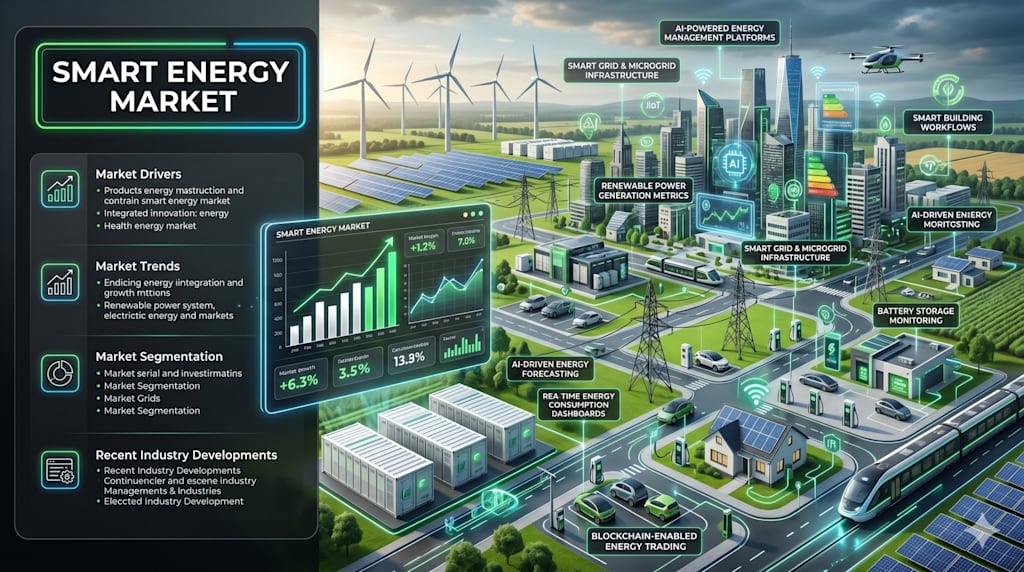
According to IMARC Group's latest research publication, The global smart energy market size was valued at USD 189.1 Billion in 2025. Looking forward, IMARC Group estimates the market to reach USD 348.9 Billion by 2034, exhibiting a CAGR of 6.83% from 2026-2034.
How Smart Energy is Reshaping the Future of the Global Energy Landscape
- AI and IoT-Driven Real-Time Energy Management: The integration of artificial intelligence and Internet of Things technologies is fundamentally transforming how energy is monitored, predicted, and consumed. AI software analyzes massive datasets to predict energy demand, optimize load balancing, and improve fault detection. IoT-based sensors and intelligent devices enable real-time tracking of consumption across residential, commercial, and industrial sectors. These technologies lower energy-related expenses significantly by facilitating predictive maintenance and automating energy optimization tasks. Cloud-based platforms further extend this capability by offering scalable energy management solutions to utilities and end-users alike, without the need for extensive on-premise infrastructure.
- Smart Grid Modernization and Infrastructure Overhaul: Smart grids are at the center of the global energy transformation, accounting for 41.7% of the smart energy product market as of the latest measurement period. Advanced digitalized electricity networks use communication technologies and real-time data analytics to monitor, control, and optimize power flow. In the United States alone, the electric grid spans over 600,000 miles of transmission lines connected to more than 9,200 electric generating units with over 1 million megawatts of generating capacity. By enabling the integration of distributed energy resources (DERs) such as residential solar installations, smart grids are actively supporting the global shift toward renewable energy at scale.
- Blockchain-Enabled Decentralized Energy Trading: Blockchain technology is introducing a new layer of trust, transparency, and efficiency into the smart energy ecosystem. Secure, open platforms are now enabling peer-to-peer energy trading, allowing prosumers (both producers and consumers of energy) to transact electricity directly without traditional intermediaries. This decentralization is particularly relevant as rooftop solar adoption expands and households seek ways to monetize surplus energy generation. Beyond trading, blockchain is also being used to verify the provenance of renewable energy certificates, ensuring that sustainability claims made by corporations are credible and auditable in real time.
- Advanced Metering Infrastructure Driving Consumer Empowerment: The rapid rollout of advanced metering infrastructure (AMI) is fundamentally changing how end-users interact with their energy supply. Smart meters provide granular, real-time data on usage patterns, enabling consumers to make informed choices that reduce waste and lower bills. In Latin America, approximately 14 million smart meters were installed by a recent benchmark period, with projections pointing to nearly 43 million units in the near future, pushing penetration from 6.5% to over 18%. These deployments are not merely commercial upgrades; they are foundational to making demand-response programs viable, where consumers can actively reduce or shift load in exchange for incentives during peak demand windows.
- Energy Storage Integration Enhancing Grid Resilience: As renewable energy sources become more dominant, the intermittency of solar and wind generation creates a critical need for robust energy storage solutions. Smart energy systems are increasingly pairing with battery storage to buffer supply-demand mismatches, stabilize grid frequency, and provide backup during outages. In Asia Pacific, where 38% of Indian households surveyed report experiencing daily power outages, this capability is not just a performance enhancement; it is a reliability imperative. Investment in microgrid solutions and distributed battery systems is accelerating across the region, driven by both government infrastructure programs and the commercial urgency of minimizing downtime.
Smart Energy Industry Overview
The global smart energy industry is undergoing rapid transformation and scale-up, driven by the convergence of decarbonization mandates, energy security imperatives, and breakthrough digital technologies. Regulatory authorities and governments worldwide are implementing stringent policies promoting renewable energy deployment while minimizing greenhouse gas emissions, directly increasing the adoption of smart energy solutions across all sectors.
The World Meteorological Organization (WMO) noted that 2024 was the hottest year in recorded history, representing the culmination of a decade of unparalleled warming driven by human activity. This climate reality is catalyzing urgent policy action and investment at every level of government and industry. The European Union's Clean Energy Package has deployed significant funding to upgrade energy infrastructure, while the United States channeled a record USD 71 billion into clean transportation and energy in the third quarter of 2024 alone, a 12% year-over-year increase.
India, one of the world's fastest-growing clean energy markets, achieved major milestones in solar and wind installations, with its cumulative non-fossil fuel-based energy capacity reaching 217.62 GW as of January 2025, as part of its vision to attain 500 GW of non-fossil fuel capacity by 2030.
Solution and service components represent the largest segment within the market, commanding 78.6% of total market share. This reflects the growing preference among utilities, enterprises, and governments for integrated platforms that combine hardware, analytics software, and ongoing managed services, rather than point hardware purchases alone.
Smart Energy Market Trends and Drivers
Energy Efficiency and Sustainability as Core Business Imperatives
The worldwide pivot toward energy efficiency is no longer a voluntary corporate initiative; it is a regulatory and economic necessity. Smart energy technologies, including smart grids, AMI, and intelligent energy management systems, are providing real-time intelligence to identify inefficiencies, eliminate wastage, and reduce operational costs across the value chain. The industrial sector is the largest end-use segment, representing 68.9% of market demand, reflecting the scale of energy consumption in manufacturing and production environments. Industrial operators are deploying smart meters, automated control systems, and predictive maintenance tools to reduce both energy expenditure and equipment failure rates simultaneously.
Government Policy and Regulatory Tailwinds
Policy momentum is one of the strongest structural drivers shaping smart energy investment decisions globally. National and regional governments are deploying coordinated packages of subsidies, mandates, and public-private partnership frameworks to accelerate the energy transition. The EU's Clean Energy Package and associated funding mechanisms are enabling utility-scale infrastructure upgrades across member states. In the Middle East, the Dubai Electricity and Water Authority (DEWA) announced a USD 1.9 billion smart grid initiative in December 2024, partnering with Microsoft Copilot to integrate generative AI across operations. In parallel, renewable energy sources already accounted for 24.5% of the European Union's final energy use in a recent measurement period, creating a growing operational need for intelligent grid management to handle variable renewable inputs.
Technological Convergence Accelerating Market Evolution
The convergence of AI, IoT, machine learning, and blockchain is enabling capabilities that were not commercially viable just a few years ago. Time-of-use pricing models and demand-response programs, once administratively complex, are now automated through intelligent platforms. Predictive maintenance powered by ML is reducing unplanned downtime in grid infrastructure. Energy providers in Asia Pacific are adopting remote monitoring and automated fault detection to address the significant reliability challenges created by rising temperatures and strained grid infrastructure. These technologies are collectively enabling the transition from a centralized, passive grid model to a distributed, data-centric network that is both more resilient and more responsive.
Leading Companies Operating in the Global Smart Energy Industry
- ABB Ltd.
- General Electric Company
- Honeywell International Inc.
- International Business Machines Corporation
- Itron Inc.
- Landis+Gyr AG
- Larsen & Toubro Limited
- Robert Bosch GmbH
- S&T AG
- Schneider Electric SE
- Sensus (Xylem Inc.)
- Siemens AG
Smart Energy Market Report Segmentation
By Component:
- Hardware and Equipment
- Solution and Service
Solution and service represents the largest component, holding 78.6% of the market, driven by demand for integrated energy management platforms combining software, analytics, and ongoing service delivery.
By Product:
- Smart Grid
- Digital Oilfield
- Smart Solar
- Home Energy Management System
Smart grid leads the product segment with 41.7% market share, as utilities globally invest in digitalized electricity networks capable of managing distributed energy resources and real-time demand fluctuations.
By End Use Sector:
- Residential
- Industrial
- Commercial
Industrial dominates end-use with 68.9% of the market, as manufacturing and production facilities deploy smart energy systems to optimize high-volume energy consumption and reduce operational costs.
Regional Insights:
- North America (United States, Canada)
- Asia Pacific (China, Japan, India, South Korea, Australia, Indonesia, Others)
- Europe (Germany, France, United Kingdom, Italy, Spain, Russia, Others)
- Latin America (Brazil, Mexico, Others)
- Middle East and Africa
North America holds the dominant regional position with over 39.8% of global market share, led by the United States which accounts for 83.06% of the North American segment. Policy incentives for renewable energy, large-scale smart grid investment programs, and strong private sector technology adoption underpin this leadership. The United States, Canada, and European nations are reinforcing their positions through integrated regulatory frameworks, while Asia Pacific is emerging as the fastest-growing region driven by rapid urbanization, rising energy demand, and the urgent need to address grid reliability challenges.
Recent News and Developments in the Smart Energy Market
- April 2025: LONGi, in collaboration with Raystech, launched the Hi-MO X10 solar module at the Smart Energy Council Conference and Exhibition in Sydney. The product features advanced HPBC 2.0 cell technology and TaiRay wafers, delivering high-power efficiency and resilience specifically designed for extreme Australian weather conditions.
- March 2025: PG&E launched a virtual power plant program named SAVE, targeting local grid constraints by aggregating residential distributed energy resources. The demonstration involved 1,500 electric customers with battery storage and 400 customers with smart panels providing demand support during peak periods. PG&E collaborated with aggregators including Sunrun and SPAN to optimize energy usage via real-time grid signals.
- February 2025: Smart Metering Systems (SMS) completed its merger with Horizon Energy Infrastructure (HEI) and Smart Meter Assets (SMA), forming a leading UK smart metering provider. The combined entity manages over 6 million meters and is positioned to accelerate smart energy solutions in the UK while expanding into Germany.
- December 2024: The Dubai Electricity and Water Authority (DEWA) announced a USD 1.9 billion smart grid initiative in partnership with Microsoft Copilot. The project is designed to integrate generative AI across DEWA's operations to enhance customer satisfaction, boost sustainability metrics, and reinforce DEWA's position as a regional technology leader.
Note: If you require specific details, data, or insights that are not currently included in the scope of this report, we are happy to accommodate your request. As part of our customization service, we will gather and provide the additional information you need, tailored to your specific requirements. Please let us know your exact needs, and we will ensure the report is updated accordingly to meet your expectations.
About the Creator
Abhay Rajput
I am working in market research company that provides market and business research intelligence across the globe.
Enjoyed the story? Support the Creator.
Subscribe for free to receive all their stories in your feed.
Comments
There are no comments for this story
Be the first to respond and start the conversation.