
Smart Elevator Market Trends: IoT Integration, Energy Efficiency & Forecast to 2034
How AI-powered automation, predictive maintenance systems, and smart building integration are transforming operational efficiency and passenger experience in the smart elevator market

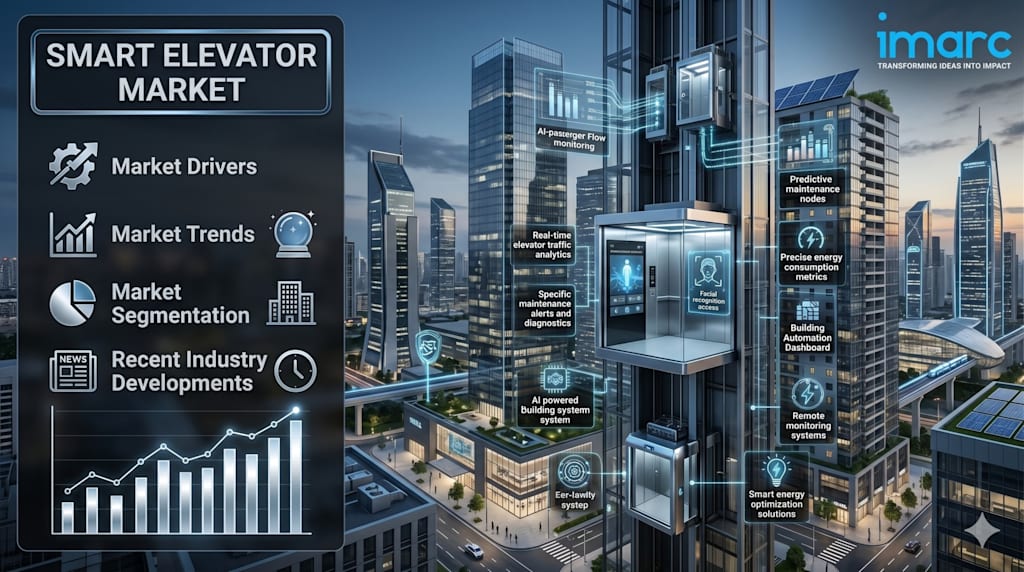
According to IMARC Group's latest research publication, The global smart elevator market size reached USD 32.7 Billion in 2025. Looking forward, IMARC Group expects the market to reach USD 62.5 Billion by 2034, exhibiting a growth rate (CAGR) of 7.25% during 2026-2034, exhibiting steady growth driven by rapid urbanization and population growth, increasing focus on sustainability and energy efficiency, significant technological advancements and innovation, growing urban mobility challenges, and increasing aging population and accessibility requirements.
How AI is Reshaping the Future of the Smart Elevator Market
- IoT Integration and Predictive Maintenance: The integration of Internet of Things (IoT) sensors within smart elevator systems is fundamentally transforming how building operators manage vertical transportation infrastructure. These sensors collect real-time data on elevator usage, performance metrics, and environmental conditions, enabling remote monitoring and data-driven insights that optimize operational efficiency. By leveraging IoT connectivity, facility managers can detect anomalies in mechanical systems before they escalate into failures, reducing unplanned downtime significantly. Predictive maintenance capabilities driven by continuous sensor data allow for proactive scheduling of service interventions, extending the lifespan of elevator components and reducing the frequency of costly emergency repairs across commercial, residential, and institutional buildings.
- Machine Learning for Performance Optimization: Machine learning algorithms are playing an increasingly critical role in advancing the capabilities of the smart elevator market by enabling real-time analysis of vast datasets collected from sensors and historical usage patterns. These algorithms identify patterns in passenger demand, optimize elevator dispatching, and predict maintenance requirements with a degree of accuracy that manual systems cannot achieve. By processing data from thousands of elevator journeys, machine learning models continuously refine routing decisions, minimizing unnecessary stops and maximizing throughput during peak traffic periods. The outcome is a measurable improvement in energy efficiency, reduced passenger wait times, and enhanced overall reliability of vertical transportation systems across high-density urban buildings.
- Destination Dispatch Systems and Traffic Management: Destination dispatch technology represents one of the most impactful innovations reshaping the smart elevator market, fundamentally changing how elevator cars are allocated in response to real-time passenger demand. Rather than passengers selecting a floor inside the elevator car, destination dispatch systems collect floor requests in the lobby and assign the most efficient elevator car before passengers board, grouping travelers headed to the same destination together. This intelligent allocation reduces the number of stops per journey, decreases wait times, and dramatically improves traffic flow in high-rise buildings during peak hours. For commercial towers and mixed-use developments handling large daily footfall volumes, these systems deliver measurable gains in building operational efficiency and occupant satisfaction.
- Biometric Access Control and Touchless Interfaces: The growing emphasis on building security and hygiene is accelerating the adoption of biometric authentication and touchless interface technologies within the smart elevator market. Fingerprint scanners, facial recognition systems, and iris scanners provide secure, reliable passenger authentication that prevents unauthorized access to designated floors in corporate offices, government buildings, and high-security research facilities. Touchless interfaces, including gesture-based controls and mobile device integration, eliminate the need for physical contact with elevator panels, improving hygiene standards in high-traffic environments such as hospitals, airports, and retail centers. These access control innovations also enable building operators to generate granular data on floor usage patterns, supporting more intelligent building management and security compliance.
- Cloud Computing and Remote Building Management: The adoption of cloud computing by key players in the smart elevator market is enabling the delivery of flexible, scalable, and cost-effective elevator management solutions that eliminate the limitations of traditional on-premises infrastructure. Cloud-hosted GIS and building management platforms allow facility teams to access performance dashboards, receive real-time alerts, and manage elevator systems across multiple properties from a centralized location. This capability is particularly valuable for real estate operators managing large portfolios of commercial or residential buildings across multiple geographies, as it reduces the overhead of maintaining separate local monitoring systems at each site. Cloud integration also accelerates software updates and the deployment of new AI-driven features, ensuring that smart elevator systems remain current with evolving building management requirements.
Smart Elevator Industry Overview:
The global smart elevator market is witnessing stable and sustained growth, underpinned by accelerating urbanization, rising construction of high-rise buildings, and the widespread adoption of smart city frameworks by governments across North America, Asia Pacific, Europe, and the Middle East. North America leads the global market, driven by robust economic activity, stringent building codes promoting energy efficiency, and accessibility regulations that mandate advanced vertical transportation solutions in commercial and residential buildings. Smart city initiatives in major metropolitan centers such as New York, Chicago, and San Francisco prioritize sustainable infrastructure and operational efficiency, spurring the integration of smart elevator technologies across new and retrofit building projects. Leading elevator manufacturers including Otis Elevator Company and Schindler Group maintain a strong North American presence, continuously driving market advancement through research-led innovation and strategic deployment partnerships.
Asia Pacific holds the dominant regional position in the smart elevator market, propelled by rapid urbanization, surging population growth, and large-scale infrastructure investment programs in China, India, and Japan. Government-led smart city development initiatives across the region are accelerating the deployment of intelligent building systems, with smart elevators serving as a foundational component of sustainable high-rise infrastructure. Europe represents a significant and mature market, characterized by stringent environmental sustainability standards, an aging population requiring enhanced accessibility solutions, and the presence of globally recognized manufacturers including KONE Corporation and TK Elevator, whose ongoing product innovation continues to elevate market standards. Latin America and the Middle East and Africa are emerging as high-growth regions, with rapid urbanization, luxury real estate development in cities such as Dubai and Riyadh, and government investments in smart city projects generating new demand for advanced vertical transportation systems across both commercial and institutional building segments.
Smart Elevator Market Trends and Drivers
Rapid urbanization and population concentration in urban centers represent the most powerful structural driver of the smart elevator market. As cities expand vertically to accommodate growing populations within limited land areas, demand for high-rise residential towers, commercial skyscrapers, and mixed-use developments intensifies, making efficient vertical transportation a non-negotiable building requirement. Smart elevators contribute directly to smart city objectives by improving energy efficiency, reducing carbon footprints, and enhancing building-level connectivity, positioning them as a critical component of government-backed urban development strategies worldwide. Furthermore, the rising penetration of IoT-based devices across building infrastructure is creating continuous data streams that enable smarter elevator management, while the growing adoption of automated and connected building systems is establishing new integration standards that smart elevator platforms are well positioned to fulfill.
The increasing focus on sustainability and energy efficiency is a defining trend reshaping the smart elevator market, as building owners and operators face growing regulatory pressure to reduce energy consumption and environmental impact. Smart elevators incorporate regenerative drives that recover kinetic energy during descent and feed it back into the building's electrical grid, LED lighting systems that minimize power draw, and energy management software that adjusts elevator operation in real time based on occupancy demand patterns. Predictive maintenance capabilities further enhance sustainability outcomes by extending equipment lifespans, reducing the resource consumption associated with premature component replacement, and minimizing energy waste attributable to malfunctioning or suboptimally operating elevator systems. These combined sustainability features are making smart elevators an increasingly attractive investment for building operators pursuing green building certifications and long-term operational cost reductions.
The growing urban mobility challenge across densely populated cities is creating a structural demand for smart elevator solutions capable of managing high passenger volumes with maximum efficiency. Traffic congestion within high-rise buildings during peak commuting hours imposes real costs on building tenants and operators, reducing productivity and tenant satisfaction. Smart elevators equipped with advanced traffic management algorithms and destination dispatch systems directly address this challenge by optimizing car allocation, reducing unnecessary stops, and improving overall throughput. Additionally, the rapidly aging population in North America, Europe, and Asia Pacific is generating increasing demand for elevator solutions with accessibility-focused features, including priority service protocols, wider cabin designs, intuitive touchless interfaces, and emergency communication systems that cater to the mobility requirements of elderly and disabled building occupants, expanding the addressable market for smart elevator deployments across healthcare, institutional, and residential sectors.
Leading Companies Operating in the Global Smart Elevator Industry:
- Fujitec Co. Ltd.
- Hitachi Lift India Pvt. Ltd.
- Hyundai Elevator Co. Ltd.
- KONE Corporation
- Mitsubishi Electric US, Inc.
- Nidec Elevator
- Otis Elevator Co.
- Schindler India Pvt. Ltd.
- TK Elevator
- Toshiba Elevators and Building Systems Corporation
Smart Elevator Market Report Segmentation:
By Solution:
- Control Systems (Security Control System, Elevator Control System)
- Access Control System (Maintenance Systems, Communication Systems)
- Services (Support and Maintenance, New Deployments, Modernization)
Control systems account for the majority of the market share, as destination dispatch systems, predictive maintenance algorithms, and energy management software form the technological backbone governing elevator operations, optimizing traffic flow, and improving operational efficiency across all building types.
By Application:
- Residential
- Commercial
- Industrial
- Institutional
- Others
Commercial holds the largest share in the industry, driven by the demand for efficient vertical transportation in office buildings, retail centers, and mixed-use developments where high foot traffic volumes, tenant satisfaction requirements, and energy efficiency goals make smart elevator deployment a strategic priority for building owners and operators.
Regional Insights:
- North America (United States, Canada)
- Asia Pacific (China, Japan, India, South Korea, Australia, Indonesia, Others)
- Europe (Germany, France, United Kingdom, Italy, Spain, Russia, Others)
- Latin America (Brazil, Mexico, Others)
- Middle East and Africa
North America leads the market, accounting for the largest smart elevator market share, driven by smart city initiatives, stringent energy efficiency and accessibility building codes, and the strong presence of leading elevator manufacturers driving continuous technological innovation across commercial and residential building segments.
Recent News and Developments in the Smart Elevator Market
- February 2025: KONE Corporation announced the expansion of its KONE 24/7 Connected Services platform across the Asia Pacific region, integrating AI-driven predictive maintenance capabilities with real-time IoT monitoring to proactively identify mechanical issues and reduce unplanned downtime for building operators managing large elevator portfolios across commercial and residential high-rise developments.
- November 2024: Otis Elevator Co. unveiled its next-generation Otis ONE IoT platform upgrade, incorporating enhanced machine learning algorithms that analyze elevator performance data across its global connected fleet of over 2 million units, enabling more precise predictive maintenance scheduling, remote diagnostics, and energy consumption optimization for building management teams.
- August 2024: TK Elevator launched its MAX predictive maintenance solution in select Middle East markets, partnering with smart building developers in Dubai to deploy IoT-connected elevator monitoring systems across newly constructed mixed-use towers, supporting the region's expanding smart city real estate portfolio and sustainability-driven building management requirements.
- May 2024: Schindler Group introduced its PORT destination dispatch technology upgrade for commercial high-rise installations across European markets, featuring enhanced AI-based traffic management algorithms that reduce average passenger wait times by optimizing elevator car allocation in real time across multi-elevator shaft configurations in premium office buildings.
- March 2024: Hyundai Elevator Co. Ltd. deepened its digital transformation partnership with a leading South Korean telecommunications provider to accelerate 5G-enabled remote monitoring and smart diagnostics deployment across its elevator installations in residential and commercial buildings, enhancing real-time operational visibility and predictive maintenance response times for facility management teams.
Note: If you require specific details, data, or insights that are not currently included in the scope of this report, we are happy to accommodate your request. As part of our customization service, we will gather and provide the additional information you need, tailored to your specific requirements. Please let us know your exact needs, and we will ensure the report is updated accordingly to meet your expectations.
About the Creator
Abhay Rajput
I am working in market research company that provides market and business research intelligence across the globe.
Enjoyed the story? Support the Creator.
Subscribe for free to receive all their stories in your feed.
Comments
There are no comments for this story
Be the first to respond and start the conversation.