
Smart Coatings Are Reshaping Industries And the Market Is Growing Fast
Advanced surface technologies are turning everyday materials into intelligent, cost-saving assets.

Introduction
Surfaces are no longer just passive layers of protection. Today, they can respond, adapt, and even repair themselves. This shift is at the heart of the rapidly expanding Smart Coating And Surface Chemical Market, where innovation is transforming how industries protect assets, reduce costs, and meet environmental goals.
From self-healing car finishes to pollution-fighting building facades, smart coatings are redefining expectations. What was once considered a premium niche is now becoming a strategic investment across sectors like automotive, construction, aerospace, and healthcare. With strong demand and regulatory support, the market is on track for remarkable growth over the next decade.
A Market on a Steep Growth Curve
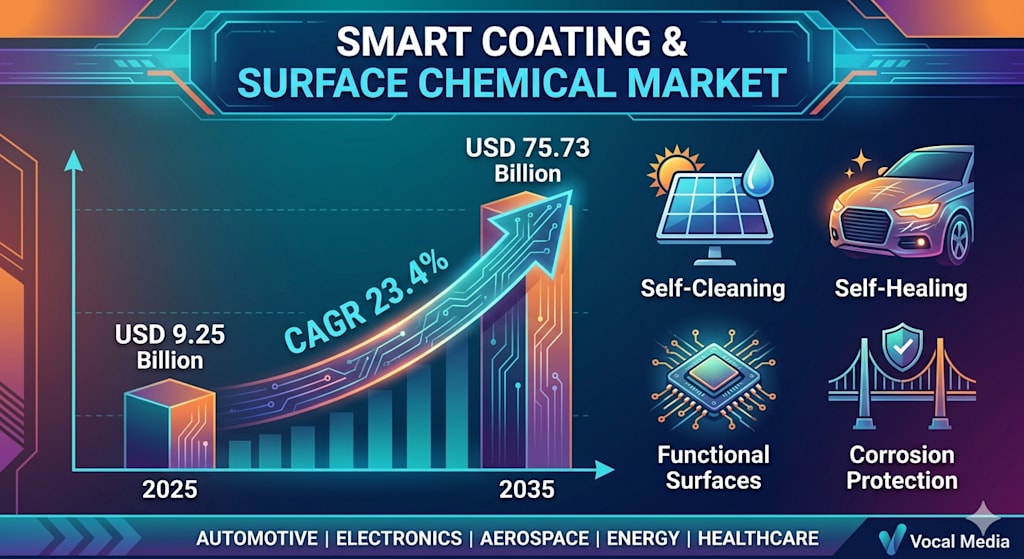
The global Smart Coating And Surface Chemical Market is projected to grow from USD 9.25 billion in 2025 to around USD 75.73 billion by 2035, reflecting a striking compound annual growth rate of 23.4%. This isn’t just steady expansion—it’s acceleration driven by real-world demand.
North America currently leads the market, accounting for over 40% of global share. This dominance is tied to advanced manufacturing ecosystems, strong defense spending, and strict environmental regulations that encourage innovation. Meanwhile, Asia Pacific is emerging as the fastest-growing region, fueled by infrastructure development and electric vehicle production.
Growth isn’t happening in isolation. It’s being driven by industries that are increasingly focused on lifecycle cost savings rather than upfront expenses. When a coating can reduce maintenance, downtime, or energy use, it quickly proves its value.
Market Highlights
- North America leads with a 42.7% market share, valued at USD 3.9 Billion.
- By Product Type, Single Layer dominates with a 67.3% share.
- By Function, Anti-corrosion leads with a 34.1% share.
- By Application, Automotive holds a 43.6% share.
- By End-use, Building and Construction commands a 48.3% share.
What Makes a Coating ‘Smart’?
Unlike traditional paints or finishes, smart coatings are engineered to react to their environment. They can respond to heat, light, moisture, or mechanical stress in ways that deliver functional benefits.
For example, a self-healing coating can repair minor scratches without human intervention. Photocatalytic coatings can break down pollutants when exposed to sunlight. Electrochromic coatings can change transparency, helping regulate temperature inside buildings or vehicles.
These features may sound futuristic, but they are already in use. The key difference lies in embedded functionality. Instead of acting as a static barrier, these coatings become active contributors to performance, safety, and sustainability.
This shift is why industries are willing to pay a premium. Over time, the savings from reduced maintenance and improved efficiency often outweigh the initial investment.
Automotive and Construction Lead Adoption
Among all applications, the automotive sector stands out as the largest adopter. Car manufacturers are under constant pressure to improve durability, reduce warranty claims, and enhance customer satisfaction. Smart coatings address all three.
Self-healing paint protection films, anti-corrosion layers, and advanced ceramic coatings are now becoming standard in high-end vehicles—and increasingly in mid-range models. As electric vehicles gain traction, new coating requirements are emerging, especially around battery protection and thermal management.
Construction is another major driver. Buildings are long-term assets, and maintaining them is expensive. Smart coatings offer solutions like self-cleaning surfaces, heat-reflective facades, and antimicrobial walls. These features not only reduce maintenance costs but also help meet stricter environmental and health regulations.
Together, these sectors account for a significant share of demand, setting the pace for adoption across other industries.
Key Functions Driving Demand
Not all smart coatings are created equal. Different functions serve different industries, but some stand out for their widespread impact.
Anti-corrosion coatings lead the market, addressing a problem that costs industries billions each year. Infrastructure, machinery, and vehicles all benefit from coatings that prevent degradation and extend lifespan.
Self-cleaning and antimicrobial coatings are gaining traction in healthcare and public infrastructure. These coatings actively reduce contamination risks, making them especially valuable in hospitals and high-traffic environments.
Meanwhile, anti-fouling coatings are essential in marine applications, where buildup on ship hulls can significantly increase fuel consumption. New formulations are also responding to environmental regulations that limit harmful chemicals.
Emerging technologies like color-shifting and electrochromic coatings are opening new possibilities in design and energy management. These innovations are moving beyond novelty and becoming practical tools for efficiency and aesthetics.
Challenges Slowing the Pace
Despite strong growth, the market faces real obstacles. One of the biggest is cost. Producing smart coatings—especially those involving nanotechnology—requires advanced equipment and precise processes. This makes scaling production difficult and expensive.
Consistency is another challenge. Ensuring that a coating performs reliably across different surfaces and conditions is not simple. Small variations in production can affect functionality, which is a critical concern for industries like aerospace or healthcare.
Regulation adds another layer of complexity. Different regions have different standards, particularly around chemical composition and emissions. Companies often need to reformulate products to meet local requirements, increasing both time and cost.
These barriers mean that the market is currently dominated by large, well-funded companies. Smaller players may struggle to compete unless they bring highly specialized innovations to the table.
Innovation Is Expanding the Opportunity
Even with challenges, innovation continues to push the market forward. One of the most exciting developments is the integration of smart coatings with digital technologies.
Imagine a bridge coating that detects early signs of corrosion and sends alerts before damage becomes visible. Or a wind turbine blade that signals microcracks before they lead to failure. These capabilities turn coatings into data-generating assets, not just protective layers.
Sustainability is another major driver. Companies are developing coatings with lower emissions, recyclable materials, and improved energy efficiency. This aligns with global efforts to reduce environmental impact while maintaining performance.
New applications are also emerging in solar energy, where coatings can enhance panel efficiency, and in architecture, where dynamic glass can adjust to changing light conditions. These innovations are expanding the market beyond traditional boundaries.
Conclusion
The evolution of coatings from passive protection to active functionality marks a significant shift in material science. The Smart Coating And Surface Chemical Market is not just growing—it’s redefining how industries think about surfaces and long-term value.
As technology advances and costs gradually come down, adoption is likely to spread even further. What’s currently seen as cutting-edge may soon become standard across multiple sectors.
In the end, the appeal is simple: coatings that do more, last longer, and save money. For industries facing increasing pressure to improve efficiency and sustainability, that’s not just an advantage—it’s a necessity.
About the Creator
Yash Mule
SEO Specialist with 10+ years of experience at Evolvance Market Research. Expert in technical SEO, content strategy, and data-driven optimization, with a proven track record of significantly increasing organic traffic and search rankings.
Enjoyed the story? Support the Creator.
Subscribe for free to receive all their stories in your feed.
Comments
There are no comments for this story
Be the first to respond and start the conversation.