
Silicone Coating Market Records Remarkable Growth with AI Integration
How technological advancements in formulation, enhanced performance requirements, and regulatory compliance are transforming the silicone coating market landscape

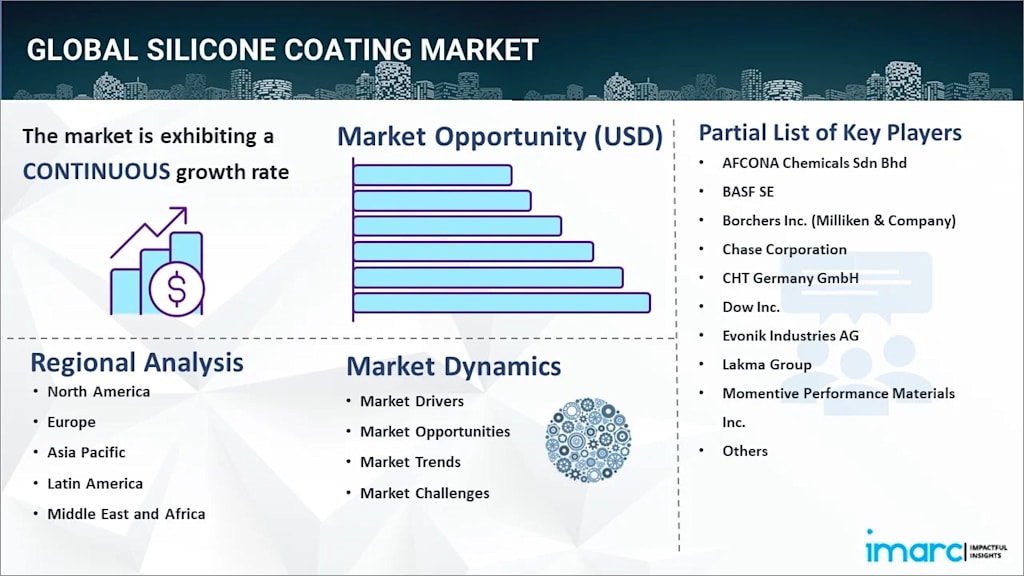
Rising product requirement across various industries, such as automotive, chemical, and construction, is stimulating silicone coating demand, supported by growing environmental consciousness, product innovation, and expanding application fields. According to IMARC Group’s latest data, The global silicone coating market size was valued at USD 7.2 Billion in 2025. Looking forward, IMARC Group estimates the market to reach USD 10.3 Billion by 2034, exhibiting a CAGR of 3.91% from 2026-2034.
Silicone coatings now represent a multi-billion-dollar global industry exceeding several billion dollars and exhibiting steady year-on-year expansion. Demand is driven by rising infrastructure development, the escalating need for high-performance protective materials, and shifting focus toward sustainable development. Continuous improvements in formulation chemistry and the expansion of eco-friendly, low-emission grades are further accelerating uptake. Major segments include silicone additives, silicone water repellents, silicone polymers, and 100% silicone, with industries prioritizing weather resistance, thermal stability, and specific environmental claims
Silicone Coating Market Growth Drivers:
- Expanding Applications in Electronics and Semiconductors
Electronic components require robust insulation to shield sensitive parts from moisture, heat, and environmental corrosion. Silicone coatings serve as vital conformal barriers, safeguarding circuitry within advanced consumer tech and renewable energy infrastructure. A strong example is Dow's introduction of its solventless UV and dual moisture-cure conformal series, explicitly engineered to shield modules under extreme operating environments. These protective formulations enhance overall component lifespan, minimizing mechanical failures in severe conditions. Manufacturers leverage these solutions to build resilient digital systems, satisfying critical reliability standards while maintaining device processing efficiency across fast-evolving technical applications.
- Surging Demand in Building and Construction
Modern infrastructure projects require durable material options capable of enduring heavy weather anomalies and intense ultraviolet exposure. High-performance water-based acrylate-silicone coatings are increasingly used across commercial and residential developments to prevent structural degradation caused by dampness, dust, and continuous temperature shifts. These elastomeric solutions form dense protective membranes over exterior walls and expansive roofing systems, significantly improving structural resilience. The ongoing push for energy-efficient architecture encourages contractors to use these materials to optimize thermal insulation and prevent moisture intrusion, preventing premature concrete degradation and costly long-term maintenance cycles.
Download Your "Silicone Coating Market" Industry Analysis Sample!
- Escalating Need for Industrial High-Heat Materials
Heavy machinery and industrial networks operate under extreme thermal conditions that degrade conventional protective finishes. Refineries, petrochemical units, and power generation facilities heavily rely on high-temperature barriers to protect extensive piping, boilers, and storage tanks. This ongoing operational challenge prompted industry leaders like PPG to launch advanced spray-on insulation silicone-based coatings, specifically built to handle intense heat environments without losing flexibility. These structural layers prevent corrosion under insulation and reduce system downtime, offering necessary thermal management solutions that ensure active plant safety and structural integrity during continuous high-pressure manufacturing operations.
Silicone Coating Market Trends:
- Transition Towards Sustainable and Low-Emission Formulations
Regulatory pressures regarding volatile organic compounds push manufacturers toward environmentally sound alternatives. Companies shift away from toxic, solvent-heavy formulations, developing low-emission water-based and solventless product alternatives. This structural transition aligns with regional eco-certification standards and green building requirements globally. For instance, Evonik expanded its specialized radiation-curing coating portfolio by launching new silicone acrylate additives that deliver exceptional slip and minimal foaming without compromising environmental benchmarks. These chemical advancements allow industrial applicators to satisfy rigorous environmental audits while maintaining surface durability, making eco-compliant coatings a preferred option across urban construction and modern original equipment manufacturing lines.
- Advancements in Maritime Hull and Anti-Fouling Technologies
Shipping operations require advanced surface solutions to optimize fuel usage and protect vessel hulls from severe marine exposure. Modern silicone coatings serve as high-durability barriers that prevent bio-fouling on seafaring vessels without releasing harmful biocides into marine ecosystems. Reflecting this development trend, Hempel introduced its high-performance silicone hull coating designed for newbuild ships, aiming to deliver immediate fuel savings and long-term protection during construction and active deployment. By creating slick, low-friction external boundaries, these technical formulas minimize vessel resistance through water, directly lowering operational costs while assisting shipping companies in meeting updated international maritime emission limits.
- Collaborative Initiatives for Circular Economy and Liner Recycling
The widespread use of release liners in labeling and packaging presents waste management challenges, driving major industry associations to establish strategic recycling networks. Organizations focus on collecting and re-processing used silicone-coated materials to promote circular economics. A notable example is the collaborative merger between the Tag and Label Manufacturers Institute and CELAB North America, launching the unified Liner Recycling Initiative. This coordinated project focuses on developing scalable, real-world solutions to recycle silicone-coated label liners effectively. By addressing raw material life-cycles, these corporate efforts reduce landfill waste, establishing a sustainable blueprint for handling industrial silicone application byproducts.
Recent News and Developments in Silicone Coating Market
- August 2024: The Tag and Label Manufacturers Institute and CELAB North America merged operational efforts to research scalable recycling systems for silicone-coated label liners under the unified Liner Recycling Initiative.
- June 2025: Evonik Coating Additives expanded its TEGO Rad product range with a novel silicone acrylate additive optimized for radiation-curing formulations, improving wetting and slip across industrial ink and wood coating sectors.
- June 2025: Hempel officially launched Hempaguard NB, a high-efficiency silicone hull coating engineered for newbuild vessels to minimize bio-fouling and optimize fuel efficiency from the initial construction phase onward.
Note: If you require specific details, data, or insights that are not currently included in the scope of this report, we are happy to accommodate your request. As part of our customization service, we will gather and provide the additional information you need, tailored to your specific requirements. Please let us know your exact needs, and we will ensure the report is updated accordingly to meet your expectations.
About the Creator
Andrew Sullivan
Hello, I’m Andrew Sullivan. I have over 9+ years of experience as a market research specialist.
Enjoyed the story? Support the Creator.
Subscribe for free to receive all their stories in your feed.
Comments
There are no comments for this story
Be the first to respond and start the conversation.