
Sesame Seeds Market Outlook: Nutrient-Rich Food Demand and Growth Opportunities
The Sesame Seeds Market is experiencing steady growth driven by increasing demand for nutrient-rich and plant-based food ingredients.

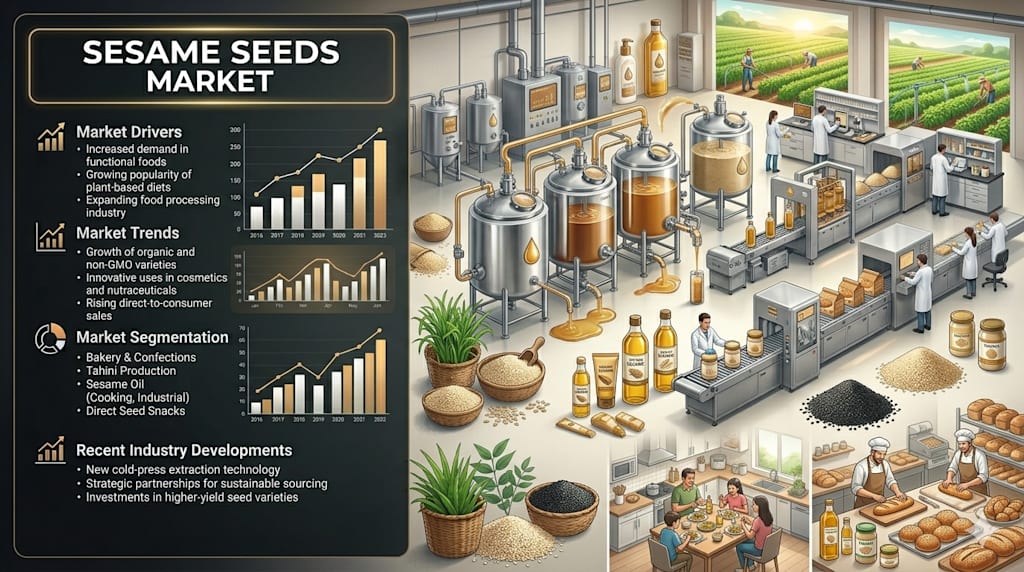
According to IMARC Group's latest research publication, the global sesame seeds market size reached USD 7.5 Billion in 2025. Looking forward, IMARC Group expects the market to reach USD 9.2 Billion by 2034. The increasing demand for healthy foods, growing awareness regarding the nutritional benefits of sesame seeds, and the rising popularity of ethnic cuisines represent some of the key factors driving the market.
How AI is Reshaping the Future of the Sesame Seeds Market
- Precision Agriculture and Yield Optimization: AI-powered tools are being deployed to analyze soil health, climate conditions, and pest risk across sesame farming regions. Olam International expanded contract farming programs in Burkina Faso and India where farmers receive digital soil health reports, customized fertilizer packs, and yield-linked bonuses, directly improving seed quality and output consistency at scale.
- Supply Chain Traceability and Transparency: Blockchain and AI-driven traceability platforms are transforming sesame seed trade from volume-based commodity flows into premium, traceable value chains. Sarvoday Natural implemented blockchain-based traceability for 80% of its sesame seed supply chain, enabling compliance with strict international aflatoxin and food safety standards enforced by the EU and Japan, which have accelerated investments in pre-shipment testing across Africa and Asia.
- Quality Control and Processing Efficiency: AI-led moisture control units are now being deployed in sesame processing facilities to maintain uniform seed drying and reduce impurity levels. Dipasa USA installed AI-driven moisture control systems in Mexico to ensure compliance with international quality benchmarks. Similarly, solar-powered optical color sorters funded by the African Development Bank have been rolled out in Ethiopia's Gonder region, reducing foreign-matter content and making sesame export-ready at lower cost.
Sesame Seeds Industry Overview
Asia-Pacific held 46.0% of the sesame seed market value in 2025, fueled by China's 900,000-metric-ton import requirement and Japan's significant consumption. Sesame seeds production reached 8.2 million tons in 2025, driven by rising demand from food processing, bakery, oil extraction, and health supplement industries. India, Sudan, Myanmar, and Tanzania contribute to over 50% of global production, with India alone producing approximately 1.2 million metric tons annually. In India, the government's Integrated Scheme for Oilseeds includes sesame under the National Food Security Mission, offering cluster-based support and seed hubs across Telangana and Gujarat. India exported over 600,000 tonnes in FY24, a 5% increase over the previous year. The Saudi Arabian Public Investment Fund agreed to pay USD 1.78 billion to boost its ownership position in Olam Agri from 35.4% to 80.01%, with an option to acquire the remaining 19.99% within three years.
Sesame Seeds Market Trends and Drivers
The expanding global health and wellness movement is a core pillar sustaining sesame seed demand. Sesame seeds are rich in calcium, magnesium, and iron, and tahini delivers 17 grams of protein per 100 grams according to USDA FoodData Central data. This nutritional density is driving adoption across vegan and plant-based product lines as manufacturers seek allergen-friendly, soy-free alternatives for ready-to-eat spreads and meal-replacement beverages. Over 12 new sesame-based health supplements were introduced globally, incorporating extracts standardized for sesamin and sesamolin content, and the cosmetics industry launched over 15 new products containing sesame seed oil, including anti-aging creams and hair serums, which recorded sales exceeding 2 million units.
The growing popularity of ethnic cuisines globally is creating sustained demand for sesame-based staples such as tahini, sesame oil, and sesame-crusted bakery products. The hulled sesame seed segment is expected to capture USD 6.5 billion and demonstrate strong growth through 2034, reflecting rising demand from food processors and the bakery industry. The white sesame segment currently holds the largest share by color, while black sesame is gaining momentum owing to its distinct flavor profile and premium positioning in health food markets.
Digital transformation and e-commerce are reshaping sesame seed distribution, particularly in North America and Europe where clean-label organic products command significant price premiums. Regulatory clarity from the FDA and the EU Novel Food pathway simplifies new-product launches, drawing multinational brands to contract schemes in Tanzania and Ethiopia that guarantee steady seed volumes. Freight disruptions on the Red Sea route and aflatoxin compliance pressures have collectively accelerated the shift toward traceable, certified supply chains that favor established processors over informal intermediaries.
Companies developed sesame seed snack blends combining white and black seeds, targeting health-conscious consumers, which captured over 5% of the specialty snack market in North America within six months of launch. Simultaneously, high-protein sesame flour and spray-dried tahini powders are disrupting conventional bakery and snack markets by enabling gluten-free formulations that cater to a growing intolerance-aware consumer base.
Leading Companies Operating in the Global Sesame Seeds Industry
- Accura Group
- Dhaval Agri Exports LLP
- Dipasa USA Inc.
- Frontier Co-op
- HL Agro Products Pvt. Ltd.
- McCormick and Company Incorporated
- NOW Foods
- Olam International
- Orienco
- Samruddhi Organic Farm (India) Private Limited
- Shyam Industries
- Tradin Organic Agriculture B.V.
- Unicorn Ingredients Limited
- Virdhara International
- Wholefood Earth LTD
Sesame Seeds Market Report Segmentation
By Type:
- Raw Seed
- Processed Seed
- Others
Processed seed dominates end-use applications owing to its integration across bakery, oil extraction, confectionery, and nutraceutical manufacturing.
By Color:
- White
- Black
- Brown
- Others
White sesame accounts for the largest market share. According to 2024 segment data, white sesame was valued at USD 2.5 Billion, black at USD 2.0 Billion, and other variants at USD 1.4 Billion.
By Category:
- Organic
- Conventional
Organic represents the largest and fastest-growing category segment, driven by rising consumer preference for clean-label, chemical-free agricultural products in developed markets.
By Application:
- Food and Beverages
- Cosmetics
- Others
Food and Beverages command the largest share. Approximately 3.5 million metric tons of sesame seeds were processed for edible oil extraction in 2024, underscoring the dual-purpose importance of the crop.
By Distribution Channel:
- Online
- Offline
Regional Insights:
- North America (United States, Canada)
- Asia Pacific (China, Japan, India, South Korea, Australia, Indonesia, Others)
- Europe (Germany, France, United Kingdom, Italy, Spain, Russia, Others)
- Latin America (Brazil, Mexico, Others)
- Middle East and Africa
Asia Pacific dominates the global sesame seeds market with a 40%+ share, anchored by large-scale cultivation, robust food processing industries, and high domestic consumption in China, India, Japan, and Southeast Asia.
Recent News and Developments in the Sesame Seeds Market
- November 2025: The International Fund for Agricultural Development (IFAD), Japan's Ministry of Agriculture, Forestry and Fisheries, Euglena, and Grameen Euglena jointly initiated a project in Bangladesh to support small-scale sesame farmers, focusing on enhancing seed quality and providing high-grade sesame to Japanese companies through a social procurement model.
- September 2025: Olam Agri signed a Memorandum of Understanding with Kadoya Sesame Mills, IFAD, and MC Agri Alliance during TICAD 9 to assist Nigerian smallholder sesame farmers in enhancing productivity, quality, and sustainability across the supply chain.
- October 2024: Tanzania announced plans to develop a processing industrial park in Mtwara that will include dedicated sesame processing facilities, aiming to enhance domestic value addition and promote agro-industrial development aligned with export growth targets.
- February 2024: India's Finance Minister announced a government strategy to make the country self-reliant in edible oils including sesame by boosting domestic oilseed output and launching a comprehensive production support program under the National Food Security Mission framework.
Note: If you require specific details, data, or insights that are not currently included in the scope of this report, we are happy to accommodate your request. As part of our customization service, we will gather and provide the additional information you need, tailored to your specific requirements. Please let us know your exact needs, and we will ensure the report is updated accordingly to meet your expectations.
About the Creator
Olivia Smith
Olivia Smits is a Research and Marketing Analyst who specializes in market research, trend analysis, and consumer insights. I help businesses make smarter marketing and strategy decisions by turning data into clear, actionable insights.
Enjoyed the story? Support the Creator.
Subscribe for free to receive all their stories in your feed.
Comments
There are no comments for this story
Be the first to respond and start the conversation.