
Self Storage Market Trends: Urbanization, Space Constraints & Forecast to 2034
How rising urbanization, shrinking residential spaces, and increasing relocation activities are driving demand for flexible and secure storage solutions in the self storage market

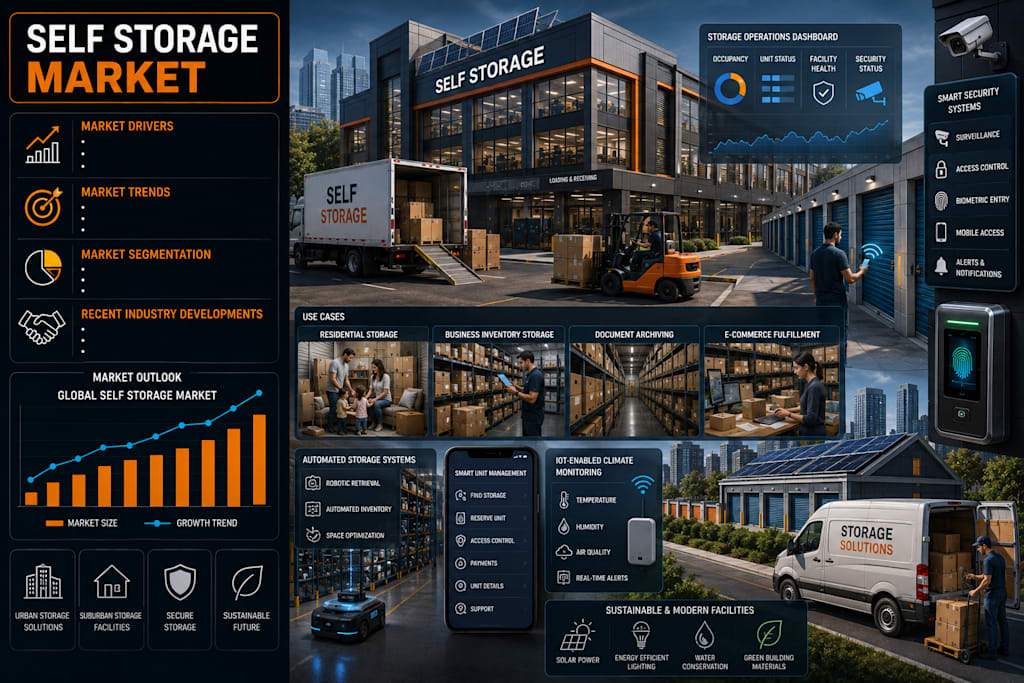
According to IMARC Group's latest research publication, The global self storage market size reached USD 62.9 Billion in 2025. Looking forward, IMARC Group expects the market to reach USD 92.0 Billion by 2034, exhibiting a growth rate (CAGR) of 4.19% during 2026-2034.
How AI is Reshaping the Future of the Self Storage Market
- Digital-First Facility Management and Automation: AI-powered platforms are enabling fully automated self storage operations, from smart pricing engines that adjust unit rates based on occupancy trends, location data, and demand signals, to contactless check-in and mobile gate access systems. Operators adopting these tools are significantly reducing overhead while improving unit turnover rates and occupancy levels. SmartStop Self Storage REIT deployed a new mobile app across all 210 U.S. and Canadian locations, enabling customers to manage accounts, open facility gates remotely, and rent units entirely through their smartphones, eliminating the need for in-person staff interactions.
- Predictive Occupancy and Revenue Optimization: Machine learning models are being trained on historical rental data, local real estate trends, and demographic movement patterns to forecast demand at the unit level. These systems allow storage operators to optimize pricing dynamically, identify underperforming locations, and anticipate maintenance cycles before disruptions occur. The result is a measurable improvement in revenue per available square foot, the core profitability metric for storage REITs and independent operators alike.
- AI-Enhanced Security and Surveillance Systems: Modern self storage facilities are deploying computer vision systems capable of identifying unauthorized access attempts, unusual movement patterns, and vehicle anomalies in real time. These AI-driven surveillance upgrades are replacing traditional static camera setups, reducing false alarms, and lowering insurance costs while giving customers verifiable assurance that their stored goods are protected around the clock.
- Supply Chain and Inventory Integration for Commercial Clients: For the growing segment of e-commerce businesses using self storage as flexible warehousing, AI tools are bridging the gap between storage unit management and inventory tracking. Businesses can now connect storage facility access logs with inventory management software, enabling real-time stock visibility without the cost of a formal warehouse lease. This integration is particularly valuable for the estimated 358 million small and medium-sized enterprises globally that operate with limited capital for fixed infrastructure.
- Location Intelligence and Expansion Planning: Real estate investment firms and self storage operators are using AI-driven geospatial analytics to identify optimal locations for new facility development. These models factor in population density, commute patterns, household income, competitor proximity, and planned residential construction to score potential development sites with far greater precision than traditional market studies, enabling companies to deploy capital into high-return submarkets ahead of demand curves.
Self Storage Industry Overview
The self storage industry has crossed a structural threshold. What was once predominantly a U.S. phenomenon has matured into a global sector, with North America currently holding a market share of over 47.8%, while Europe, Asia Pacific, Latin America, and the Middle East and Africa are all registering accelerating demand.
In the United States alone, self storage has expanded to over 2 billion square feet of total rentable space. An estimated 61.1 million square feet of new supply was completed in a recent single year, a 6.6% increase over the prior year's deliveries. The medium storage unit segment commands approximately 44.6% of the market by unit size, reflecting its versatility across both personal and commercial use cases. Personal end use leads by application with around 65.8% market share, driven by lifestyle transitions, urban downsizing, and seasonal storage cycles.
Geographically, the United States accounts for over 71.6% of the North American market, while Europe's growth is being anchored by the United Kingdom, Germany, and France, markets where urban density and e-commerce penetration are driving sustained facility demand. The Asia-Pacific region is following closely, led by densely populated metros in China, Japan, and Australia where apartment living makes off-site storage a practical necessity.
Self Storage Market Trends and Drivers
Urbanization remains the foundational demand driver. Approximately 56% of the global population, or 4.4 billion people, currently live in cities, with urban populations projected to reach a point where nearly 7 in 10 people will be city residents within decades. As cities grow denser, residential and commercial space constraints push both individuals and businesses toward external storage solutions. In the Middle East, almost two-thirds of the population already lives in urban areas, making GCC nations among the fastest-growing self storage markets globally.
The e-commerce surge is a structural tailwind. In Europe, total B2C e-commerce turnover reached approximately Euro 887 Billion (USD 932 Billion) in recent periods, with demand for flexible inventory storage rising in tandem. In Asia, India's social commerce segment is projected to reach USD 37 Billion, while China leads global retail e-commerce by volume. These dynamics are pushing SMEs and independent retailers toward self storage as a cost-effective warehousing alternative, avoiding long-term commercial lease commitments while retaining the ability to scale storage capacity up or down with business cycles.
Lifestyle transitions sustain personal storage demand. American workers change jobs on average every 4.2 years according to U.S. Bureau of Labor Statistics data, generating repeated short-term storage needs tied to relocation. Marriage, divorce, home renovation, retirement, and the growing minimalism movement collectively ensure a consistent pipeline of personal storage demand that operates largely independent of macroeconomic cycles.
Digital transformation is expanding addressable markets. Mobile ordering, online reservations, and app-based access systems are lowering the barrier to entry for first-time storage customers and enabling operators to manage facilities with leaner staffing models. The cloud kitchen and ghost commerce models emerging across food delivery and retail further extend self storage utility, as operators use distributed micro-storage units as staging points for last-mile fulfillment.
Leading Companies Operating in the Global Self Storage Industry
- Aecom
- CubeSmart
- Life Storage Inc.
- Metro Storage LLC (Find Local Storage)
- National Storage
- Public Storage
- Safestore
- Simply Self Storage
- StorageMart
- U-Haul International Inc. (AMERCO)
- Urban Self Storage
- World Class Capital Group LLC
Self Storage Market Report Segmentation
By Storage Unit Size:
- Small Storage Unit
- Medium Storage Unit
- Large Storage Unit
Medium storage units lead the market with approximately 44.6% share, reflecting their ability to serve the widest range of customers, from families in transition to small businesses storing inventory and equipment.
By End Use:
- Personal
- Business
Personal use accounts for approximately 65.8% of the market, driven by urbanization, downsizing trends, and the flexibility of month-to-month rental models that align with the unpredictability of modern life events.
Regional Insights
- North America dominates with over 47.8% global market share, characterized by high urbanization, drive-up unit convenience, and a mature REIT-driven investment structure
- United States accounts for over 71.6% of North America, supported by 2 billion-plus square feet of existing inventory and strong e-commerce-driven commercial demand
- Europe is experiencing growth led by the UK, Germany, and France, where smaller urban apartments and expanding e-commerce logistics are increasing both personal and business storage needs
- Asia Pacific is accelerating, particularly in China, Japan, and Australia, where dense urban living conditions and rising middle-class disposable incomes are normalizing self storage as a lifestyle service
- Latin America is emerging, with Brazil and Mexico seeing rising demand from urban population growth, SME warehousing needs, and a growing expat community
- Middle East and Africa is gaining traction, especially in UAE and Saudi Arabia, where rapid infrastructure development, expat mobility, and Vision 2030 urbanization initiatives are driving commercial and residential storage demand
Recent News and Developments in the Self Storage Market
- April 2025: Harbor Lockers, a division of Luxer One, launched the first national locker network for self-storage with over 500 locations across 80+ U.S. cities. The system delivers on-demand, 24/7 micro-storage and package management capabilities without requiring capital expenditure or facility modifications. Lockers install in 10 minutes and generate new revenue through pay-per-use and subscription models.
- April 2025: Colliers launched the Stockhausen-Hernandez Self-Storage Team to serve the Mid-Atlantic and Southeast U.S. regions, providing specialized expertise in brokerage, investment sales, acquisitions, dispositions, and development advisory services.
- February 2025: SmartStop Self Storage REIT launched a new mobile app rolled out across all 210 U.S. and Canadian locations, enabling customers to manage accounts, remotely open gates and doors, and complete unit rentals entirely via smartphone.
- January 2025: NexPoint launched NexPoint Storage VI DST, its sixth Delaware Statutory Trust offering, featuring two Class-A self-storage facilities in Nashville, Tennessee, and the Washington DC metro area, both managed by Extra Space Storage and targeting high-demographic-growth corridors.
- January 2025: Newmark brokered the recapitalization and joint venture between Hines and CubeSmart for a 14-property self-storage portfolio in Dallas-Fort Worth, comprising over 9,700 units and more than 1.25 million net rentable square feet, marking one of the largest U.S. self-storage portfolio transactions of the period.
Note: If you require specific details, data, or insights beyond the current scope of this discussion, customized research can be developed to match your precise requirements.
About the Creator
Abhay Rajput
I am working in market research company that provides market and business research intelligence across the globe.
Enjoyed the story? Support the Creator.
Subscribe for free to receive all their stories in your feed.
Comments
There are no comments for this story
Be the first to respond and start the conversation.