
Seed Coating Market Analysis: Polymer Innovation, Nutrient Delivery & Forecast to 2034
How crop protection needs, hybrid seed adoption, and advanced coating formulations are driving expansion across the global seed coating market.

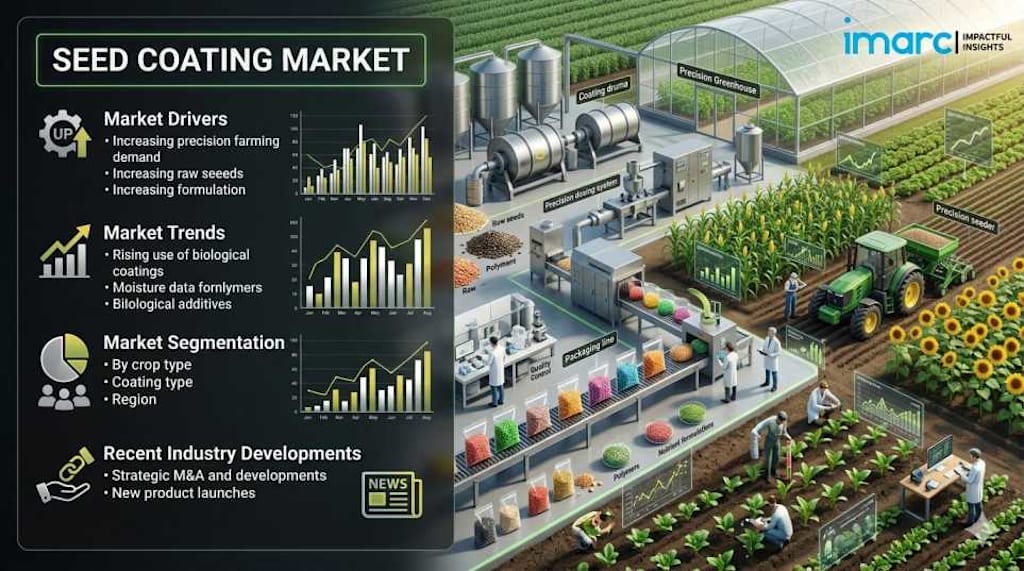
Rising demand for high-yield crops, shrinking arable land, and the push for sustainable farming are driving seed coating adoption, supported by biodegradable material innovations, precision agriculture integration, and strong government subsidies across key agricultural economies. According to IMARC Group's latest data,The global seed coating market size was valued at USD 3.0 Billion in 2025. Looking forward, IMARC Group estimates the market to reach USD 5.4 Billion by 2034, exhibiting a CAGR of 6.63% from 2026-2034. North America currently dominates the market, holding a market share of over 39.8% in 2025.
The seed coating market represents a high-growth agricultural inputs segment, driven by increasing pressure on global food production systems and the urgent need to maximize output from limited farmland. Coated seeds improve germination rates, protect against pests and diseases, and enhance compatibility with precision planting machinery. Innovations in biopolymers, biodegradable materials, and microbial seed treatments are reshaping conventional farming practices. Major segments include polymer coatings, colorants, binders, active ingredients, and pellets, with cereals and grains leading crop-type adoption. Film coating dominates process-based segments due to its precision, uniformity, and broad compatibility with active ingredient integration.
Evaluate Market Potential Before You Invest – Get the Report Sample
Seed Coating Market Growth Drivers:
Declining Arable Land and Rising Food Security Pressure
As reported by the FAO, total arable land worldwide stands at 1.38 billion hectares, while the UNCCD reports a loss of at least 100 million hectares of healthy and productive land annually between 2015 and 2019. This scarcity is pushing farmers and agricultural stakeholders to maximize yield from every available hectare. Seed coatings address this directly by boosting germination rates, strengthening seedling resistance to environmental stress, and reducing waste during mechanical planting. The global seed coating market is currently valued at USD 3.0 billion, with demand firmly rooted in the need to achieve more from fewer resources.
Advancements in Coating Materials and Biodegradable Technologies
Innovations in biopolymers and sustainable coating alternatives are transforming conventional seed treatment methods by increasing protection, improving germination, and reducing environmental impact. The Indian Institute of Oilseeds Research (IIOR) unveiled a patented biopolymer technology capable of boosting crop yields by 25 to 30%, made available to private firms to lower costs and help crops withstand climate challenges. Active ingredients such as growth boosters, pest repellents, and nutrient enhancers are increasingly integrated into single coating layers, reducing the number of separate treatments required while delivering superior outcomes on seedling establishment and early canopy development.
Precision Agriculture Adoption Driving Coated Seed Demand
The rising integration of precision agriculture practices is creating structural demand for seed coatings, as coated seeds with uniform size and shape enhance mechanical planting efficiency, reduce seed wastage, and ensure consistent crop growth. This compatibility with automated machinery is especially valuable in large-scale commercial farming. The global precision agriculture market reached a value of USD 9.3 billion, underscoring the scale at which these technologies are being adopted. Coated seeds are purpose-built to work within this ecosystem, making them an essential input for modern, resource-efficient farming.
Seed Coating Market Trends:
Government Subsidies and Policy Support Accelerating Adoption
Governing bodies across Asia Pacific, Latin America, and the Middle East are actively promoting seed coating adoption through subsidies, awareness campaigns, and agricultural modernization programs. India and China are running formal support frameworks to accelerate uptake among smallholder farmers. Brazil, which devotes 30% of its national land area to agriculture, is channeling policy resources into coating programs designed to improve climate resilience. The European Union's forthcoming microplastic ban legislation is simultaneously compelling manufacturers to pivot toward plant-based and biodegradable formulations ahead of regulatory deadlines, reshaping R&D priorities across the competitive landscape.
Biological and Micronutrient-Enriched Coating Innovations
Manufacturers are integrating biological agents such as beneficial microorganisms, nitrogen-fixing microbes, and micronutrients directly into seed coating formulations to address soil health, nutrient deficiency, and pest resistance simultaneously. In December 2024, BioConsortia partnered with New Zealand's H&T to launch FixiN 33, a nitrogen-fixing microbial seed treatment for corn, brassicas, and cereals that reduces nitrogen fertilizer dependency while maintaining crop yields. In January 2024, Lucent BioSciences introduced Nutreos, a non-toxic, plant-based, and fully biodegradable micronutrient seed coating aligned with upcoming EU microplastic regulations. These product innovations reflect a broader market shift from purely protective coatings toward multi-functional biological seed enhancement systems.
Polymer Dominance and Film Coating Process Leadership
Polymers represent the largest additive segment with 30.2% market share, driven by their superior film-forming properties, compatibility with diverse active ingredients, and ability to enable controlled release of nutrients and pesticides. Film coating leads all process segments due to its ability to deliver uniform coverage without significantly altering seed size or weight, ensuring precision sowing, reduced dust-off, and minimal product loss. Innovations in biodegradable polymer formulations are further reinforcing this segment's dominance by aligning with sustainability goals and evolving regulatory frameworks across North America and Europe.
Recent News and Developments in Seed Coating Market
December 2024: BioConsortia partnered with New Zealand's H&T to launch FixiN 33, a nitrogen-fixing microbial seed treatment for corn, brassicas, and cereals, reducing nitrogen fertilizer dependency while maintaining yields. The product features strong shelf stability and is tailored to New Zealand's regulatory environment.
January 2024: Lucent BioSciences launched Nutreos, a non-toxic, plant-based, and fully biodegradable micronutrient seed coating designed to align with the European Union's anticipated microplastic ban legislation, addressing environmental impact concerns within commercial seed treatment practices.
January 2024: Lallemand Plant Care launched LALRISE SHINE DS in the United States, a dry seed treatment for corn and dry beans combining a seed finisher with a proprietary microbe. The product enhances root vigor, phosphorus availability, and nutrient uptake to support higher yields under variable soil conditions.
Note: If you require specific details, data, or insights that are not currently included in the scope of this report, we are happy to accommodate your request. As part of our customization service, we will gather and provide the additional information you need, tailored to your specific requirements. Please let us know your exact needs, and we will ensure the report is updated accordingly to meet your expectations.
About the Creator
Suhaira Yusuf
I specialize in Consumer Insights, focusing on transforming detailed market data into strategic business solutions that accelerate growth and improve customer engagement.
Enjoyed the story? Support the Creator.
Subscribe for free to receive all their stories in your feed.
Comments
There are no comments for this story
Be the first to respond and start the conversation.