
Security Orchestration Market Witnesses Strong Growth with AI Adoption
How AI-powered threat detection, automated incident response, and cloud-native security platforms are transforming enterprise cybersecurity operations across global industries.

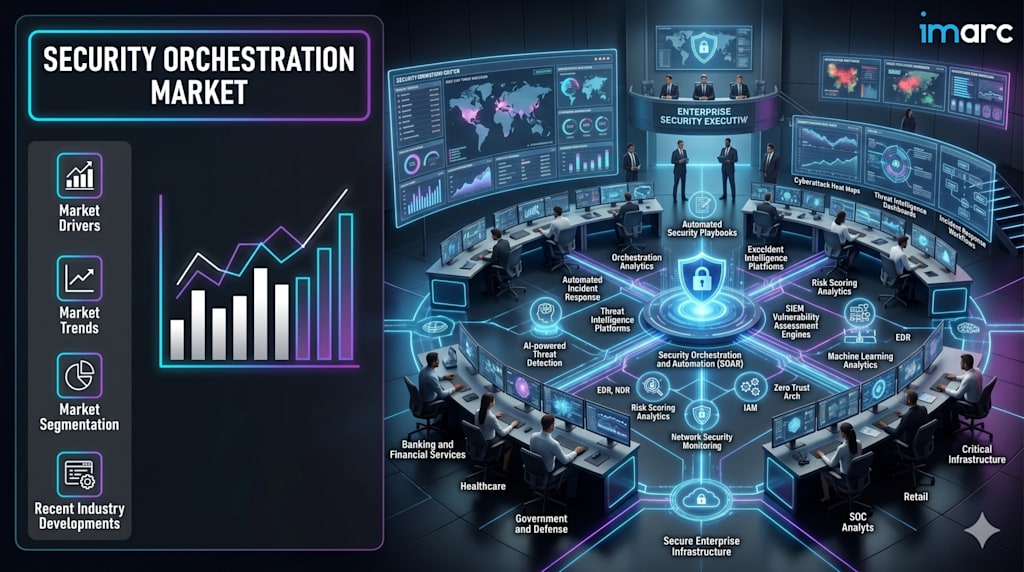
According to IMARC Group's latest research publication, The global security orchestration market size reached USD 4.1 Billion in 2025. Looking forward, IMARC Group expects the market to reach USD 12.8 Billion by 2034, exhibiting a growth rate (CAGR) of 12.95% during 2026-2034.
How AI is Reshaping the Future of the Security Orchestration Market
- Autonomous Threat Detection and Response: AI-driven security orchestration platforms are moving beyond rule-based playbooks toward autonomous decision-making. Modern Security Operations Centers (SOCs) receive thousands of alerts daily, and a large share of these alerts are often ignored simply because analysts cannot keep pace manually. AI-powered orchestration tools now triage, correlate, and act on alerts in real time, dramatically narrowing the gap between detection and containment.
- Agentic SOC Workflows: Vendors are introducing agentic AI ecosystems that let security teams build, test, and deploy autonomous security agents capable of investigating and remediating incidents without constant human intervention. These no-code agent-building platforms are being integrated with leading large language model providers and major cloud infrastructure providers, enabling coordinated response across endpoint, identity, and cloud environments.
- Reduced Mean Time to Detect and Respond: Organizations deploying advanced AI-assisted orchestration programs have reported significant reductions in both mean time to detect and mean time to respond to incidents, with some enterprises citing improvements of well over fifty percent in incident resolution speed after integrating generative AI into their SOC workflows.
- Consolidation of Fragmented Security Tools: AI is enabling vendors to unify previously siloed tools such as SIEM, SOAR, Extended Detection and Response (XDR), and Attack Surface Management (ASM) into single orchestrated platforms. This consolidation reduces tool sprawl, simplifies licensing, and allows security teams to manage detection and response from one console rather than juggling dozens of point solutions.
- AI-Powered Playbook Automation: Machine learning models are now capable of generating and refining response playbooks automatically based on historical incident patterns, MITRE ATT&CK technique mapping, and live threat intelligence feeds. This reduces the manual engineering effort historically required to build and maintain orchestration workflows, making automated response accessible even to mid-sized organizations with limited security staff.
Security Orchestration Industry Overview
Security orchestration refers to the integration of a disparate ecosystem of Security Operations Center (SOC) technologies and processes to automate routine and complex security tasks. It draws relevant data from numerous sources, enriches alerts, and helps incident response teams conduct alert triage, analytics, and threat intelligence gathering for faster, more strategic decision-making. Security orchestration is widely applied across energy and utilities, government, healthcare, retail, information technology, telecommunications, and banking, financial services, and insurance (BFSI) sectors.
The growing prevalence of bring your own device (BYOD) policies in small and medium enterprises has increased security breach exposure, pushing more organizations toward orchestration platforms. The widespread availability of cost-efficient cloud-based security orchestration tools is further propelling adoption, while telecommunications providers increasingly deploy orchestration to safeguard critical business applications amid surging data generation across data centers. Government investment in network infrastructure and cybersecurity research and development is also positively influencing the market, alongside a global cybersecurity workforce shortage exceeding four million unfilled roles, which is compelling organizations to rely more heavily on automation rather than manual headcount.
Security Orchestration Market Trends and Drivers
Enterprise consolidation through mergers and acquisitions remains a defining trend shaping the competitive landscape. Major platform providers have absorbed specialized orchestration vendors to integrate SIEM, SOAR, XDR, and AI analytics into unified offerings, reducing the operational burden organizations face when stitching together multiple disconnected tools. This trend is particularly visible among large technology and cybersecurity companies seeking to expand their next-generation security annual recurring revenue.
Cloud-based deployment is rapidly outpacing on-premises installations as organizations prioritize scalability, faster implementation, and lower upfront infrastructure costs. Cloud-native orchestration platforms allow distributed security teams to manage detection and response from anywhere, which has become especially valuable as hybrid and remote work models have become permanent fixtures in enterprise operations. Cloud delivery also enables vendors to push AI model updates and new threat intelligence feeds continuously, rather than relying on periodic on-premises upgrades.
Large enterprises continue to dominate adoption due to their complex, multi-tool security environments, often running fifty or more distinct security tools that require centralized orchestration to function efficiently. However, small and medium-sized enterprises are emerging as a high-growth segment as managed security service providers package orchestration capabilities into affordable, subscription-based offerings, lowering the barrier to entry for organizations without dedicated in-house SOC teams.
Regulatory compliance pressure is another significant driver. Frameworks requiring breach notification, data protection, and audit trails are pushing BFSI, healthcare, and government organizations to adopt orchestration platforms that can automatically document compliance management activities and generate audit-ready incident records. Government and defense agencies in particular are increasing procurement of orchestration platforms capable of coordinating threat intelligence sharing across multiple departments and allied agencies.
The rise of managed detection and response services is also reshaping market dynamics, as managed security service providers bundle orchestration software with professional services such as integration support, playbook customization, and round-the-clock monitoring. This service-led model is particularly attractive to resource-constrained organizations in retail, e-commerce, and mid-market segments that need enterprise-grade protection without building a dedicated SOC from scratch.
Leading Companies Operating in the Global Security Orchestration Industry
- Acalvio Technologies Inc.
- Accenture plc
- Amazon Web Services Inc. (Amazon.com Inc.)
- Cisco Systems Inc.
- Cyberbit (Elbit Systems)
- Exabeam Inc.
- Forescout Technologies Inc.
- International Business Machines Corporation
- Optiv Security Inc.
- Palo Alto Networks Inc.
- Swimlane Inc.
- Tufin
Security Orchestration Market Report Segmentation
By Type:
- Software
- Services
Software represents the largest market share, reflecting enterprise preference for owning and customizing core orchestration platforms rather than relying solely on outsourced services.
By Deployment Mode:
- Cloud-based
- On-premises
Cloud-based deployment exhibits a clear dominance in the market owing to lower upfront costs, faster scalability, and continuous access to updated threat intelligence and AI capabilities.
By Organization Size:
- Small and Medium-sized Enterprises
- Large Enterprises
Large enterprises hold the majority of the global market share, driven by their need to manage complex, multi-vendor security environments spanning numerous tools and data sources.
By Application:
- Compliance Management
- Threat Intelligence
- Ticketing Solutions
- Network Forensics
- Others
Threat intelligence represents the largest market share, as organizations prioritize real-time enrichment of alerts with contextual data to accelerate investigation and response.
By End Use Industry:
- BFSI
- IT and Telecommunication
- Government and Defense
- E-Commerce
- Others
The IT and telecommunication industry accounts for the majority of the total market share, given the sector's high exposure to cyber threats and its early adoption of automation-driven security operations.
Regional Insights:
- North America (United States, Canada)
- Asia Pacific (China, Japan, India, South Korea, Australia, Indonesia, Others)
- Europe (Germany, France, United Kingdom, Italy, Spain, Russia, Others)
- Latin America (Brazil, Mexico, Others)
- Middle East and Africa
North America currently dominates the global security orchestration market, supported by a mature cybersecurity ecosystem, stringent regulatory requirements, and high enterprise cybersecurity spending.
Recent News and Developments in the Security Orchestration Market
- April 2025: A leading cybersecurity platform provider agreed to acquire an AI security startup for several hundred million dollars, aiming to close emerging security gaps created by enterprise adoption of machine learning and AI applications.
- March 2025: A major networking and security company announced a partnership with a digital business risk quantification specialist to strengthen AI-driven cyber risk management capabilities for enterprise customers.
- March 2025: A leading workflow automation platform closed a multi-billion-dollar acquisition of a conversational AI company, aiming to integrate intelligent automation directly into security operations center workflows.
- May 2025: Global cybersecurity authorities jointly released formal guidance on integrating SIEM and SOAR systems, signaling growing regulatory attention to standardizing orchestration practices across critical infrastructure sectors.
- April 2026: A prominent endpoint security vendor unveiled an expanded agentic security operations ecosystem at a major industry conference, enabling enterprises and partners to build and orchestrate custom AI security agents in collaboration with leading cloud and AI infrastructure providers.
Note: If you require specific details, data, or insights that are not currently included in the scope of this report, we are happy to accommodate your request. As part of our customization service, we will gather and provide the additional information you need, tailored to your specific requirements. Please let us know your exact needs, and we will ensure the report is updated accordingly to meet your expectations.
About the Creator
Abhay Rajput
I am working in market research company that provides market and business research intelligence across the globe.
Enjoyed the story? Support the Creator.
Subscribe for free to receive all their stories in your feed.
Comments
There are no comments for this story
Be the first to respond and start the conversation.