
Scientists Couldn't Explain What AI Found Inside the Sphinx
*A speculative look at the future: what could AI uncover beneath one of history's oldest monuments?*

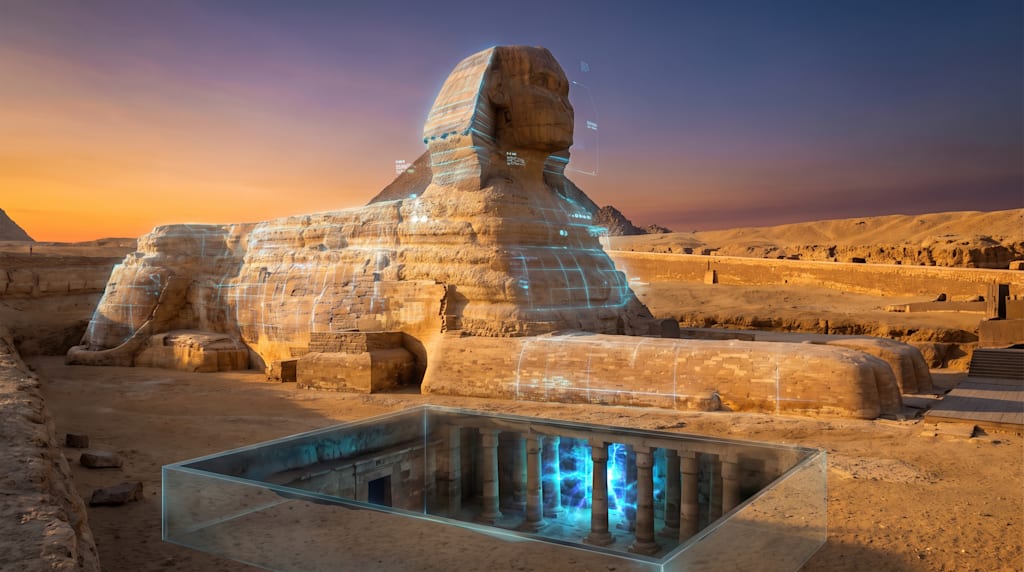
The Great Sphinx has been sitting in the Egyptian desert for over 4,500 years, watching empires rise and crumble without ever giving up its biggest secret. Now imagine this: a few years from now, that finally changes.
Picture an international team launching something called Project Insight — basically, throwing every radar scan, satellite image, and seismic survey ever taken of the Sphinx at an AI model and letting it find patterns no human ever could. The AI burns through decades of accumulated data in a matter of hours. And then it flags something nobody expected: a precisely shaped void hidden beneath the Sphinx's front paws.
At first, the team assumes it's a glitch. No earlier survey had ever confirmed a chamber there, so why would this one? They order a fresh ground-penetrating radar pass just to rule out an error. A few days later, the results come back — and the chamber is real.
Within hours, the story is everywhere. News outlets are running it, social feeds are flooded with theories, and millions of people are watching live as researchers prep a robotic probe to send down into the space.
Here's the twist, though: when the robot finally gets inside, there's no gold. No sarcophagus, no royal treasure, nothing you'd expect from a buried Egyptian tomb. Instead, the walls are covered in symbols nobody recognizes — not hieroglyphs, not any known script. They look more like equations etched into stone.
So the AI gets put to work decoding them. And what it comes back with is genuinely strange: the symbols appear to track star positions, eclipses, and planetary cycles with eerie precision — some of which line up with astronomical events that wouldn't happen until thousands of years after the Sphinx was supposedly built.
Naturally, this breaks a few assumptions historians had been comfortable with. Did the people who built the Sphinx know more about astronomy than we've ever given them credit for? Or was this chamber built for a completely different purpose — one nobody's figured out yet?
The deeper the team digs, the weirder it gets. Every single measurement inside the chamber follows the same mathematical ratio. Nothing about it looks accidental. It all looks deliberate, like someone designed it down to the last centimeter.
At some point, one researcher floats an idea that's hard to shake once you hear it: maybe this chamber was never meant to hold treasure at all. Maybe it was built to hold *information* — not for anyone living in ancient Egypt, but for whoever would eventually be capable of understanding it. Us, maybe. Or someone after us.
And then comes the detail that really stops everyone in their tracks: the layout of the chamber matches the exact position the stars will be in by the year 3000. Nobody can explain that. Coincidence? Deliberate design across thousands of years? No one's sure.
Maybe the real takeaway is this — for all this time, the Sphinx wasn't guarding gold. It was guarding knowledge. And maybe we've only just started to figure out how to read it.
---
*So — purely as a thought experiment: do you think the Sphinx is just a monument, or is there something still waiting to be found underneath it?*
About the Creator
uzair hadi
🌟 Love stories that stir the soul? ✨
Subscribe now for exclusive tales, early access, and hidden gems delivered straight to your inbox! 💌
Join the journey—one click, endless imagination. 🚀📚 #SubscribeNow
Enjoyed the story? Support the Creator.
Subscribe for free to receive all their stories in your feed.
Comments
There are no comments for this story
Be the first to respond and start the conversation.