
School Bags Market 2026–2034: Why Ergonomics, Style, and E-Commerce Are Reshaping a Back-to-School Essential
From rising student enrollments to smarter backpack designs, the school bags market is evolving into a blend of comfort, durability, fashion, and digital convenience.

School Bags Market: A Simple Product with a Growing Story
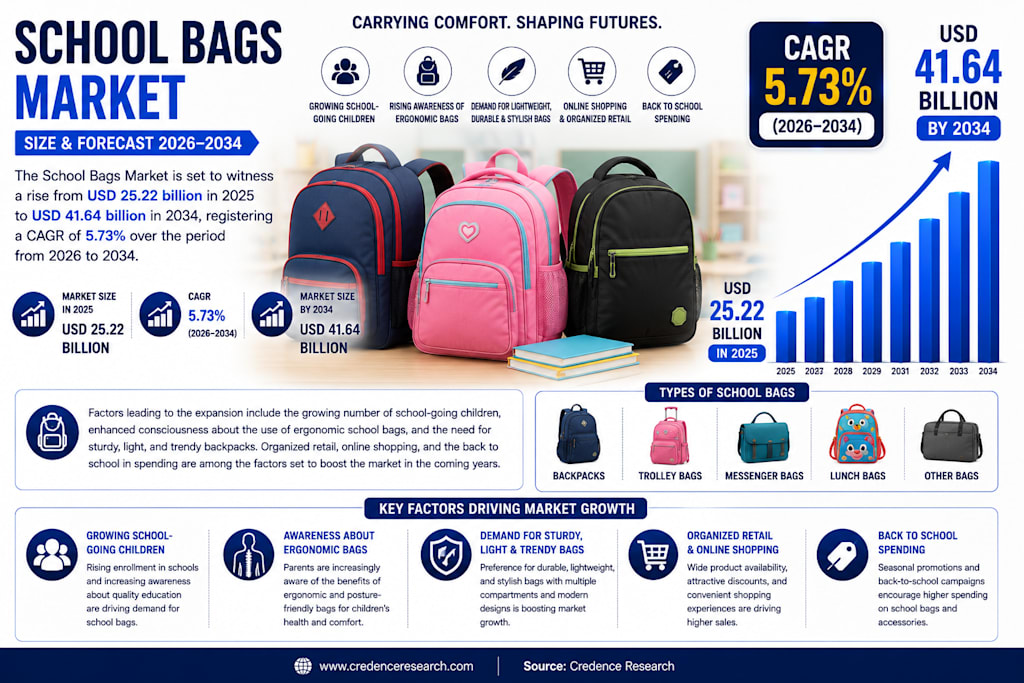
School bags may look like a routine purchase, but the market behind them is becoming increasingly dynamic. What was once a basic back-to-school item has turned into a product category shaped by education spending, changing parent preferences, ergonomic awareness, branding, online shopping, and even sustainability. Renub Research estimates that the School Bags Market will rise from USD 25.22 billion in 2025 to USD 41.64 billion by 2034, reflecting a CAGR of 5.73% from 2026 to 2034. That growth signals a market that is steadily expanding beyond function and becoming more closely tied to lifestyle and consumer choice.
The demand is supported by a mix of practical and emotional buying triggers. Parents want durability. Children want attractive designs. Schools want safer and more ergonomic products. Retailers want seasonal volume. And manufacturers want to meet all these expectations without losing competitiveness. That combination is creating a market that is both stable and surprisingly innovative.
Why the Market Is Growing
One of the strongest drivers of the school bags market is the growing number of school-going children around the world. More children in classrooms means more bags in shopping carts, and that simple equation continues to support demand year after year. Rising education expenditure in many countries has also encouraged families to spend more on quality products rather than choosing only the cheapest option.
A second major driver is ergonomics. Parents are becoming more aware that poorly designed school bags can contribute to posture problems, back pain, and discomfort in children. As a result, bags with padded shoulder straps, better weight distribution, and lightweight materials are gaining popularity. Schools and health professionals are increasingly influencing this shift, and manufacturers are responding with designs that place comfort alongside appearance.
The third major factor is product innovation. School bags are no longer limited to zippers and compartments. Today’s buyers are drawn to water-resistant fabrics, anti-theft features, USB charging ports, laptop sleeves, and stylish color palettes. This has expanded the category from a basic utility product into a more feature-driven consumer item.
Fashion Has Become Part of the Purchase Decision
In the school bags market, style matters almost as much as storage. For children and teenagers, a school bag is not just something to carry books in; it is also a visible part of their identity. Character-themed bags, branded designs, bright prints, and trendy patterns are often major purchase drivers, especially in younger age groups.
This influence is even stronger now because children are exposed to trends through social media, influencers, and peer preference. That has pushed school bags into the fashion conversation. Brands understand this well, which is why many of them now launch collections that combine practical features with eye-catching visuals. The result is a market where appearance can directly influence sales performance.
Brand value also plays a bigger role than it once did. Parents may still consider price first, but in many cases they are also looking for product reputation, durability, and safety. This is especially true in urban markets where consumers are more brand-conscious and willing to pay a little more for perceived quality.
Material Trends: Nylon, Leather, and More
The market is broad when it comes to materials, and each fabric category has its own appeal. Nylon school bags remain popular because they are lightweight, durable, water-resistant, and cost-effective. For families that want a practical option for everyday use, nylon often checks the right boxes. It is also easy for manufacturers to design into colorful and ergonomic shapes.
Leather school bags serve a different segment. They are positioned around premium appeal, durability, and a more polished look. Although heavier and more expensive, they attract buyers who value style and long-term use. Faux leather options are also gaining traction as sustainability and ethical sourcing become more important to consumers.
Polyester and canvas also continue to be important in the broader market. These materials support affordability, flexibility, and varied design options, which makes them attractive in highly competitive and price-sensitive regions. The overall picture is one of material diversity, with different buyers choosing products based on age, budget, and use case.
Product Types Are Evolving with Student Needs
The backpack remains the most common and widely used school bag type, and that is no surprise. It is practical, easy to carry, and adaptable to different age groups. But the market is not limited to backpacks alone. Satchels, messenger bags, trolley bags, laptop bags, and duffel-style school bags all occupy specific niches.
Laptop school bags are one of the fastest-growing segments because digital learning has changed what students carry to school. Tablets, laptops, chargers, and accessories now require more protective and organized storage. As a result, laptop bags with padded interiors, shock resistance, and dedicated compartments are becoming much more common.
Preschool bags, on the other hand, are designed for a very different audience. They are smaller, lighter, colorful, and often decorated with cartoons or playful themes. Safety and ease of handling matter more than storage capacity in this segment, and that makes the design process highly specialized.
High school bags sit at the other end of the spectrum. Students in this age group usually carry more books, electronics, sports items, and personal belongings, so larger capacity and stronger durability become essential. Fashion, however, remains important here too. Teenagers often want bags that look trendy while still offering enough room and support.
Distribution Is Moving Online, But Offline Still Matters
Retail has become a major part of the school bags story. Supermarkets and hypermarkets remain important because they offer convenience, affordability, and seasonal promotions. During back-to-school periods, families often prefer one-stop shopping, and school bags sit naturally alongside stationery, lunch boxes, and other school supplies. Private-label products also add price competition in these channels.
At the same time, online retail is growing quickly. E-commerce platforms make it easy for buyers to compare prices, features, reviews, and styles from multiple brands. That convenience is especially valuable for parents who want more choice without visiting multiple stores. Online channels also support customization, doorstep delivery, and exclusive product launches, which gives them a growing role in the market’s future.
This shift is important because school bag buying is increasingly driven by the digital consumer journey. Parents may still purchase in physical stores, but they often research online first. In practical terms, this means the market is becoming more transparent, more competitive, and more brand-sensitive than before.
Regional Demand Shows Different Buying Priorities
The United States market is developed and strongly influenced by back-to-school spending, laptop-friendly designs, comfort features, and brand preference. Sustainability is also becoming more visible there, with growing interest in recycled materials and environmentally conscious production. The market is supported by retail stores, specialty outlets, and online sales.
The United Kingdom market is shaped by its organized education structure and school uniform culture. This creates steady demand for simple, durable, and regulation-friendly products. At the same time, ergonomic and eco-friendly designs are gaining importance, especially among parents who want a safer and more responsible choice for children.
India is one of the most promising growth markets. Rising school enrollment, urbanization, price sensitivity, and a growing awareness of quality are all helping the category expand. Cartoon prints, colorful styles, and laptop-compatible designs are especially popular, while organized retail and online channels are increasing availability across Tier I, II, and III cities.
Saudi Arabia is also showing growth in ergonomic and laptop-compatible bags as education becomes increasingly technology-enabled. More broadly, many markets in the Middle East and Africa are seeing demand shaped by practical needs, school support programs, and the shift toward modern learning tools.
What Is Holding the Market Back?
Despite the positive outlook, the market faces a few clear challenges. Price sensitivity remains a major issue, especially in developing regions where consumers compare products heavily on cost. Local and unorganized manufacturers also make the market more competitive, often forcing branded players to work harder on pricing and promotions.
Seasonality is another challenge. Demand rises sharply before the school year begins, which creates intense competition during a short period. Many brands rely on discounts, bundling, and heavy promotions, which can pressure margins. For manufacturers, balancing affordability with durability is not easy.
Sustainability adds another layer of complexity. Consumers increasingly want eco-friendly school bags, but sustainable materials and processes can raise production costs. That means manufacturers must find a balance between greener products and marketable price points.
The Competitive Landscape Is Broad and Active
The market includes major global and regional players such as Adidas AG, Nike Inc., Puma SE, Samsonite International S.A., Sumdex Group, VIP Industries Limited, and Wildcraft. These companies are active across product innovation, branding, design, and retail presence. Their competition helps keep the market dynamic and pushes product development forward.
A notable trend is that many companies are no longer treating school bags as a standalone product. Instead, they are building collections that connect school bags with broader lifestyle, travel, sports, and youth branding strategies. That makes the category more strategic than it may appear at first glance.
Final Thoughts
The school bags market is no longer just about carrying books from home to school. It now reflects broader changes in education, parenting, design, retail, and consumer expectations. The projected growth from USD 25.22 billion in 2025 to USD 41.64 billion by 2034 shows that demand remains strong, but the winning products will likely be those that combine comfort, durability, style, and practical innovation.
In the years ahead, ergonomic design, laptop compatibility, sustainability, and e-commerce convenience are expected to shape buying behavior even more strongly. For brands and retailers, the opportunity is clear: school bags are still a necessity, but they are now also a statement of quality, identity, and care. In a market this familiar, that change makes all the difference.
About the Creator
Enjoyed the story? Support the Creator.
Subscribe for free to receive all their stories in your feed.
Comments
There are no comments for this story
Be the first to respond and start the conversation.