
Saudi Arabia Welding Consumables Market to Reach USD 253.2 Million by 2034, Growing at 4.75% CAGR
Saudi Arabia’s welding consumables market is growing steadily, driven by industrial expansion, infrastructure projects, and rising demand across construction and manufacturing sectors.

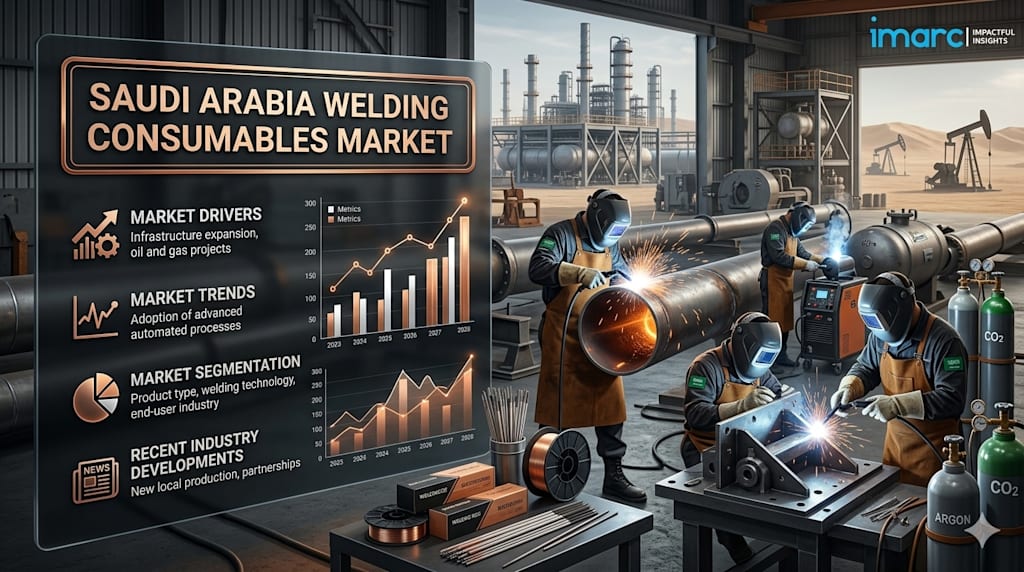
Market Overview:
Rising infrastructure development, expansion of oil and gas activities, and growth in the petrochemical and manufacturing sectors are supporting demand for welding consumables across Saudi Arabia. These developments are further reinforced by government investments under Vision 2030, along with increasing adoption of automation and advanced fabrication techniques.
According to IMARC Group's latest data, the Saudi Arabia welding consumables market size reached USD 166.8 Million in 2025. Looking forward, the market is expected to reach USD 253.2 Million by 2034, exhibiting a CAGR of 4.75% during 2026–2034.
The market is witnessing steady expansion due to large-scale construction projects, energy sector requirements, and ongoing industrial diversification. Demand for electrodes, solid wires, flux-cored wires, and submerged arc welding (SAW) consumables is increasing across sectors such as construction, energy, automotive, shipbuilding, aerospace, and industrial equipment.
Saudi Arabia Welding Consumables Market Growth Drivers
- Rising Infrastructure Development and Mega-Project Activity
Large-scale infrastructure development across Saudi Arabia is creating sustained demand for welding consumables in structural fabrication, steel assembly, and installation processes. Major construction and urban development projects are increasing the need for reliable welding materials that can deliver consistent strength and durability under challenging environmental conditions.
The growing number of commercial complexes, transportation networks, and urban expansion initiatives is also contributing to higher consumption of welding materials. These projects require continuous supply of electrodes, wires, and fluxes for both initial construction and ongoing maintenance activities. As multiple projects progress simultaneously, supply chains are adapting to ensure availability across different regions of the country.
- Expansion of Oil, Gas, and Petrochemical Sectors
The oil and gas industry remains one of the primary end-use sectors driving demand for welding consumables. Activities such as pipeline construction, refinery expansion, and routine maintenance require high-performance welding materials that meet strict safety and quality standards.
Companies such as Saudi Aramco continue to invest in upstream and downstream operations, which generates consistent demand for specialized consumables used in pressure vessels, pipelines, and heavy industrial equipment. In addition, the expansion of petrochemical production facilities is broadening the application scope of welding consumables across industrial manufacturing environments.
- Government Investment and Industrial Diversification
Government-led initiatives under Vision 2030 are encouraging the development of domestic manufacturing capabilities and industrial infrastructure. Investments in industrial zones, logistics networks, and production facilities are increasing the number of fabrication units operating within the country.
Programs such as the Saudi Industrial Development Fund are supporting small and medium enterprises involved in manufacturing and fabrication activities. This is leading to increased consumption of welding consumables across various industrial applications. Additionally, policies promoting local production are encouraging companies to establish in-country manufacturing operations, further strengthening demand.
Saudi Arabia Welding Consumables Market Trends
- Shift Toward Automated and Semi-Automated Welding
The adoption of automated and semi-automated welding systems is becoming more prominent across industries. These systems improve productivity, reduce manual errors, and enhance weld consistency, especially in large-scale industrial applications.
As a result, there is growing demand for welding consumables that are compatible with automated processes, including wire-based systems and continuous-feed materials. Manufacturers are focusing on developing products that offer stable arc performance, reduced spatter, and minimal post-weld processing. This trend is particularly visible in sectors such as construction, shipbuilding, and energy infrastructure.
- Increasing Demand for Certified and High-Quality Consumables
End-users are placing greater emphasis on product quality, certification, and compliance with international standards. Industries such as oil and gas, aerospace, and heavy equipment manufacturing require welding consumables that meet established performance benchmarks.
Certified materials help reduce the risk of defects, ensure structural reliability, and minimize the need for rework. As a result, there is a gradual shift toward higher-quality and specification-grade consumables. This trend is contributing to market standardization and improving overall product performance across applications.
- Diversification Across Emerging Industrial Sectors
The application of welding consumables is expanding beyond traditional industries into emerging sectors such as aerospace manufacturing, automotive production, and shipbuilding. These industries require specialized welding solutions tailored to different material types and precision requirements.
This diversification is creating opportunities for manufacturers to develop a broader range of consumables suited to various industrial needs. It also reflects the broader transformation of Saudi Arabia’s industrial landscape, where new sectors are contributing to overall demand growth.
Recent News and Developments
- April 2026: ESAB Corporation expanded local production capacity in Al Ahsa, supporting regional infrastructure projects.
- March 2026: Spark Weld upgraded manufacturing capabilities to introduce new low-hydrogen and stainless-steel consumables.
- February 2026: Hyundai Welding partnered with a local distributor and opened a showroom in Riyadh to improve product accessibility.
- December 2025: Manufacturers introduced low-spatter flux-cored wires to improve efficiency in pipeline and structural applications.
- June 2025: ESAB established a new manufacturing facility in partnership with regional players to support domestic and export demand.
Note: If you require specific details, data, or insights that are not currently included in the scope of this report, we are happy to accommodate your request. As part of our customization service, we will gather and provide the additional information you need, tailored to your specific requirements. Please let us know your exact needs, and we will ensure the report is updated accordingly to meet your expectations.
About the Creator
Kishan Kumar
My name is Kishan Roy and I am a market analyst having 5 years of experience and a skilled researcher with a keen eye for consumer trends and data-driven insights.
Enjoyed the story? Support the Creator.
Subscribe for free to receive all their stories in your feed.
Comments
There are no comments for this story
Be the first to respond and start the conversation.