
Saudi Arabia Video Surveillance Systems Market: AI Surveillance, Smart Security & Growth Outlook
How rising investments in smart city projects under Vision 2030, increasing adoption of AI-powered analytics and IP-based surveillance systems, and growing demand for public safety, traffic monitoring, and critical infrastructure protection are driving innovation and rapid digital transformation across the Saudi Arabia Video Surveillance Systems Market.

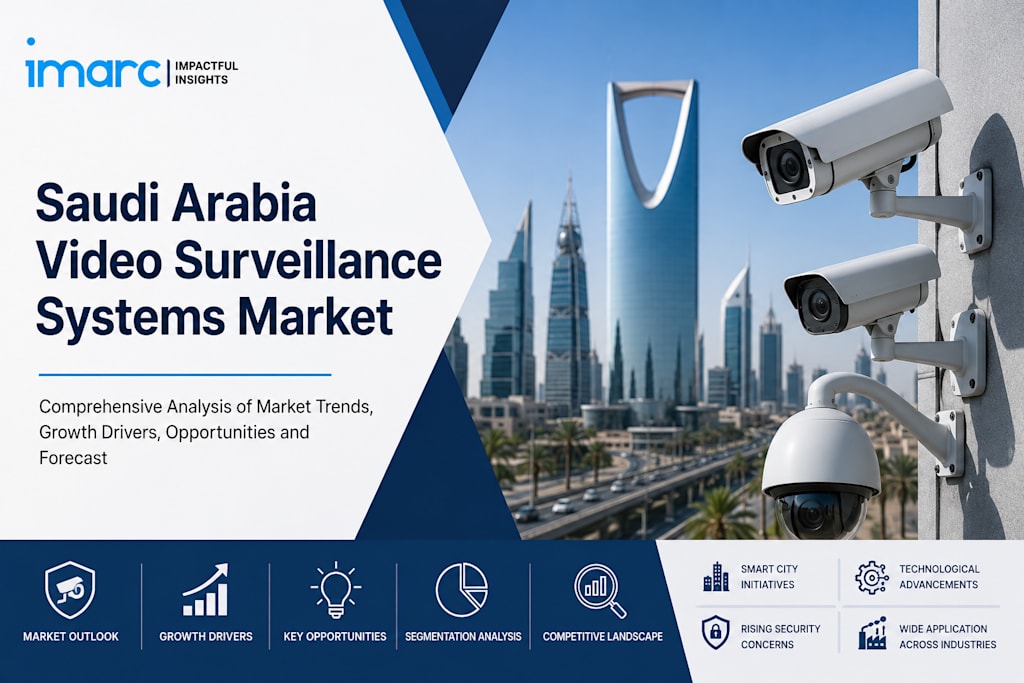
Saudi Arabia’s video surveillance systems market is one of the fastest-growing security technology segments in the Middle East and the numbers reflect why. A combination of large-scale government infrastructure projects, rising cybersecurity threats, and genuine public demand for safer urban spaces has turned the Kingdom into one of the most active surveillance technology investment destinations in the region. According to IMARC Group’s latest data, The Saudi Arabia video surveillance systems market size reached USD 780.9 Million in 2025. Looking forward, IMARC Group expects the market to reach USD 2,242.4 Million by 2034, exhibiting a growth rate (CAGR) of 12.44% during 2026-2034.
What makes this market particularly compelling is that growth is coming from multiple directions at once. Vision 2030 megaprojects NEOM, the Red Sea Project, and Qiddiya are demanding integrated surveillance from the ground up, not as an afterthought. Meanwhile, Saudi Arabia ranked as the safest country among all G20 nations in the 2023 Safety Index, with 92.6% of residents saying they feel safe walking alone at night a direct reflection of the effectiveness of the Kingdom’s security infrastructure investments. The market spans system types including analog, IP, and hybrid surveillance, with applications across commercial, military and defense, infrastructure, residential, and other sectors. Components are categorized as hardware, software, and services, with enterprise sizes ranging from small to large scale, serving both B2B and B2C customer segments across four key regions.
Saudi Arabia Video Surveillance Systems Market Growth Drivers:
- Vision 2030 Smart City Push and Public Safety Mandate
Government-led smart city projects are the most powerful demand engine for video surveillance in Saudi Arabia. NEOM’s LINE city concept, Riyadh’s metro expansion, and the Red Sea Project’s tourism corridors all require surveillance networks built in from day one covering perimeter monitoring, crowd analytics, traffic management, and emergency response coordination. The National Transport and Logistics Strategy and public space upgrades across airports, seaports, and urban districts are creating layered procurement cycles. Beyond megaprojects, the broader Vision 2030 goal of improving quality of life across the Kingdom underpins sustained public investment in intelligent surveillance infrastructure at every level of government.
- Escalating Cyber and Physical Threat Landscape
Saudi Arabia’s threat environment makes video surveillance an operational necessity, not a luxury. The Kingdom recorded over 180 major cyber incidents in a single year, with 47% of compromised data from domestic organizations appearing for sale on the dark web. More than 50 million email threats and 34 million malware attacks were blocked in the same period. These figures are driving parallel investment in physical surveillance particularly AI-enabled systems that can detect intrusions, monitor access points, and flag anomalies in real time. For critical assets like energy facilities, financial centers, and government installations, high-definition video surveillance is now a baseline security requirement.
- AI and IoT Integration Driving System Upgrade Cycles
The shift from passive recording to intelligent, analytics-driven surveillance is accelerating upgrade spending across both public and private sectors. Organizations are moving away from legacy analog setups toward IP-based and hybrid systems capable of supporting facial recognition, license plate detection, behavioral analytics, and real-time threat alerts. The rollout of 5G infrastructure across Saudi cities is enabling seamless connectivity between distributed camera networks and centralized command centers, allowing security teams to act on live intelligence rather than review footage after incidents. Saudi Arabia’s AI spending is projected to reach USD 1.9 billion by 2027, with a meaningful portion directed toward intelligent surveillance applications.
Saudi Arabia Video Surveillance Systems Market Trends:
- AI-Powered Surveillance Moving from Pilot to Mainstream
Facial recognition, behavioral analytics, and automated anomaly detection are no longer pilot-stage technologies in Saudi Arabia they’re being deployed at scale. Retailers are using AI-driven cameras to monitor customer flow and flag shoplifting in real time. Hospitals are using intelligent surveillance to manage patient safety zones and restrict access to sensitive areas. Airports and metro stations are running license plate recognition systems integrated with law enforcement databases. Eagle Eye Networks opened a dedicated AI-enhanced cloud video surveillance data center in Riyadh, specifically designed to meet local cybersecurity and data privacy regulations, showing just how seriously the market is maturing beyond basic camera installations.
- Cloud-Based and Remote Surveillance Gaining Ground
Cloud migration is reshaping how surveillance systems are managed and scaled across the Kingdom. Rather than maintaining expensive on-premise server infrastructure, organizations are shifting to centralized cloud platforms that allow remote monitoring, instant firmware updates, and unified management across multiple sites. Eagle Eye Networks’ Riyadh data center launch is a direct response to this demand, purpose-built to align with Saudi cybersecurity regulations while delivering scalable video-as-a-service to businesses nationwide. For enterprises managing dozens of retail outlets, hotel properties, or industrial facilities, cloud-based surveillance means consistent security standards without the overhead of site-by-site hardware management.
- Thermal and Long-Range Systems Expanding Beyond Military Use
Advanced thermal imaging and long-range surveillance systems traditionally the domain of defense applications are being adopted more widely for border security, critical infrastructure protection, and large-area monitoring. Teledyne FLIR’s USD 7.8 million contract to supply its Lightweight Vehicle Surveillance System (LVSS) to Saudi Arabia is a concrete example, with the deployment covering border monitoring and critical infrastructure protection including mission equipment and operational training. As the distinction between military-grade and commercial surveillance technology narrows, high-performance thermal and long-range cameras are increasingly appearing in energy sector deployments, port security, and large-scale event management.
Recent News and Developments in Saudi Arabia Video Surveillance Systems Market
- March 2025: Teledyne FLIR secured a USD 7.8 million contract to deliver its Lightweight Vehicle Surveillance System (LVSS) to Saudi Arabia. The system is purpose-built for long-range thermal surveillance, and the contract includes mission equipment and operational training. The deployment targets border security and critical infrastructure protection, reinforcing the Kingdom’s commitment to equipping its security forces with state-of-the-art video surveillance technology.
- September 2024: Eagle Eye Networks opened a new, purpose-built data center in Riyadh designed specifically to meet the expected surge in demand for AI-enhanced cloud video surveillance across Saudi Arabia. The facility is structured to comply with local cybersecurity and data privacy regulations, enabling businesses across the Kingdom to access secure, scalable video surveillance-as-a-service without the cost of maintaining on-premise server infrastructure.
- December 2025: Saudi Arabia’s Ministry of Investment announced more than SR 500 million (approximately USD 133 million) in new cybersecurity and security technology funding at the fourth edition of Black Hat Middle East and Africa in Riyadh. The investment package spans digital security infrastructure, startup development, and advanced surveillance capabilities signaling that the Kingdom is treating security technology as a strategic economic priority, not just a procurement line item.
- October 2025: IDEMIA Public Security entered a strategic partnership with SAMI Advanced Electronics to accelerate the deployment of biometric and smart surveillance solutions across Saudi Arabia’s travel and transportation infrastructure. The collaboration pairs IDEMIA’s global expertise in secure identity and video analytics technologies with SAMI’s established local presence, creating a strong platform for scaling intelligent surveillance across airports, ports, and smart mobility corridors throughout the Kingdom.
Note: If you require specific details, data, or insights that are not currently included in the scope of this report, we are happy to accommodate your request. As part of our customization service, we will gather and provide the additional information you need, tailored to your specific requirements. Please let us know your exact needs, and we will ensure the report is updated accordingly to meet your expectations.
About the Creator
Shubham Sharma
Market research enthusiast sharing insights on global industries, emerging trends, growth opportunities, and data-driven analysis across diverse markets.
Enjoyed the story? Support the Creator.
Subscribe for free to receive all their stories in your feed.
Comments
There are no comments for this story
Be the first to respond and start the conversation.