
Saudi Arabia Third-Party Logistics (3PL) Market: Supply Chain Modernization, E-commerce Growth & Expansion Outlook
How rapid expansion of e-commerce, rising investments in transport and warehousing infrastructure under Vision 2030, and growing demand for efficient supply chain management are driving adoption of digital logistics platforms, automation, and integrated freight solutions across the Saudi Arabia Third-Party Logistics (3PL) Market.

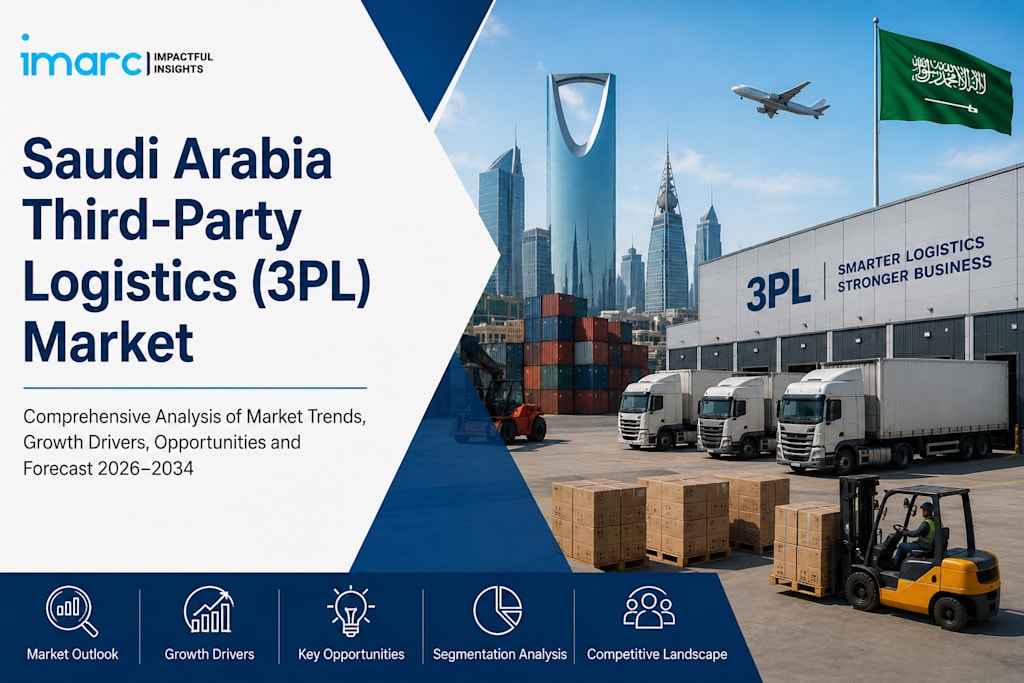
Saudi Arabia’s third-party logistics sector is quietly becoming one of the most consequential growth stories in the Kingdom’s economic transformation. As businesses across e-commerce, healthcare, manufacturing, and energy shift toward outsourced supply chain models, the demand for capable, technology-driven 3PL partners has moved from optional to essential. Vision 2030’s goal of turning the Kingdom into a global logistics hub is translating into real infrastructure, real investment, and real demand and 3PL providers are at the center of it all. According to IMARC Group’s latest data, The Saudi Arabia third-party logistics (3PL) market size reached USD 14.5 Billion in 2025. Looking forward, IMARC Group expects the market to reach USD 24.9 Billion by 2034, exhibiting a growth rate (CAGR) of 6.20% during 2026-2034.
The scale of what’s happening in Saudi Arabia’s logistics sector is hard to overstate. The government allocated USD 3 billion specifically for logistics infrastructure in 2024 alone, covering new warehouses, distribution centers, and port facility upgrades. The Kingdom’s 73,000 km road network and 4,500 km railway system provide the physical backbone for 3PL operations, while ports like King Abdullah Port continue to see surging throughput. E-commerce revenue is growing at 13.5% annually through 2027, over 90% of the population is connected to the internet, and around 80% of online users actively shop digitally a trifecta that makes last-mile delivery and fulfillment the fastest-growing demand segment for 3PL providers. The market is segmented by service type into domestic transportation management, international transportation management, and value-added warehousing and distribution, with end users spanning automotive and manufacturing, oil and gas, chemical, distributive trade (wholesale and retail trade including e-commerce), pharmaceutical and healthcare, construction, and others, across the Northern and Central, Western, Eastern, and Southern regions.
Saudi Arabia Third-Party Logistics (3PL) Market Growth Drivers:
- Strong Government Support and Vision 2030 Logistics Mandate
Vision 2030 isn’t just a policy document it’s an active procurement engine for the 3PL sector. The National Transport and Logistics Strategy targets reducing logistics costs to 6% of GDP, digitizing customs processes, and establishing free economic zones that offer tax exemptions and streamlined regulatory environments to attract global operators. The government’s USD 3 billion infrastructure allocation in 2024 covered warehouses, distribution centers, and port upgrades. Initiatives like MODON’s logistics zone partnerships and the integration of port community systems are directly removing the friction that previously slowed cargo movement, creating a structurally more attractive operating environment for 3PL providers of every scale.
- E-Commerce Surge Creating Scalable, Recurring 3PL Demand
E-commerce is arguably the single most transformative demand driver for 3PL in Saudi Arabia right now. Revenue is growing at 13.5% annually through 2027, with around 80% of the Kingdom’s internet-connected population actively shopping online. That translates into surging demand for warehousing, order fulfillment, and last-mile delivery at a scale that most retailers simply cannot manage in-house. Seasonal peaks during Ramadan and Eid amplify volume spikes that only outsourced logistics partners with elastic capacity can absorb. Aramex has already expanded its e-commerce fulfillment services in the Kingdom through strategic alliances, a clear signal that providers who invest in scalable digital infrastructure now will capture disproportionate market share as online retail matures.
- Technology Innovation Transforming Logistics Operations
IoT, AI-powered route optimization, automation, and blockchain are fundamentally changing what 3PL providers can offer in Saudi Arabia. The Kingdom’s IoT market reached USD 9,490.7 million, with logistics identified as a priority vertical. Warehouse automation alone has generated a market of USD 595.7 million, projected to more than double by 2033. Geek+ deployed autonomous mobile robots in Saudi warehouses through a partnership with Starlinks, while Aramex’s automated robotic sorting facility at Jeddah Islamic Port processes up to 96,000 shipments per day. For clients in pharma, food, and automotive, these capabilities translate directly into fewer errors, lower costs, and supply chain resilience that manual-heavy providers simply cannot match.
Saudi Arabia Third-Party Logistics (3PL) Market Trends:
- Strategic Global-Local Joint Ventures Reshaping the Competitive Landscape
The most impactful competitive moves in Saudi 3PL are coming from joint ventures that pair global operational expertise with deep local market knowledge. CEVA Logistics and Almajdouie Logistics formed CEVA Almajdouie Logistics to address integrated logistics demand across the Kingdom, combining international network reach with established Saudi relationships. FedEx partnered with the King Salman International Airport Development Company and SILZ to position Saudi Arabia as a world-class air cargo center. Saudi Arabia Railways’ collaboration with Procter & Gamble to move goods by rail reflects how sustainability and efficiency goals are converging into new multimodal logistics arrangements that both public and private sector players are actively pursuing.
- Port and Infrastructure Upgrades Creating New 3PL Capacity Opportunities
The physical infrastructure supporting Saudi Arabia’s 3PL sector is being rebuilt at speed. Hassan Allam Roads & Bridges secured the contract for roads and paving at the Port of NEOM, while King Abdullah Port capacity upgrades and MSC’s new Clanga shipping service connecting Saudi Arabia directly to Singapore, Shanghai, and Colombo are opening premium East Asian trade corridors. For 3PL providers, improved port connectivity means faster cargo turnaround, lower demurrage costs, and better asset utilization. Providers that can integrate port APIs directly into their transport management systems are gaining real-time clearance advantages that translate into measurable service differentiation and pricing power.
- Green Logistics Shifting from Corporate Commitment to Procurement Requirement
Sustainability in Saudi 3PL is moving beyond marketing language into actual qualification criteria. The 2025 SASO rule has embedded green logistics standards directly into procurement and tender processes, meaning 3PL providers without credible sustainability credentials are increasingly shut out of major contracts. Kuehne + Nagel already provides green logistics services in the Kingdom that explicitly attract environmental compliance-driven clients. Saudi Arabia’s commitment to net-zero emissions by 2060 is prompting electric delivery fleet pilots and energy-efficient warehouse designs. 3PL operators who move early on solar-powered facilities, EV fleets, and carbon-measured delivery reporting are positioning themselves to win the next wave of long-term supply chain contracts.
- Recent News and Developments in Saudi Arabia Third-Party Logistics (3PL) Market
- February 2025: Saudi Arabia’s National Unified Procurement Co. (NUPCO) secured three major financing deals worth SR 2.5 billion (USD 666.6 million) at the PIF Private Sector Forum to strengthen supply chain financing for healthcare providers. On the same day, NUPCO signed an MoU with MODON to improve logistics services, localize content, and bolster pharmaceutical supply chains specifically designed to deliver third-party logistics solutions to pharmaceutical manufacturers and companies in industrial areas across the Kingdom.
- January 2025: Aramex inaugurated a state-of-the-art robotic sorting facility at Jeddah Islamic Port, equipped with 120 robotic guided vehicles (RGVs) capable of processing up to 96,000 shipments per day. The facility handles approximately 65% of Saudi Arabia’s maritime imports and integrates robotics with AI-driven operational systems setting a new benchmark for port-based logistics automation in the Kingdom.
- October 2024: CEVA Logistics and Almajdouie Logistics finalized an agreement to form CEVA Almajdouie Logistics, a joint venture combining both companies’ transport and logistics operations to deliver end-to-end integrated supply chain services across Saudi Arabia. The partnership directly targets the Kingdom’s rising demand for comprehensive 3PL solutions, leveraging CEVA’s global scale and Almajdouie’s entrenched regional expertise and client relationships.
- October 2024: FedEx partnered with the King Salman International Airport Development Company (KSIADC) and the Saudi Integrated Logistics Zone (SILZ) to advance Saudi Arabia’s position as one of the world’s leading logistics and air cargo centers. The collaboration is designed to modernize air freight handling infrastructure, streamline customs processing, and position the Kingdom as a strategic air cargo hub connecting Europe, Asia, and Africa.
Note: If you require specific details, data, or insights that are not currently included in the scope of this report, we are happy to accommodate your request. As part of our customization service, we will gather and provide the additional information you need, tailored to your specific requirements. Please let us know your exact needs, and we will ensure the report is updated accordingly to meet your expectations.
About the Creator
Faisal Al-Harbi
Market research professional based in Saudi Arabia (KSA), focused on industry trends, market growth, and economic insights.
Writing data-driven articles on Saudi markets, business outlook, and Vision 2030–driven sectors.
Enjoyed the story? Support the Creator.
Subscribe for free to receive all their stories in your feed.
Comments
There are no comments for this story
Be the first to respond and start the conversation.