
Saudi Arabia Smart Manufacturing Market: Industry 4.0, Automation & Growth Outlook
How real-time data integration, industrial IoT adoption, and AI-driven automation are reshaping production efficiency, supply chain agility, and decision-making across the Saudi Arabia Smart Manufacturing Market.

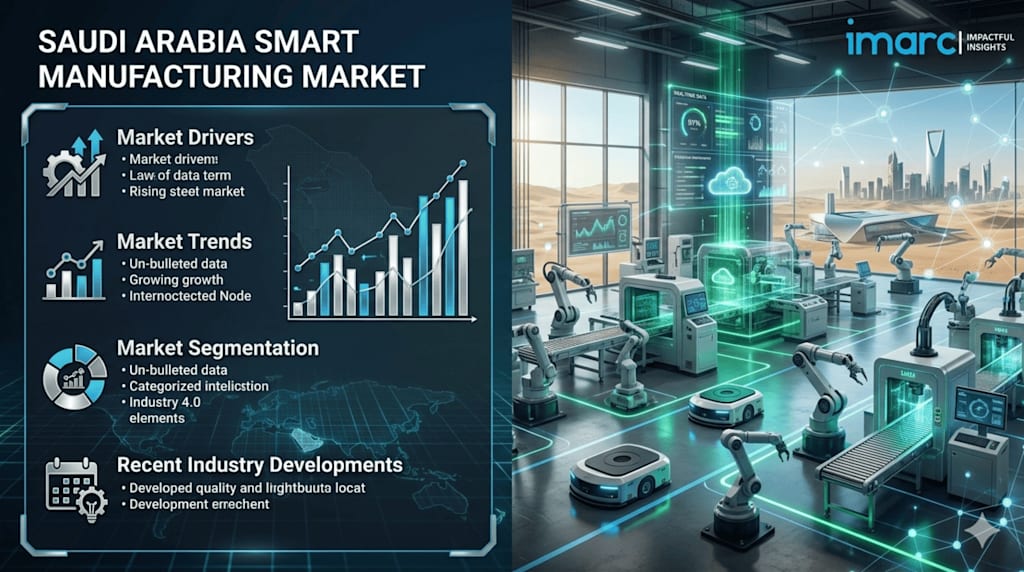
Saudi Arabia is quietly becoming one of the most exciting smart manufacturing markets in the world, and most people outside the industry haven’t fully registered that yet. Driven by Vision 2030’s push to diversify the economy and modernize the industrial base, the Kingdom is pouring investment into automation, AI, robotics, and IoT-enabled factory systems at a pace that’s hard to ignore. According to IMARC Group’s latest data, the Saudi Arabia smart manufacturing market size reached USD 3,797.0 Million in 2025. Looking forward, IMARC Group estimates the market to reach USD 11,859.4 Million by 2034, exhibiting a CAGR of 13.49% from 2026-2034. The market spans key components including Hardware, Software, and Services, and covers technologies ranging from SCADA and PLCs to 3D printing and AI-powered machine vision across end-use sectors like oil and gas, automotive, electronics, and healthcare.
This isn’t just a story about technology adoption. It’s about a country deliberately rebuilding its industrial identity. Saudi Arabia’s IoT in manufacturing sector alone reached USD 612.03 Million, with connected sensors, predictive maintenance systems, and real-time data platforms becoming standard tools in petrochemical plants, packaging lines, and food processing facilities. Giga-projects like NEOM are being designed from the ground up with smart manufacturing at the core, serving as real-world testbeds for the next generation of industrial technology. The regulatory environment, investment frameworks, and workforce development programs are all lining up in the same direction.
Saudi Arabia Smart Manufacturing Market Growth Drivers:
- Rising Adoption of Automation and Robotics
Walk into any modern Saudi manufacturing facility today and you’re likely to see robotic arms handling assembly, automated inspection systems running quality checks, and conveyor lines that barely need a human operator. Industries like automotive, petrochemicals, and packaging are leading this shift, deploying robotics to improve precision and eliminate costly errors. With labor costs rising and international quality benchmarks tightening, automation has moved from “nice to have” to essential. Government incentives and partnerships with global technology companies are making these systems more accessible, and as costs continue to fall, adoption across mid-sized manufacturers is accelerating noticeably.
- Strong Government and Private Sector Investment
The scale of investment flowing into Saudi smart manufacturing is genuinely impressive. Beyond government-led initiatives, AI spending in Saudi Arabia alone was anticipated to exceed USD 720 Million recently and is on track to reach USD 1.9 Billion within a few years. Giga-projects like NEOM and The Line are designed with intelligent manufacturing embedded from the start, functioning as real-world proving grounds for advanced industrial solutions. Venture capital is also backing startups in robotics, IoT, and automation. This combination of top-down funding and bottom-up innovation is building a technology ecosystem that supports long-term, sustainable growth across manufacturing sectors.
- Increasing Demand for Operational Efficiency and Cost Reduction
In industries like petrochemicals, steel, and cement, where margins are tight and energy costs are significant, even small efficiency gains translate into substantial savings. Smart manufacturing delivers exactly that — real-time analytics, predictive maintenance, and process automation that cut energy consumption, reduce unplanned downtime, and extend asset life. Companies are also using advanced decision-support tools to streamline supply chains and optimize logistics. For Saudi manufacturers competing in both regional and global markets, the business case for smart technology adoption isn’t theoretical. The ROI is measurable, often within the first two years of deployment, which is why uptake keeps accelerating.
Saudi Arabia Smart Manufacturing Market Trends:
- Vision 2030 and Industrial Diversification Goals
Vision 2030 is doing something quite specific for smart manufacturing — it’s creating demand at a national level. The government is actively funding technology integration across automotive, chemicals, electronics, and consumer goods sectors, pushing factories to adopt AI, robotics, and intelligent production systems. This isn’t a soft suggestion; it’s backed by procurement policies, local content requirements, and funding programs designed to make digital transformation the default path. For manufacturers, this top-down push removes a lot of the hesitation that typically slows technology adoption. The result is sector-wide modernization happening faster than most market watchers initially predicted.
- Integration of IoT and Connected Manufacturing Devices
The Saudi Arabia IoT in manufacturing market reached USD 612.03 Million, reflecting just how deeply connected technology has embedded itself in local factories. Sensors on production lines, real-time dashboards tracking energy usage, and machine-to-machine communication are now standard features in petrochemical plants and food processing facilities. The shift to connected manufacturing isn’t just about visibility — it’s about action. When a sensor detects a pressure anomaly or an efficiency drop, the system flags it before it becomes a breakdown. This predictive capability is changing how plant managers operate, reducing reactive maintenance and improving overall equipment effectiveness across sectors.
- Growth of Industry 4.0 and Digital Twin Adoption
Industry 4.0 is moving beyond buzzword status in Saudi Arabia and into active deployment. A standout example: Naver launched an innovative five-year project with the Saudi government to build digital twin platforms for Riyadh and four other major cities, creating highly precise 3D city models accurate within 10 centimeters using advanced cloud technology. On the factory floor, digital twins let manufacturers simulate production changes, test new configurations, and identify bottlenecks before they appear in real life. Combined with AI-driven analytics and advanced manufacturing execution systems, this is enabling Saudi companies to meet global supply chain standards, improve customization, and compete effectively in international markets.
Recent News and Developments in Saudi Arabia Smart Manufacturing Market
- August 2025: Desert Technologies and AlKhorayef Industries announced a strategic cooperation agreement aimed at enhancing Saudi Arabia’s capacity in smart infrastructure. The collaboration was designed to merge the expertise of both companies to deliver cutting-edge industrial solutions, with anticipated benefits including new avenues for domestic manufacturing, technology exchange, and employment generation across the Kingdom.
- May 2025: The Riyadh International Industry Week 2025 brought together more than 500 exhibitors from 20 nations to foster collaboration and innovation across key industrial sectors. The event featured four consolidated exhibitions — Plastics & Petrochemicals, Printing and Packaging, Smart Manufacturing, and Smart Logistics — providing a unified platform for showcasing emerging technologies and building strategic partnerships among industry leaders.
- Ongoing 2024–2025: The Public Investment Fund (PIF) continued advancing industrial localization through joint ventures targeting smart manufacturing components, automation systems, and digital infrastructure. These partnerships are building domestic supply chains for technology-intensive industries, creating skilled employment, and positioning Saudi Arabia as a regional hub for next-generation manufacturing aligned with Vision 2030 objectives.
Note: If you require specific details, data, or insights that are not currently included in the scope of this report, we are happy to accommodate your request. As part of our customization service, we will gather and provide the additional information you need, tailored to your specific requirements. Please let us know your exact needs, and we will ensure the report is updated accordingly to meet your expectations.
About the Creator
Faisal Al-Harbi
Market research professional based in Saudi Arabia (KSA), focused on industry trends, market growth, and economic insights.
Writing data-driven articles on Saudi markets, business outlook, and Vision 2030–driven sectors.
Enjoyed the story? Support the Creator.
Subscribe for free to receive all their stories in your feed.
Comments
There are no comments for this story
Be the first to respond and start the conversation.