
Saudi Arabia Smart Cities Market: Digital Infrastructure, Urban Innovation & Growth Outlook
How Vision 2030 initiatives, rising investments in digital infrastructure, and the integration of AI, IoT, and smart mobility solutions are transforming urban living, sustainability, and public service efficiency across the Saudi Arabia Smart Cities Market.
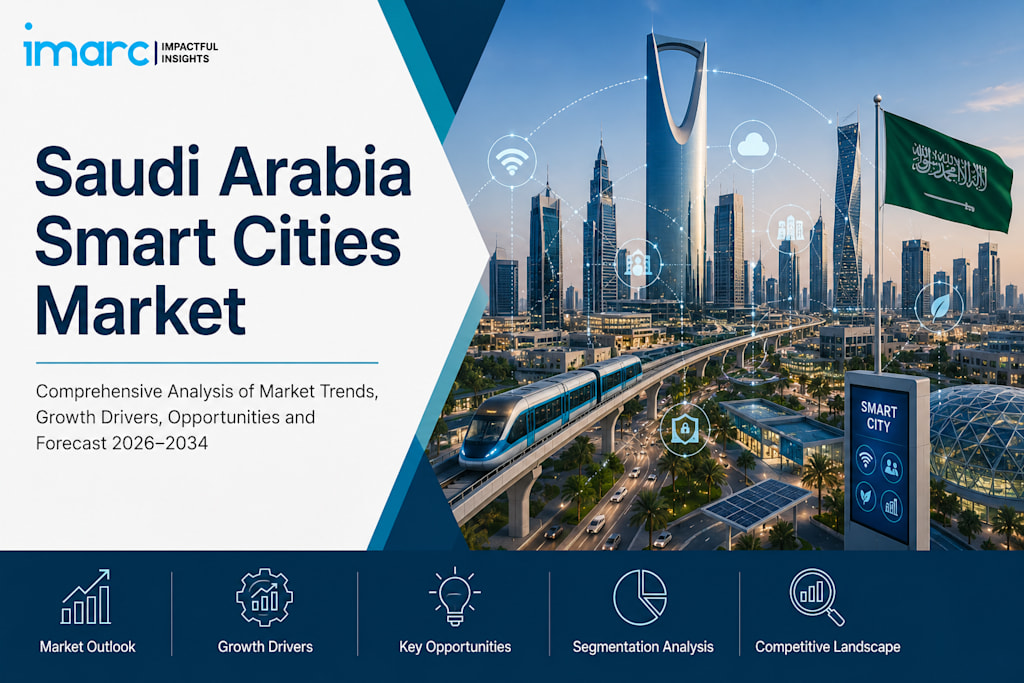
Saudi Arabia is not just building new cities it’s redefining what a city can do. Fueled by Vision 2030’s USD 500 billion commitment to smart infrastructure, rising digital literacy, and rapid urbanization, the Kingdom is becoming one of the most ambitious smart city markets in the world. According to IMARC Group’s latest data, The Saudi Arabia smart cities market size reached USD 14,424.9 Million in 2025. Looking forward, IMARaC Group expects the market to reach USD 32,336.7 Million by 2034, exhibiting a growth rate (CAGR) of 8.91% during 2026-2034.
Saudi Arabia’s smart city push is the real deal. Projects like NEOM, The Line, and Qiddiya aren’t just headline-grabbing concepts they’re being built from scratch with digital-first infrastructure at their core. The Saudi Data and Artificial Intelligence Authority (SDAIA) is spearheading AI-led urban initiatives, while telecom operators STC, Mobily, and Zain are rolling out 5G nationwide to power connected services. Six Saudi cities including Riyadh, Jeddah, Makkah, Madinah, Al-Khobar, and AlUla were featured in the IMD World Smart Cities Index 2025, reflecting the Kingdom’s growing global credibility in urban innovation. Key focus areas driving this market include smart transportation (covering traffic management, connected vehicles, and freight systems), smart buildings, smart utilities, and smart citizen services spanning education, healthcare, public safety, and street lighting.
Saudi Arabia Smart Cities Market Growth Drivers:
Vision 2030 and Massive Government Investment
The Saudi government has committed over USD 500 billion to smart infrastructure under Vision 2030, making it one of the largest state-backed urban transformation programs globally. Initiatives led by the Ministry of Communications and Information Technology (MCIT), the Digital Government Authority (DGA), and SDAIA are fast-tracking smart city rollouts across the Kingdom. E-government platforms, digital identity systems, and AI-powered public services are being deployed at scale. Public-private partnerships are also being structured to bring in global technology expertise, enabling cities like Riyadh, Jeddah, and Dammam to modernize faster and more efficiently.
Rapid Urbanization Demanding Smarter Infrastructure
Saudi Arabia’s urban population is on track to reach 36 million residents, creating intense pressure on transportation, energy, water, and public safety infrastructure. Traditional systems simply can’t keep up with that pace of growth. Smart city solutions offer a practical answer IoT sensors, AI analytics, and connected infrastructure help cities manage more people with fewer resources. Riyadh’s Smart Control Room, for instance, already uses AI to optimize traffic flows, cutting commute times by 15–20%. That kind of measurable impact is exactly why municipal authorities are accelerating adoption across the board.
High Internet Penetration and Digital Literacy Fueling Adoption
According to the Communications, Space and Technology Commission, around 48.6% of internet users in Saudi Arabia are online for seven or more hours daily. That level of connectivity makes it genuinely feasible to run cloud-based platforms, mobile city services, and real-time data tools at scale. Citizens are already using apps to track transportation schedules, pay utility bills, and report civic issues. With the Saudi IoT market valued at USD 9,490.7 Million, the underlying infrastructure for smart city services is firmly in place, giving operators a ready and engaged user base to build on.
Saudi Arabia Smart Cities Market Trends:
IoT and AI Integration Reshaping Urban Management
IoT and AI are no longer pilots in Saudi cities they’re becoming the operational backbone. Across transport, energy, waste, and security, sensors are feeding real-time data into centralized platforms that allow faster, smarter decisions. AI integration is already reducing traffic congestion by up to 30% in key corridors through intelligent routing. In building management, smart systems monitor lighting and occupancy to cut energy waste. On the utilities side, advanced metering infrastructure and distribution management systems are helping the Kingdom optimize consumption. Saudi Arabia’s AI investment is projected to reach USD 1.9 billion, with logistics and urban services among the top beneficiaries.
Digital Twin Technology Scaling Across Major Cities
Digital twins precise 3D virtual replicas of physical cities are becoming a serious planning and management tool in Saudi Arabia. Naver’s ongoing project to build digital twins of Riyadh, Medina, Jeddah, Dammam, and Mecca delivers 10cm-level accuracy, allowing urban planners to simulate infrastructure changes and emergency scenarios before committing resources. The technology has already been extended to cover over 6,800 square kilometers across Mecca, Medina, and Jeddah. By enabling real-time data evaluation and advanced simulations, digital twins are improving resource allocation, emergency preparedness, and long-term urban design across the Kingdom’s fastest-growing cities.
Smart Transportation Leading Investment and Innovation
Transportation is where smart city investment is most visible in Saudi Arabia. Smart traffic signals, AI-based route optimization, and real-time transit updates are already deployed across major urban corridors. The smart parking segment alone expanded at a double-digit rate exceeding 19% annually between 2019 and 2024, reducing fuel waste and driver frustration in dense city centers. Integrated mobility apps now combine bus, metro, and ride-sharing options into a single user journey. Connected vehicle infrastructure and freight information systems are also being built out, positioning Saudi cities to handle the mobility demands of a rapidly growing, increasingly urban population.
Recent News and Developments in Saudi Arabia Smart Cities Market
February 2025: Orange Business announced subscription-based Smart City solutions for Saudi Arabia, deploying services via cloud to cut adoption costs by 40–60% and reduce implementation time by up to 80%. The flexible model allows city authorities to select specific smart services as needed, significantly lowering the barrier to entry for municipalities at different stages of digital maturity.
April 2025: KAFD Development and Management Company, alongside Huawei, launched Saudi Arabia’s first smart WiFi-7 service at the King Abdullah Financial District. Powered by AI and data analytics as part of KAFD’s Smart City Platform, the initiative enhances digital services for thousands of residents, workers, and visitors in one of Riyadh’s most prominent business districts.
April 2025: Six Saudi cities Riyadh, Jeddah, Makkah, Madinah, Al-Khobar, and AlUla were included in the IMD World Smart Cities Index 2025, recognizing the Kingdom’s progress under Vision 2030. The achievement reflects coordinated efforts by the Saudi Data and AI Authority and multiple government agencies to convert urban areas into intelligent, citizen-centric environments.
Note: If you require specific details, data, or insights that are not currently included in the scope of this report, we are happy to accommodate your request. As part of our customization service, we will gather and provide the additional information you need, tailored to your specific requirements. Please let us know your exact needs, and we will ensure the report is updated accordingly to meet your expectations.
About the Creator
Shubham Sharma
Market research enthusiast sharing insights on global industries, emerging trends, growth opportunities, and data-driven analysis across diverse markets.
Enjoyed the story? Support the Creator.
Subscribe for free to receive all their stories in your feed.
Comments
There are no comments for this story
Be the first to respond and start the conversation.