
Saudi Arabia Shrimp Market: Demand Growth, Aquaculture Expansion & Export Opportunities
How rising seafood consumption, government support for aquaculture under Vision 2030, and increasing investments in sustainable shrimp farming technologies are driving production capacity, export opportunities, and supply chain modernization across the Saudi Arabia Shrimp Market.
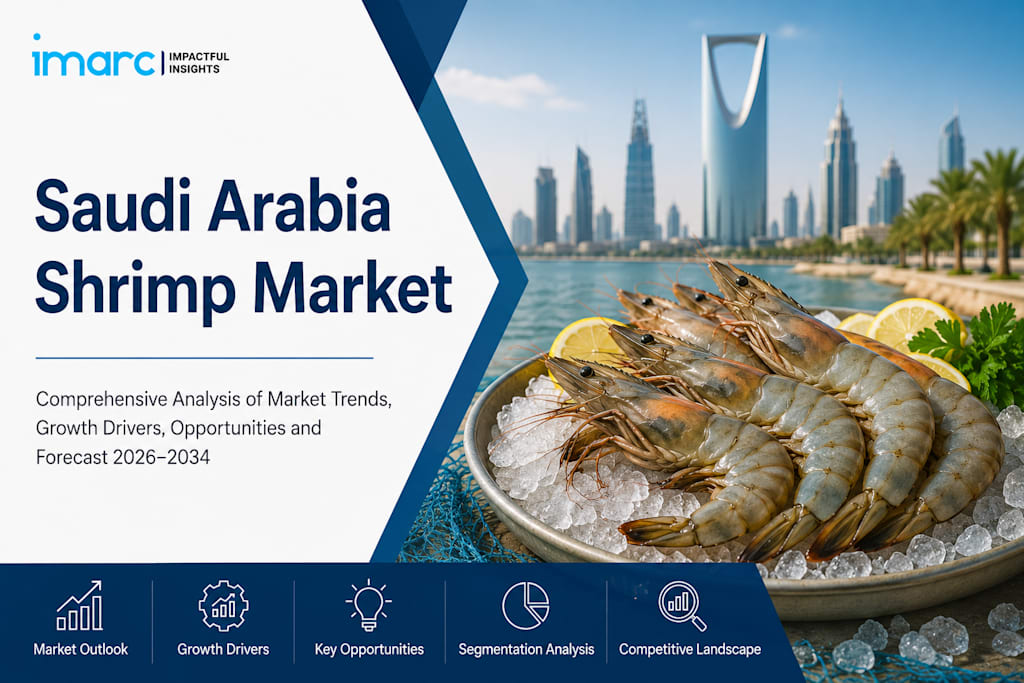
Saudi Arabia’s shrimp market tells an interesting story one where a country with no natural rivers and barely any rainfall has quietly become one of the top white shrimp exporters in the world, shipping to over 40 countries across Asia, Europe, the Americas, and the Middle East. The shift from small coastal fisheries to large-scale, technology-driven aquaculture operations has been rapid, deliberate, and backed by serious government intent. According to IMARC Group’s latest data, The Saudi Arabia shrimp market size was valued at USD 277.77 Million in 2025. Looking forward, IMARC Group expects the market to reach USD 384.76 Million by 2034, exhibiting a CAGR of 3.69% during 2026-2034.
What makes this market particularly compelling is how many converging forces are supporting it. The foodservice sector is booming hotels and restaurants already account for 32.33% of total shrimp distribution. Farmed shrimp commands a 61.52% share of supply, powered by Red Sea coastal operations and an emerging wave of inland recirculating aquaculture systems. Penaeus vannamei (Pacific whiteleg) dominates species demand with a 72.15% share, valued for its fast growth, disease tolerance, and strong global market appeal. The Northern and Central Region, anchored by Riyadh’s 7 million-plus urban population, holds the largest regional slice at 31%. Key segments span environment (farmed vs wild), species, shrimp size (with 41-50 count as the bestseller at 21.84%), distribution channel, and region.
Saudi Arabia Shrimp Market Growth Drivers:
- Booming Foodservice and Tourism Sector Driving Consumption
Saudi Arabia’s restaurant and hospitality industry is expanding fast, and shrimp is right at the center of it. Riyadh alone recorded 15.1 million tourists by the third quarter of the year, fueling demand across luxury hotels, international chains, and local dining concepts. IMARC Group projects the Saudi foodservice market to reach USD 58,310 Million, supported by a young population, rising female workforce participation, and digital food delivery growth. Shrimp fits naturally into this landscape it’s versatile, seen as a premium ingredient, and works across traditional Saudi dishes like shrimp kabsa as well as international menus. Shrimp Shack, a homegrown chain started in Riyadh, has now scaled to 13 locations nationally, showing just how mainstream shrimp dining has become.
Vision 2030 Government Investment Supercharging Aquaculture
The government isn’t just encouraging aquaculture growth it’s funding it. The National Fisheries Development Program has a target of attracting USD 4 billion in private sector investment through 2030. In May 2025, Saudi Arabia formalized bilateral investment agreements totaling SAR 14 billion (USD 3.7 billion) specifically in agriculture and fisheries, covering shrimp genetics, hatchery technology, and food security infrastructure. The Agricultural Development Fund provides subsidized, Sharia-compliant credit that lowers capital barriers for new producers. The Kingdom’s production target of 600,000 tons of fish by 2030 up from 280,000 tons reflects just how seriously aquaculture is being treated as a strategic national priority, not just an agricultural niche.
- Health-Conscious Consumers Shifting Toward Seafood Protein
Saudi consumers are rethinking what they eat. With 23.1% of the population aged 15 and above classified as obese and 45.1% considered overweight (GASTAT data), there is growing pressure social and medical to shift away from heavy red meat consumption. Shrimp offers a compelling alternative: high protein, low calorie, and packed with selenium, zinc, vitamins D and B12, and omega-3 fatty acids. For someone managing their weight while staying active, it’s genuinely practical. Restaurants and food brands are responding by spotlighting shrimp on health-focused menus, and the retail channel is seeing stronger uptake of fresh and frozen shrimp as home cooking interest grows.
Saudi Arabia Shrimp Market Trends:
- Advanced Aquaculture Technology Raising Quality and Yields
Saudi shrimp farms are no longer basic pond operations. Recirculating aquaculture systems, biosecure hatcheries, AI-driven feeding platforms, and genetic selection programs are becoming standard at leading facilities. The National Aquaculture Group was the first company in the MENA region to earn Aquaculture Stewardship Council certification for Vannamei shrimp, placing Saudi Arabia among the top 15 countries globally with this sustainability credential. KAUST and the Ministry of Environment, Water and Agriculture (MEWA) showcased major milestones of their joint Aquaculture Development Program at a November 2024 workshop, covering everything from disease-resistant breeding lines to feed efficiency improvements. This technology push is what has allowed Saudi producers to build credibility in export markets across 40-plus countries.
- Government-Backed Expansion Scaling Domestic Production Capacity
In 2024, KAUST partnered with the Ministry to launch a structured Aquaculture Development Program targeting a jump in domestic seafood output from 280,000 tons to 530,000 tons annually by 2030. The Saudi Agricultural and Livestock Investment Company also acquired significant stakes in major aquaculture groups that year, channeling capital into pond infrastructure expansion, upgraded processing facilities, and modern farming methods. Beyond fish, the government is actively promoting inland shrimp production using recirculating systems a smart response to water scarcity in an arid country. These coordinated moves between public and private entities are creating an industry that is far more structured, bankable, and export-competitive than it was even five years ago.
- Sustainability and Circular Economy Practices Reshaping Production
Environmental responsibility is no longer optional for Saudi shrimp producers it’s becoming a market entry requirement. Water recycling systems, renewable energy integration, and waste-to-fertilizer valorization are being adopted to address the Kingdom’s water scarcity constraints and meet international buyer standards. Producers are partnering with local feed manufacturers to replace imported fishmeal with alternative proteins, cutting supply chain exposure and improving feed conversion ratios. KAUST’s environmental consultancy arm, KBD, is driving applied research in sustainable practices through the Aquaculture Development Program. For export-focused producers, certifications like ASC and Best Aquaculture Practices are increasingly a prerequisite for accessing premium buyers in Europe and Asia.
Recent News and Developments in Saudi Arabia Shrimp Market
- November 2025: MHAB Food Company, the brand behind the popular Shrimp Shack restaurant chain, selected Jadarah Business Consulting as its partner for a full organizational transformation initiative. Founded in Riyadh in 2016, Shrimp Shack has grown to 13 locations across the Kingdom. The chain’s success built on premium seafood including shrimp, crab, mussels, and lobster at accessible prices reflects the strong and growing appetite for dedicated seafood dining concepts in Saudi Arabia’s evolving restaurant market.
- May 2025: Saudi Arabia formalized bilateral investment agreements totaling SAR 14 billion (approximately USD 3.7 billion) in agriculture and fisheries development. A dedicated allocation within this package targets shrimp genetics research, hatchery technology transfer, and integrated food-security infrastructure, reinforcing the Kingdom’s ambition to become a regional aquaculture hub and reduce dependence on imported seafood across commercial and institutional channels.
- November 2024: KAUST and the Ministry of Environment, Water and Agriculture (MEWA) presented key milestones of their joint Aquaculture Development Program at the 6th International Saudi Aquaculture Development Workshop held at KAUST. Achievements highlighted included advances in sustainable fish production, disease-resistant shrimp breeding, and water-efficient farming techniques all central to the Kingdom’s push to reach 600,000 tons of domestic seafood output by 2030.
- 2024: The Saudi Agricultural and Livestock Investment Company acquired significant stakes in major aquaculture groups, injecting capital for pond infrastructure expansion, upgraded processing facilities, and advanced farming methodology implementation. The investment signals growing institutional confidence in the commercial viability of Saudi shrimp production, with producers increasingly targeting premium export markets in Asia, Europe, and North America alongside the strong domestic foodservice demand base.
Note: If you require specific details, data, or insights that are not currently included in the scope of this report, we are happy to accommodate your request. As part of our customization service, we will gather and provide the additional information you need, tailored to your specific requirements. Please let us know your exact needs, and we will ensure the report is updated accordingly to meet your expectations.
About the Creator
Shubham Sharma
Market research enthusiast sharing insights on global industries, emerging trends, growth opportunities, and data-driven analysis across diverse markets.
Enjoyed the story? Support the Creator.
Subscribe for free to receive all their stories in your feed.
Comments
There are no comments for this story
Be the first to respond and start the conversation.